Cracking a skill-specific interview, like one for Underwater Warfare, requires understanding the nuances of the role. In this blog, we present the questions you’re most likely to encounter, along with insights into how to answer them effectively. Let’s ensure you’re ready to make a strong impression.
Questions Asked in Underwater Warfare Interview
Q 1. Explain the principles of passive and active sonar.
Sonar, short for Sound Navigation and Ranging, is the fundamental technology for underwater detection. It operates on the principle of sound propagation in water. Passive sonar listens for sounds generated by other underwater objects, like a submarine’s machinery or propeller noise. Active sonar, conversely, emits sound pulses and listens for the echoes reflected back from targets. Think of it like this: passive sonar is like eavesdropping, while active sonar is like shouting and listening for the echo.
Passive Sonar: This method is stealthy, as it doesn’t reveal the listener’s position. The system analyzes the received sounds to identify the type of vessel, its speed, and bearing. Challenges include distinguishing target sounds from ambient noise (like marine life or ocean currents). Effective passive sonar relies on sophisticated signal processing techniques to isolate and interpret faint target signatures.
Active Sonar: This system transmits a sound pulse (ping) and measures the time it takes for the echo to return. This allows for determining the target’s range and bearing. The frequency and type of pulse can be varied to optimize detection based on target characteristics and environmental conditions. However, active sonar reveals the user’s position and can be detected by enemy sensors, making it less stealthy.
In practice, both passive and active sonar are often used in conjunction. Passive sonar is used for initial detection and target localization, followed by active sonar to verify the target and obtain precise range and bearing information.
Q 2. Describe different types of underwater threats and countermeasures.
Underwater threats are diverse and constantly evolving. They include:
- Submarines: Nuclear-powered ballistic missile submarines (SSBNs) pose the most significant strategic threat, while attack submarines (SSNs) present a tactical threat. They are designed for stealth and offensive capabilities.
- Mines: These can be moored to the seabed or drift freely, posing a significant danger to surface ships and submarines. They can be acoustic, magnetic, or pressure-activated.
- Torpedoes: Self-propelled underwater weapons designed to sink ships or submarines. They come in various types – acoustic homing, wire-guided, and wake-homing torpedoes.
- Divers and Special Forces: These pose a direct threat to ports and naval bases, potentially conducting sabotage or reconnaissance.
Countermeasures: Defense against these threats involves a multi-layered approach:
- Anti-Submarine Warfare (ASW) Platforms: Ships, aircraft, and submarines equipped with sonar, torpedoes, and other weapons systems.
- Mine Countermeasures (MCM) Vessels: Ships specialized in detecting, neutralizing, and destroying mines.
- Electronic Warfare (EW): Techniques to disrupt or deceive enemy sensors, including sonar jamming and deception techniques.
- Physical Security Measures: Protecting ports and bases with physical barriers, surveillance systems, and other security measures.
The effectiveness of countermeasures depends on the specific threat and the environment. For example, the challenging underwater acoustics in littoral regions may limit sonar effectiveness, necessitating reliance on other sensors and techniques.
Q 3. What are the key components of an anti-submarine warfare (ASW) system?
A comprehensive ASW system involves a complex interplay of sensors, platforms, and weapons. Key components include:
- Sonar Systems: Both active and passive sonar, integrated on various platforms (surface ships, submarines, aircraft, and unmanned underwater vehicles (UUVs)).
- Acoustic Sensors: Hydrophones, which are underwater microphones, play a vital role in detecting and locating underwater sound sources.
- Magnetic Anomaly Detectors (MAD): These sensors detect the subtle magnetic disturbances caused by submarines, particularly useful in detecting submarines at shallow depths.
- ASW Weapons: Torpedoes, depth charges, and other weapons designed to destroy submarines.
- Data Fusion and Command & Control Systems: Sophisticated software and algorithms to combine data from multiple sensors and guide ASW operations. This is critical for making sense of the vast amounts of data generated.
- Platforms: The platforms that carry the sensors and weapons, such as ASW helicopters, maritime patrol aircraft, destroyers, frigates, and anti-submarine warfare submarines themselves.
The integration and coordination of these components are critical for effective ASW. A successful ASW operation hinges on real-time information sharing, efficient data analysis, and swift response.
Q 4. Explain the concept of acoustic tomography and its applications in UWS.
Acoustic tomography is a technique that uses sound waves to map the three-dimensional structure of the ocean. Imagine it like a medical CT scan, but for the ocean. It leverages the fact that sound speed in water varies with temperature, salinity, and pressure. By transmitting sound waves across a network of underwater sensors and analyzing the travel times, researchers can infer the variations in these oceanographic parameters and create a detailed three-dimensional image of the underwater environment.
Applications in UWS:
- Environmental Modeling: Acoustic tomography provides valuable data for creating accurate models of ocean conditions, crucial for predicting sonar performance and submarine navigation.
- Submarine Detection: By understanding the sound speed profile, the detection range and accuracy of sonar can be greatly improved.
- Oceanographic Research: The technique is invaluable for studying ocean currents, eddies, and other oceanographic phenomena that affect submarine operations.
A real-world application could be using acoustic tomography to map a region known for strong ocean currents, providing critical information for submarine navigation and avoiding areas with high levels of acoustic noise.
Q 5. Describe the different types of submarines and their capabilities.
Submarines are classified into several types based on their propulsion system and mission:
- Nuclear-powered Ballistic Missile Submarines (SSBNs): These carry nuclear-armed ballistic missiles and are the backbone of a nation’s strategic nuclear deterrent force. They are designed for extended underwater operations and survivability.
- Nuclear-powered Attack Submarines (SSNs): Highly versatile platforms capable of a wide range of missions, including anti-submarine warfare, anti-surface warfare, intelligence gathering, and special operations support. They are characterized by high speed and maneuverability.
- Diesel-electric Submarines: These submarines use diesel engines for surface propulsion and electric motors for underwater operations. They are more limited in underwater endurance compared to nuclear-powered submarines but are more affordable and easier to maintain.
- Midget Submarines: Smaller, specialized submarines designed for covert operations such as reconnaissance, sabotage, or the placement of mines.
Each type has unique capabilities. For instance, SSBNs prioritize stealth and endurance, while SSNs focus on speed and versatility. Diesel-electric submarines prioritize cost-effectiveness but compromise on endurance and noise levels.
Q 6. What are the challenges of operating in littoral environments?
Littoral environments, or coastal regions, present unique challenges for submarine operations compared to the open ocean. The shallower waters and complex underwater terrain create significant problems for sonar operation. This is due to sound reflections off the seabed and surface, as well as the presence of numerous man-made objects and natural obstacles.
Specific Challenges:
- Complex Acoustic Environment: The shallow depths, varying bottom topography, and presence of obstacles cause multipath propagation and reverberation, making it difficult to isolate target sounds from background noise.
- Increased Detection Risk: The shallower depths bring submarines closer to surface ships, aircraft, and coastal sensors, increasing the risk of detection.
- Navigation Difficulties: Navigating through complex underwater terrain requires more sophisticated navigation systems.
- Limited Maneuverability: Shallow waters restrict submarine maneuverability, making evasive tactics more challenging.
- Mine threat: Mines are more prevalent in littoral zones.
Successfully operating in these challenging environments requires advanced sonar technology, sophisticated navigation systems, and skilled submarine crews.
Q 7. How does oceanographic data influence submarine operations?
Oceanographic data, encompassing temperature, salinity, density, currents, and sound speed profiles, significantly influences submarine operations. Understanding these factors is crucial for optimizing sonar performance, planning navigation routes, and achieving stealth.
Influence on Submarine Operations:
- Sonar Performance: Sound speed variations affect the propagation of sound waves, influencing the range, accuracy, and effectiveness of sonar systems. Accurate oceanographic data is crucial for predicting sonar performance and choosing optimal operating depths and frequencies.
- Navigation and Route Planning: Ocean currents can significantly affect submarine transit times and fuel consumption. Knowledge of currents helps to plan efficient routes and predict arrival times.
- Stealth and Evasion: Understanding the oceanographic environment allows submarines to utilize natural features, such as thermal layers or sound channels, for concealment from enemy sensors. This is essential for avoiding detection.
- Tactical Advantage: By exploiting the oceanographic environment, submarines can gain a tactical advantage over their adversaries. For instance, a submarine may use a specific current to approach its target undetected.
Modern submarine operations extensively utilize advanced oceanographic models and real-time data to make informed decisions, maximizing effectiveness while minimizing risk. This is particularly important in challenging environments like the littoral zone where the oceanographic conditions are highly variable.
Q 8. Explain the concept of acoustic propagation and its impact on sonar performance.
Acoustic propagation refers to how sound waves travel through water. Understanding this is crucial in underwater warfare because it directly impacts the effectiveness of sonar, the primary sensory tool for detecting and tracking underwater objects. Sound speed in water isn’t constant; it varies with temperature, salinity, and pressure. These variations create complex sound channels and refraction patterns, bending sound waves and causing them to travel in unpredictable ways.
Imagine throwing a pebble into a calm lake versus a turbulent river. In the calm lake, the ripples spread outwards predictably. In the river, the current bends the ripples, making their path difficult to predict. Similarly, variations in water properties create ‘refractive layers’ that can either focus or scatter sound waves, impacting sonar’s ability to accurately locate a target. A submarine might use these variations to its advantage, hiding in a ‘shadow zone’ where sound waves are refracted away from the sonar. Conversely, knowing the sound propagation characteristics of an area allows for the optimal deployment of sonar systems to maximize detection range and accuracy. For instance, a low-frequency sonar might be more effective at longer ranges due to its ability to penetrate deeper into the water column and travel longer distances without significant attenuation.
Q 9. Discuss the role of intelligence in underwater warfare.
Intelligence plays a pivotal role in underwater warfare, providing the critical information needed for successful operations. It encompasses all aspects of gathering, analyzing, and disseminating information about the enemy’s capabilities, intentions, and activities. This could include details about the enemy’s submarine fleet – their numbers, classes, patrol areas, and technological advancements. It also involves understanding their tactics, operational procedures, and the environmental conditions they operate in. In essence, good intelligence informs every decision, from where to deploy forces to how best to counter enemy threats.
Consider the example of anti-submarine warfare (ASW). Effective ASW requires knowing the enemy submarine’s likely patrol routes, its acoustic signature (the noise it generates), and its operational tactics. This knowledge guides the deployment of ASW assets, including ships, aircraft, and sonobuoys, to maximize the chances of detection and engagement. Similarly, intelligence on enemy minefields is crucial for safe navigation and planning mine countermeasure (MCM) operations. The lack of accurate intelligence can lead to costly failures, resource misallocation and even loss of life.
Q 10. Describe different types of underwater mines and mine countermeasures.
Underwater mines come in various types, categorized by their triggering mechanism and deployment method. Contact mines detonate upon physical contact with a ship or submarine, while influence mines are activated by magnetic, acoustic, or pressure changes caused by a passing vessel. Bottom mines are anchored to the seabed, while moored mines hang from buoys at a specific depth. Drifting mines, conversely, float freely, posing a significant threat to navigation.
Mine countermeasures (MCM) involve a range of techniques to locate, neutralize, and destroy underwater mines. These include hunting (using sonar to locate mines individually), sweeping (using specialized equipment to detonate mines remotely), and neutralization (disarming mines for later analysis and disposal). Sophisticated technologies such as remotely operated vehicles (ROVs) and autonomous underwater vehicles (AUVs) are now frequently used, allowing for safer and more efficient MCM operations. The choice of MCM technique depends heavily on the type of mine, the environment, and the available resources. For example, a magnetic sweep might be employed against magnetic mines, whereas a sonar-guided ROV could be used to neutralize individual contact mines.
Q 11. How do submarines maintain stealth and avoid detection?
Submarine stealth relies on minimizing the chances of detection through various means. Acoustic quieting is paramount, achieved through advanced hull designs, noise-reducing equipment, and careful operational practices. Submarines strive to minimize noise generated by their propulsion systems, machinery, and even crew movements. Hydrodynamic design minimizes the wake and turbulence the submarine produces, further reducing detection. Depth control allows submarines to exploit sound channels or other environmental factors to reduce their detectability by sonar.
Beyond acoustic stealth, submarines employ passive measures like using advanced coatings to absorb sonar signals and careful route planning to avoid areas with high sensor density. Furthermore, the use of electronic warfare techniques, such as jamming or deceiving enemy sensors, contributes to evasion. Imagine a submarine as a ghost trying to remain unseen. Every measure – from quiet propulsion to clever routing – contributes to it achieving this goal. The effectiveness of stealth tactics is often a battle of wits, with the submarine striving to evade detection and the enemy forces trying to locate it.
Q 12. What are the limitations of underwater communications?
Underwater communication presents significant challenges compared to communication in air or space. The primary limitation is the attenuation of electromagnetic waves in water. Radio waves, used for most above-water communication, are severely hampered by water’s conductivity. This means that radio communication has very limited range underwater. Sound waves, while less attenuated, are susceptible to various factors like sound channel variations, ambient noise, and multipath propagation (signals arriving at the receiver via multiple paths).
This results in low bandwidth, limited range, and susceptibility to interference. Alternative methods such as acoustic communication are employed, but these systems also suffer from significant limitations. The choice of communication method depends greatly on the operational conditions, with acoustic modems being preferable for shorter ranges, while very low frequency (VLF) radio communication remains the primary option for long-range communication, albeit at low data rates.
Q 13. Explain the principles of underwater navigation.
Underwater navigation relies on a combination of techniques due to the limitations of GPS and other surface-based systems. Inertial navigation systems (INS) track a submarine’s position and orientation using accelerometers and gyroscopes. However, INS drifts over time, requiring periodic updates. Doppler sonar measures the speed of the submarine relative to the seabed or water column, providing velocity data that can be integrated with INS data to improve accuracy. Celestial navigation is also employed, though limited to surface or periscope depth operations. Modern submarines often use integrated navigation systems combining data from various sources to achieve the highest possible accuracy.
Imagine a pilot flying blind. They rely on instruments to know their speed, altitude, and direction. Similarly, a submarine navigator depends on a combination of sensors and algorithms to estimate its location underwater. The accuracy of this process is paramount for safe navigation and effective mission execution.
Q 14. Describe the process of target acquisition and tracking in underwater warfare.
Target acquisition and tracking in underwater warfare involves detecting, identifying, classifying, and continuously monitoring the location and movements of enemy vessels or objects. Sonar plays a crucial role, providing the primary means of detecting underwater targets. The process begins with the detection of a possible contact, often just an acoustic signature. Signal processing techniques are then used to analyze the signal characteristics and extract information like range, bearing, and target speed.
Further analysis helps identify the target’s type (e.g., submarine, ship, mine) based on its acoustic signature, size, and movements. Once a target is identified and acquired, it enters a tracking phase, where its position and trajectory are continuously monitored using various sensor systems. This might involve the use of multiple sonar arrays, potentially integrated with other sensors like magnetic anomaly detectors (MAD) or electronic intelligence (ELINT) systems. Sophisticated algorithms and prediction models are employed to accurately track the target’s movements, even in the presence of noise and interference. The whole process depends on the successful integration and coordination of multiple sensors and data processing capabilities to ensure accurate target acquisition and tracking for timely and effective responses.
Q 15. What are the safety procedures involved in underwater operations?
Underwater operations demand rigorous safety protocols to mitigate risks inherent in the harsh and unforgiving environment. These procedures encompass pre-dive checks, comprehensive emergency response plans, and meticulous post-dive analysis.
- Pre-dive checks: This crucial phase involves rigorous equipment inspection, including life support systems, communication devices, and submersible integrity. Divers undergo thorough medical evaluations to ensure fitness for the mission. Detailed dive plans are formulated, considering environmental factors like currents, visibility, and potential hazards.
- Emergency procedures: Contingency plans address various scenarios, from equipment malfunctions to decompression sickness. Emergency communication systems and readily accessible emergency equipment are paramount. Regular training drills enhance preparedness and team coordination.
- Post-dive procedures: This stage is equally crucial. Divers undergo mandatory decompression protocols to prevent decompression sickness (‘the bends’). Equipment undergoes thorough cleaning and inspection to identify potential issues. Post-dive medical checks are standard procedure, and comprehensive reports documenting the entire operation are compiled.
For instance, a pre-dive check on a remotely operated vehicle (ROV) would involve testing its thrusters, manipulator arms, cameras, and the integrity of its pressure hull. Failure to conduct such checks can lead to equipment failure underwater, posing serious risks to personnel and the mission.
Career Expert Tips:
- Ace those interviews! Prepare effectively by reviewing the Top 50 Most Common Interview Questions on ResumeGemini.
- Navigate your job search with confidence! Explore a wide range of Career Tips on ResumeGemini. Learn about common challenges and recommendations to overcome them.
- Craft the perfect resume! Master the Art of Resume Writing with ResumeGemini’s guide. Showcase your unique qualifications and achievements effectively.
- Don’t miss out on holiday savings! Build your dream resume with ResumeGemini’s ATS optimized templates.
Q 16. Explain the principles of underwater acoustics.
Underwater acoustics is the science of sound propagation in water. It’s fundamental to underwater warfare, particularly for sonar systems. The principles revolve around sound wave generation, transmission, reflection, refraction, and absorption.
- Sound wave generation: Sound waves are generated by various sources, including active sonar (which emits sound pulses) or passive sonar (which listens to ambient noise). The frequency and intensity of the sound are crucial factors influencing its propagation.
- Transmission: Sound travels faster in water than in air and its speed varies with water temperature, salinity, and pressure. This variability affects sound wave paths and the accuracy of sonar systems.
- Reflection and Refraction: Sound waves bounce off (reflect) objects in the water, enabling sonar to detect submarines or other underwater objects. The bending (refraction) of sound waves occurs as they pass through layers of water with differing properties.
- Absorption: Water absorbs sound energy, attenuating the signal over distance. Higher frequencies are typically absorbed more quickly than lower frequencies.
Think of it like throwing a pebble into a pond. The ripples are like sound waves. The way those ripples spread, bounce off objects, and eventually fade depends on factors analogous to temperature, salinity, and pressure in the water.
Q 17. What are the different types of underwater weapons systems?
Underwater weapons systems are diverse, ranging from torpedoes and mines to cruise missiles with underwater launch capabilities.
- Torpedoes: These self-propelled underwater projectiles are designed to attack submarines, ships, or other underwater targets. They can be wire-guided, acoustic-homing, or use other sophisticated guidance systems.
- Mines: These are explosive devices placed underwater to obstruct enemy navigation or attack ships. They can be contact mines (detonating upon contact) or influence mines (triggered by magnetic or acoustic signals).
- Underwater-launched cruise missiles: Some cruise missiles can be launched from submarines, extending the submarine’s range and lethality. These missiles use various guidance methods to reach their targets.
Each weapon type has unique characteristics tailored to its intended use. For example, a wake-homing torpedo pursues its target by detecting the disturbance (wake) it creates in the water, while a magnetic mine detects the magnetic signature of a passing vessel.
Q 18. Describe the role of unmanned underwater vehicles (UUVs) in UWS.
Unmanned Underwater Vehicles (UUVs), including Autonomous Underwater Vehicles (AUVs) and Remotely Operated Vehicles (ROVs), play an increasingly significant role in Underwater Warfare (UWS). They offer several advantages over crewed submarines:
- Intelligence, Surveillance, and Reconnaissance (ISR): UUVs can conduct covert surveillance and reconnaissance missions, mapping the seabed, searching for mines, or monitoring enemy activity without risking human lives.
- Mine Countermeasures (MCM): UUVs are used to locate, identify, and neutralize mines, greatly reducing the risk to human mine-clearance divers.
- Anti-submarine warfare (ASW): UUVs can be deployed to search for and track enemy submarines, providing valuable targeting data for other platforms.
- Cost-effectiveness: The operational cost of UUVs is generally lower than that of crewed submarines, making them a cost-effective solution for many UWS tasks.
Imagine a scenario where a UUV is deployed to scout a suspected minefield. Its sensors can map the area, identify potential mines, and transmit the information back to a command center, allowing for a better-informed decision on whether to send in specialized clearance teams or deploy a different countermeasure.
Q 19. How does environmental noise impact sonar performance?
Environmental noise significantly impacts sonar performance by masking the target’s acoustic signature and introducing interference. This noise can originate from various sources:
- Shipping noise: The noise from ships’ propellers, engines, and other machinery is a major source of interference.
- Biological noise: Marine life, including whales, dolphins, and fish, generates sounds that can interfere with sonar operation.
- Ambient noise: This includes background noise from wave action, currents, and other natural sources.
- Seismic noise: Underwater seismic activity, such as earthquakes, can produce strong acoustic signals, degrading sonar performance.
The effect is similar to trying to hear a whisper in a noisy room. The louder the background noise, the harder it becomes to detect the faint sound of the whisper (the target’s acoustic signature). Advanced sonar systems use sophisticated signal processing techniques to filter out unwanted noise and enhance target detection, but strong environmental noise can still present considerable challenges.
Q 20. Explain the concept of acoustic masking.
Acoustic masking refers to the phenomenon where a strong sound source obscures weaker sounds, effectively masking the acoustic signature of a target from a sonar system. This effect is often exploited tactically.
Consider the situation where a submarine uses its own noisemakers (producing intentional noise) to hide its acoustic signature from an opposing sonar system. This noise effectively ‘masks’ the submarine’s quieter sounds, such as its propeller noise, making it more difficult for the opposing force to detect the submarine. The effectiveness of acoustic masking depends on various factors, including the intensity and spectral characteristics of the masking noise, the distance between the source and the target, and the capabilities of the sonar system trying to detect the target.
Q 21. Describe the challenges of maintaining submarine equipment in harsh environments.
Maintaining submarine equipment in the harsh underwater environment presents several significant challenges:
- Corrosion: Saltwater is highly corrosive, damaging metal components and electronic systems. Regular maintenance, including cleaning and application of protective coatings, is essential.
- Pressure: The immense pressure at depth puts significant stress on submarine structures and equipment. Materials must be robust and designed to withstand these extreme pressures.
- Temperature extremes: Submarines can experience drastic temperature fluctuations, from the frigid depths to warmer surface waters, affecting the performance and longevity of equipment.
- Limited access: Repairing or replacing components within a submarine can be difficult and time-consuming, requiring specialized tools and techniques.
- Biofouling: Marine organisms can attach to the hull and equipment, increasing drag and potentially harming sensors or other systems. Regular cleaning and the use of antifouling coatings are critical.
Imagine the difficulty of repairing a leaking pipe in a confined space under immense pressure while dealing with cold temperatures and the risk of saltwater corrosion. Specialized training, robust materials, and redundant systems are all crucial to overcome these maintenance challenges.
Q 22. What are the different types of submarine hull designs and their advantages?
Submarine hull designs are crucial for a vessel’s performance and survivability. The primary designs fall into two categories: single-hull and double-hull.
- Single-hull submarines: These feature a single pressure hull containing all crew spaces, equipment, and machinery. They are simpler to construct and maintain, but offer less internal space and less protection against external pressures. Historically, many early submarines employed this design.
- Double-hull submarines: These possess an inner pressure hull surrounded by an outer hull. The space between acts as a ballast tank, offering increased buoyancy control and greater protection against collision damage or external pressure changes. Modern submarines overwhelmingly utilize double-hull designs due to their improved safety and increased internal volume for equipment and crew comfort.
- Teardrop hull: This is a more hydrodynamic shape, offering improved streamlining and reduced drag. Though sometimes combined with double-hull designs, improving speed and quietness is the primary advantage.
The choice of hull design depends on the submarine’s intended mission, size, and operational depth. A deep-diving research submarine might prioritize a robust double-hull design, whereas a smaller coastal patrol submarine might favor a single-hull design for its simplicity.
Q 23. Explain the concept of underwater pressure and its effects on equipment.
Underwater pressure increases dramatically with depth. It’s simply the weight of the water column above pressing down. This pressure is measured in Pascals (Pa) or atmospheres (atm). For every 10 meters of depth, the pressure increases by approximately 1 atmosphere (roughly 101,325 Pa). This pressure impacts equipment in several ways:
- Structural integrity: Equipment must withstand immense pressure. Submarine pressure hulls are designed to withstand crushing forces at their operational depth. Failure can lead to catastrophic implosion.
- Material selection: Materials chosen for submarine construction and internal equipment must be strong and resilient to the high pressure. Special alloys of steel and titanium are often used.
- Sealing and leak prevention: Submarines need incredibly tight seals on hatches, penetrations, and any other opening to prevent water ingress. This involves intricate engineering and rigorous testing.
- Electronic function: Electronic components can malfunction under extreme pressure if not specifically designed to operate in these conditions. Pressurization and special shielding are often required.
Imagine squeezing a balloon. The deeper you go in the ocean, the more the water ‘squeezes’ the submarine and its internal systems. Understanding this pressure is critical for designing and maintaining all underwater equipment.
Q 24. How does the water column affect the propagation of sound waves?
The water column significantly affects sound propagation. Sound travels much faster in water than in air, and its speed varies with water temperature, salinity, and pressure. This creates complex sound propagation characteristics known as the ‘Sound Channel’ or SOFAR channel.
- Sound Speed Profile: The speed of sound in water isn’t constant. It generally increases with depth due to increasing pressure, until the temperature starts to affect it at a certain depth. This varying speed creates refractive effects, bending the sound waves.
- SOFAR Channel: In some regions, a layer of minimum sound speed exists, creating a natural waveguide (SOFAR channel) where sound can travel over vast distances with minimal energy loss. Submarines leverage this for long-range communication and detection.
- Temperature Gradients and Salinity: Changes in temperature and salinity can create refraction or reflection, causing shadow zones where sound is weak or absent. Sonar operators account for this by using sophisticated models of the water column.
- Absorption: Water absorbs sound, especially at higher frequencies. This means high-frequency sound signals lose energy more quickly with distance, limiting their range.
Understanding the sound speed profile and its impact on sound propagation is essential for effective sonar operations. Sonar systems are carefully designed to compensate for these effects to maximize detection range and accuracy.
Q 25. What are the principles of underwater explosive ordnance disposal?
Underwater explosive ordnance disposal (EOD) is a hazardous but critical field. It involves safely locating, identifying, and neutralizing explosive devices submerged in water. The principles involved include:
- Remote Neutralization: EOD technicians prioritize minimizing risk to personnel. Robots and remotely operated vehicles (ROVs) are frequently used to approach, inspect, and disarm ordnance from a safe distance.
- Controlled Detonation: In many cases, the safest method is to detonate the ordnance in a controlled manner, selecting a location minimizing environmental and structural damage. This often involves specialized demolition techniques and careful consideration of blast effects.
- Material Identification: Accurate identification of the explosive type is crucial for selecting appropriate disposal methods. Visual inspection, often aided by sonar and ROVs, coupled with historical information is critical.
- Environmental Considerations: Underwater EOD must account for the environment. Water depth, currents, nearby structures, and potential marine life impact choices about the safe disposal method.
Think of it like defusing a bomb, but underwater, with added challenges like pressure, currents, and visibility. Every situation requires a tailored approach based on the specific device and environmental context.
Q 26. Describe different types of underwater sensors and their applications.
Various underwater sensors are vital for submarine operations, autonomous underwater vehicles (AUVs), and oceanographic research. They provide crucial data about the underwater environment and threats. Here are a few examples:
- Sonar (Sound Navigation and Ranging): Sonar systems use sound waves to detect and locate objects underwater, ranging from other submarines to mines and wreckage. Different sonar types exist, including active (transmitting sound pulses) and passive (listening for sound).
- Magnetometers: Detect variations in the Earth’s magnetic field, useful in locating metallic objects like submarines or mines. They are often used in conjunction with other sensors for improved accuracy.
- Hydrophones: These are underwater microphones that detect sound. Used passively to listen for sounds like ships’ propellers or marine mammals. They’re used in arrays for better localization.
- Depth Sensors: These measure the water pressure to determine depth. Essential for submarines to maintain depth and avoid pressure-related damage.
- Optical Sensors: Though their range is limited in water, these provide visual data close to the submarine. Used for near-field observation and target identification.
These sensors, often working in concert, provide a comprehensive picture of the submarine’s surroundings, essential for navigation, threat detection, and mission success.
Q 27. Explain the role of hydrographic surveys in submarine operations.
Hydrographic surveys create detailed maps of the ocean floor, including depth, bottom type, and underwater features. They play a crucial role in submarine operations:
- Navigation: Accurate charts are essential for safe submarine navigation, preventing collisions with underwater obstacles. Submarines rely heavily on detailed bathymetric data for route planning.
- Minefield Detection: Hydrographic surveys can identify potential minefields or underwater obstacles that could pose a threat to submarines. They can help identify safe passages or guide mine-sweeping operations.
- Target Identification: Surveys provide critical information about the underwater terrain, helping identify suitable launch or deployment locations for submarine-launched weapons or equipment.
- Submarine Base Planning: They inform the design and construction of submarine bases, ensuring sufficient water depth, access, and protection.
Essentially, hydrographic surveys provide the underwater equivalent of geographical maps, enabling safe and effective submarine operations. A lack of such detailed data can significantly impact the safety and success of submarine deployments.
Q 28. What are the ethical considerations of underwater warfare?
Ethical considerations in underwater warfare are complex and involve numerous aspects, often intertwining with international law:
- Targeting: Distinguishing between military targets and civilians is challenging in underwater environments, especially with autonomous systems. Accidental harm to civilians needs to be minimized.
- Environmental Protection: Underwater warfare can have devastating effects on the marine environment, through damage to marine habitats, pollution from sunken vessels, or unexploded ordnance. Minimizing environmental damage is crucial.
- Autonomous Weapons Systems (AWS): The use of autonomous weapons systems raises ethical dilemmas around accountability, the potential for unintended consequences, and the loss of human control in lethal decision-making.
- International Law: Underwater warfare must adhere to international laws of armed conflict, including the laws of proportionality, distinction, and military necessity. These legal frameworks are paramount to ensure conflicts are conducted humanely and legally.
Underwater warfare isn’t simply a technical challenge; it demands careful consideration of the ethical and environmental ramifications. It’s a constant challenge to balance military objectives with ethical responsibilities and international legal obligations.
Key Topics to Learn for Underwater Warfare Interview
- Sonar Principles and Applications: Understanding passive and active sonar systems, signal processing techniques, and their applications in target detection, classification, and tracking.
- Underwater Acoustics: Knowledge of sound propagation in water, including factors affecting sound speed and attenuation, and their impact on sonar performance. Practical application includes understanding environmental noise and its effects on detection.
- Anti-Submarine Warfare (ASW) Tactics and Strategies: Familiarization with ASW operational concepts, sensor integration, and the decision-making process in a complex underwater environment. This includes understanding different ASW platforms and their capabilities.
- Oceanography and Underwater Environments: Understanding the physical characteristics of different ocean regions, including bathymetry, currents, and temperature gradients, and their influence on underwater operations.
- Underwater Navigation and Positioning: Knowledge of various navigation systems used in underwater warfare, including inertial navigation, GPS integration (where applicable), and dead reckoning techniques. Practical application includes understanding limitations and error propagation.
- Mine Warfare: Understanding mine types, detection methods, and countermeasures. This includes both offensive and defensive aspects of mine warfare operations.
- Command, Control, Communications, Computers, Intelligence, Surveillance, and Reconnaissance (C4ISR): Understanding the integration of various systems and data sources for effective situational awareness and decision-making in an underwater warfare context. Problem-solving includes managing data from diverse sensors.
Next Steps
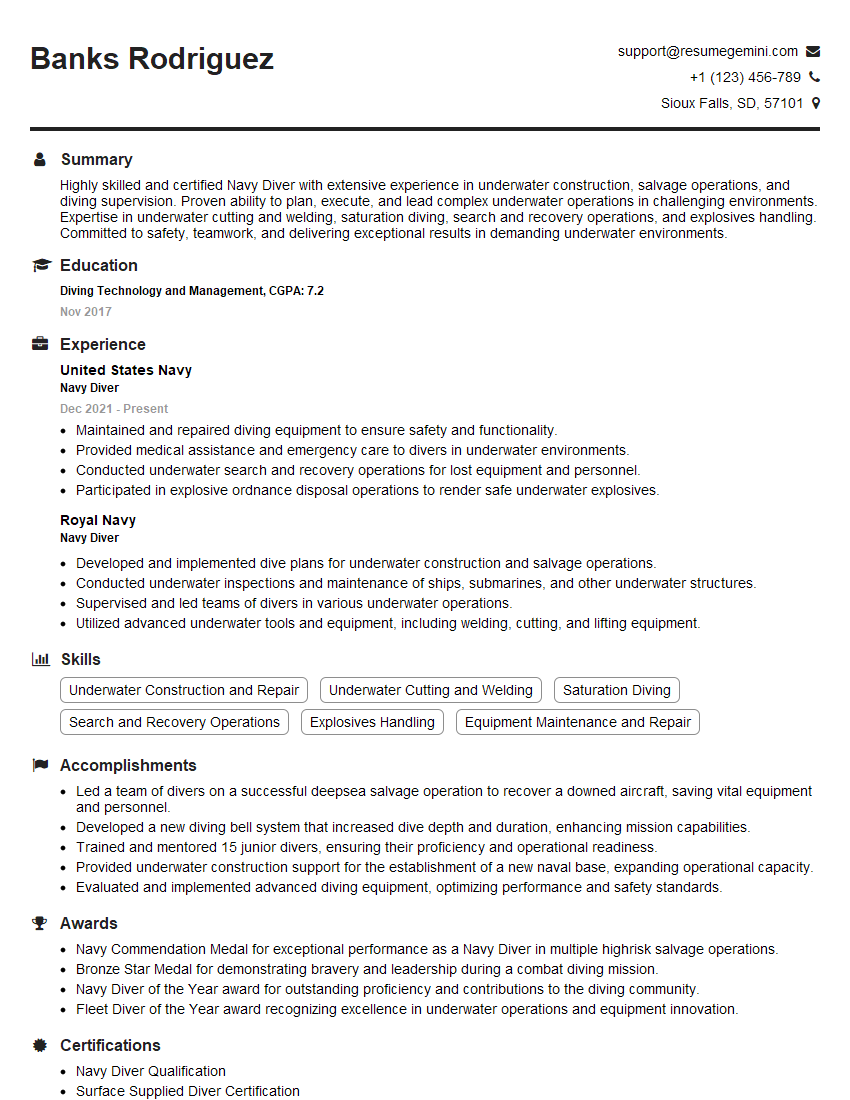
Mastering Underwater Warfare opens doors to a challenging and rewarding career with significant growth potential in a highly specialized field. To maximize your job prospects, it’s crucial to present your skills and experience effectively. Crafting an ATS-friendly resume is essential for getting your application noticed by recruiters. ResumeGemini is a trusted resource that can help you build a professional and impactful resume, tailored to the specific requirements of Underwater Warfare roles. Examples of resumes tailored to this field are available to guide you through the process. Invest time in building a strong resume – it’s your first impression and a key to unlocking your career aspirations.
Explore more articles
Users Rating of Our Blogs
Share Your Experience
We value your feedback! Please rate our content and share your thoughts (optional).
What Readers Say About Our Blog
Very informative content, great job.
good