Cracking a skill-specific interview, like one for Upholstery Basics, requires understanding the nuances of the role. In this blog, we present the questions you’re most likely to encounter, along with insights into how to answer them effectively. Let’s ensure you’re ready to make a strong impression.
Questions Asked in Upholstery Basics Interview
Q 1. What types of upholstery fabrics are you familiar with and their properties?
Upholstery fabrics are as diverse as the furniture they cover! Choosing the right fabric is crucial for both aesthetics and durability. Here are some common types and their properties:
- Cotton: A natural fiber, cotton is breathable, soft, and relatively inexpensive. However, it’s prone to wrinkling and can be less durable than other options. It’s great for less-used pieces or where a soft, natural feel is desired.
- Linen: Another natural fiber, linen is known for its strength, durability, and luxurious drape. It’s more expensive than cotton but boasts a beautiful, slightly textured appearance. It’s a good choice for high-traffic areas but can wrinkle easily.
- Velvet: A luxurious fabric with a dense pile, velvet is soft, plush, and elegant. It’s durable but can show wear and tear more easily than some others. It’s perfect for statement pieces where texture and opulence are paramount.
- Polyester: A synthetic fiber, polyester is highly durable, stain-resistant, and relatively inexpensive. It’s easy to clean and maintain, making it a practical choice for families with children or pets. However, it can feel less luxurious than natural fibers.
- Leather: A classic choice, leather is exceptionally durable and develops a unique patina over time. It’s luxurious and adds a timeless touch to furniture. However, it requires careful cleaning and conditioning to maintain its quality.
- Microfiber: A synthetic material known for its softness and stain resistance. It’s often used in budget-friendly upholstery. While highly durable, it can sometimes feel less breathable than natural fabrics.
The choice depends heavily on the piece’s intended use, the desired aesthetic, and the budget. For example, I wouldn’t use delicate velvet for a family room sofa where kids and pets are likely to be present. A more durable fabric like microfiber or a treated cotton would be a better fit.
Q 2. Explain the process of preparing a piece of furniture for reupholstering.
Preparing furniture for reupholstering is a crucial step that dictates the final result. It’s a meticulous process that involves carefully dismantling and assessing the existing structure. Here’s a breakdown:
- Disassembly: Carefully remove all existing fabric, tacks, and staples. Photograph the process as you go to ensure you can reassemble it correctly. Note the order and placement of components.
- Inspection: Thoroughly examine the frame for any damage, including broken joints, loose screws, or rot. Repair or replace damaged components. It’s better to fix these structural issues before proceeding.
- Cleaning: Clean the frame and any existing padding or webbing. A thorough cleaning prevents transferring grime or odors to the new upholstery.
- Webbing and Padding Assessment: Check the condition of existing webbing and padding. If damaged or deteriorated, these need replacement before proceeding to the new upholstery.
- Preparation for New Materials: Once the frame is repaired and cleaned, you’re ready to install new webbing, padding, and finally, the new upholstery fabric.
Think of this stage like prepping a house for renovation—you wouldn’t start painting before addressing structural problems. Careful preparation ensures a smooth and successful reupholstering project.
Q 3. Describe different types of upholstery stitching techniques.
Upholstery stitching techniques vary greatly depending on the style and desired aesthetic. Here are a few common ones:
- Straight Stitch: The most basic stitch, used for creating seams. It’s simple, strong, and widely used.
- Zigzag Stitch: Creates a more flexible and durable seam, commonly used for edges or areas prone to stretching.
- Blind Stitch: Creates a nearly invisible seam, ideal for finishing edges or creating clean lines. It requires specialized needles and thread.
- French Seam: Encapsulates raw edges, creating a clean and professional finish. This method is particularly useful for fine fabrics.
- Decorative Stitching: Used to add visual interest. This could be simple lines or more complex patterns, depending on the desired outcome and the skill of the upholsterer.
Choosing the right stitching technique is essential for both the durability and the aesthetic appeal of the finished piece. For example, a robust zigzag stitch would be more appropriate for a high-traffic area compared to a delicate blind stitch better suited for a decorative accent pillow.
Q 4. How do you measure and cut fabric for upholstery?
Measuring and cutting fabric for upholstery requires precision and careful planning. Errors here can lead to wasted material and a poorly fitting finished product.
- Detailed Measurements: Take precise measurements of each section of the furniture piece you’re covering. Account for seam allowances and extra fabric for pattern matching or adjustments.
- Pattern Making: Create patterns for each piece, taking into consideration the shape and curves of the furniture. You may need to draft several patterns to accurately cover each area.
- Fabric Lay-Out: Carefully lay out the fabric, ensuring proper pattern matching if using a patterned material. Consider the nap or direction of the fabric pile.
- Cutting: Use sharp shears or a rotary cutter to cut the fabric along your marked lines. Avoid stretching the fabric, which can distort the finished piece.
- Checking: Always double-check your cuts before proceeding to avoid mistakes.
Imagine cutting a complex dress pattern—the process is similar, requiring accurate measurements and consideration of how fabric will drape and behave when assembled. Precision is key to avoid wasting fabric and achieving a professional finish.
Q 5. What tools and equipment are essential for upholstery work?
Having the right tools is essential for efficient and quality upholstery work. Here’s a selection of essential tools and equipment:
- Sharp Shears/Rotary Cutter: For accurate fabric cutting.
- Measuring Tape: For precise measurements.
- Staple Gun: For attaching fabric to the frame.
- Hammer: For setting tacks and other tasks.
- Screwdrivers (various sizes): For assembling and disassembling furniture.
- Pliers: For removing staples and tacks.
- Sewing Machine (optional, but highly recommended): For creating strong and durable seams.
- Utility Knife: For trimming excess fabric and foam.
- Tacks and Staples: Various sizes to suit different fabrics and materials.
Investing in good quality tools makes a significant difference in the speed, efficiency, and the final quality of the reupholstery project. Just like a chef needs the right knives, an upholsterer needs the right tools to succeed.
Q 6. How do you handle different types of foam and padding?
Foam and padding are critical for comfort and the overall look of upholstered furniture. Different types offer varied properties:
- High-Resilience (HR) Foam: Provides excellent support and durability. It’s a good option for high-traffic pieces.
- Memory Foam: Conforms to the body, providing excellent comfort. It’s often used in cushions and mattresses.
- Polyester Fiberfill: A softer, less supportive option, often used as a layer under other padding materials.
- Cotton Batting: A natural fiber used for added softness and cushioning. It’s often combined with other materials.
The type of foam or padding chosen depends on the desired level of comfort and support. For instance, I’d use high-resilience foam for a sofa that needs to withstand daily use, whereas memory foam would be a better choice for a luxury chair where comfort is paramount. The layering of materials, like using fiberfill over foam for a softer feel, also contributes to the overall comfort.
Q 7. Explain the process of installing webbing and burlap.
Installing webbing and burlap is a fundamental step in upholstery, providing a strong base for the padding and fabric. Here’s how it’s done:
- Webbing Installation: Measure and cut the webbing to fit the frame. Attach the webbing to the frame using staples, ensuring it’s taut and evenly spaced. This creates a supportive framework.
- Burlap Installation: Lay the burlap over the installed webbing. Secure it to the frame using staples. The burlap provides an even surface for the padding and acts as a barrier.
- Padding Installation: After the burlap is secured, install the chosen padding materials, typically using a combination of foam and softer layers, such as fiberfill or cotton batting. The layering creates the desired level of comfort and support.
Think of the webbing and burlap as the foundation of a house—a solid base is necessary before adding walls (padding) and the roof (upholstery). A well-installed webbing and burlap system ensures the longevity and comfort of the upholstered piece.
Q 8. How do you deal with challenging fabric patterns during installation?
Dealing with challenging fabric patterns during upholstery installation requires meticulous planning and precision. Think of it like assembling a complex jigsaw puzzle – each piece (fabric section) needs to be carefully positioned to achieve the desired overall effect.
- Pattern Matching: Before cutting, carefully lay out the fabric and match the pattern repeat. This is crucial for achieving a seamless and professional look, especially with large-scale designs. I often use pins to temporarily hold pieces in place and verify the alignment before cutting.
- Cutting Technique: Use sharp shears and a cutting mat to ensure clean, precise cuts. For intricate patterns, I may use a rotary cutter for greater control and accuracy. Cutting straight and precisely is essential to avoid mismatched seams.
- Seaming: Seams should be carefully aligned and precisely stitched, using a stitch length appropriate for the fabric. For some patterns, a seam allowance may need to be adjusted to allow for better matching. A test piece is beneficial for determining ideal seam allowance and stitch length.
- Pre-Planning: I always create a detailed layout before beginning the cutting process, using the pattern repeat as a guide. This helps prevent errors and wasted fabric. In cases of very complex patterns, sometimes I will create a full-scale template of the piece before cutting.
For example, working with a damask fabric with a large, intricate floral pattern requires an even greater level of attention to ensure the flowers align perfectly across the seams. A slight misalignment can be very noticeable, so meticulous planning is paramount.
Q 9. Describe your experience with various types of furniture frames (wood, metal).
My experience encompasses a wide range of furniture frames, from solid hardwood to various metals. Each material presents unique challenges and requires a specific approach.
- Wood Frames: I’m proficient in working with different types of wood, including hardwood such as oak, maple, and cherry, as well as softer woods like pine. Understanding the wood’s grain and structural integrity is key to successful upholstery. I’ve worked on frames needing repair, reinforcement, or simply requiring careful preparation for new upholstery. Assessing the soundness of the joints and the overall structure is the first step.
- Metal Frames: Metal frames, often found in antique or vintage pieces, can range from wrought iron to steel and aluminum. Working with metal requires different tools and techniques. I’m familiar with repairing or reinforcing rusted or weakened metal parts using appropriate welding or brazing techniques (when needed). Sometimes, I’ll use specialized epoxy for repairs and reinforcements.
One memorable project involved a 1920s armchair with a severely damaged wooden frame. Through careful repair and reinforcement, utilizing traditional woodworking techniques, along with new upholstery, the chair was restored to its former glory. Conversely, I recently reupholstered a modern chaise lounge with a sleek aluminum frame, which required a different set of tools and a focus on precise attachment points.
Q 10. How do you repair damaged furniture frames?
Repairing damaged furniture frames depends heavily on the type of damage and the frame material. A thorough inspection is always the first step.
- Wood Frame Repairs: Minor cracks can be repaired using wood glue and clamps. For more significant damage, wood filler might be necessary, followed by sanding and refinishing. Loose joints can often be tightened with wood glue and reinforcing dowels or screws. Severe damage might require replacing sections of the frame.
- Metal Frame Repairs: Rust needs to be addressed first, usually through wire brushing and possibly a rust converter. Small cracks or holes might be repaired with welding, brazing, or specialized epoxy, depending on the metal type and the extent of the damage. Loose joints can be tightened or re-welded. Severe damage may require partial or complete frame replacement.
For instance, a wobbly chair leg might be fixed simply by tightening the joint with wood glue and a clamp. However, a broken chair leg might require a more complex repair involving replacing the broken piece with a new one, ensuring it’s properly fitted and structurally sound.
Q 11. What are common upholstery problems and how do you solve them?
Common upholstery problems are often related to fabric wear, frame issues, or improper installation.
- Fabric Wear and Tear: Rips, tears, and fading are common. Solutions vary depending on the severity: small tears can often be mended invisibly, while larger ones may require patching or even fabric replacement. Fading is often unavoidable, but proper cleaning and sun protection can help mitigate this.
- Frame Issues: Weak or broken frames are major problems. These require professional repair, often involving woodworking or metalworking skills, before reupholstering can begin. Ignoring these issues leads to failure of the finished piece.
- Improper Installation: Uneven padding, poor stitching, or incorrect staple placement can result in an unprofessional finish and affect the furniture’s comfort and longevity. These problems generally require re-doing the affected areas.
- Spring Problems (in sprung furniture): Broken or sagging springs lead to discomfort and an uneven sitting surface. This requires replacing the damaged springs or entire spring system.
For example, a sagging seat cushion might be addressed by adding more padding or replacing the foam, while a ripped seam requires careful restitching or patch repair. The approach depends heavily on identifying the root cause of the issue.
Q 12. How do you ensure a professional finish on upholstery projects?
Achieving a professional finish in upholstery involves attention to detail at every stage.
- Accurate Cutting: Precise cutting ensures clean lines and a professional look. Using sharp tools is crucial.
- Neat Seams: Clean, well-aligned seams are vital. Proper seam finishing techniques, like serging or pinking, prevent fraying and add a polished look.
- Even Padding and Filling: Uniform padding ensures comfort and avoids lumps or bumps. Careful layering of various materials (foam, batting, etc.) is key.
- Proper Stapling or Nail Placement: Staples or tacks should be evenly spaced and carefully driven in to avoid damage to the fabric or frame.
- Finishing Touches: Trimming excess fabric and carefully concealing raw edges completes the professional look. This often involves using techniques like welt cord or cording.
I often use a combination of hand-stitching and machine stitching, depending on the project and fabric. For instance, hand-stitching may be ideal for some details, while machine stitching is better for large areas of fabric.
Q 13. What safety precautions do you take during upholstery work?
Safety is paramount in upholstery work. I always prioritize these precautions:
- Proper Ventilation: Good ventilation is crucial when using adhesives, sprays, or working with materials that may release harmful fumes. I always work in well-ventilated areas or wear appropriate respirators.
- Protective Gear: Gloves protect hands from cuts, splinters, and chemicals. Eye protection prevents injuries from flying debris or chemicals. A dust mask protects from inhaling dust and fibers.
- Sharp Tool Handling: Knives, shears, and other sharp tools should be used carefully and stored safely when not in use. I always cut away from myself and ensure the tools are sharp to prevent accidents.
- Safe Lifting Techniques: Furniture can be heavy. I always use proper lifting techniques to avoid back injuries. I often use mechanical aids when lifting heavier pieces.
- Electrical Safety: When using electrical tools, I always ensure proper grounding and check the cords for damage.
For example, I’ll never rush through a project. Taking my time to work safely is always a priority. It’s a combination of good habits and safety awareness that allows me to produce high quality work while staying safe.
Q 14. Describe your experience with different types of upholstery tacks and nails.
Upholstery tacks and nails come in various types, each suited for different applications and materials.
- Upholstery Tacks: These come in various sizes and finishes (e.g., brass, black, antique). I choose the tack size based on the fabric weight and the thickness of the material being fastened. Larger tacks are needed for heavier fabrics and thicker materials.
- Finishing Nails: Small, fine nails, often used for attaching fabric to the frame, particularly in areas needing a more discreet finish. I often use these when attaching a fabric skirt to a frame.
- Staples: Used extensively, particularly with heavier duty upholstery work, using a pneumatic staple gun for efficiency. Different gauge staples are used for different fabric weights.
The choice depends on the aesthetic and the structural requirements. For example, for a period piece where visible tacks are a design feature, I’d carefully select decorative tacks; while for modern furniture where I need a clean, hidden finish, I’d often use staples or finishing nails instead.
Q 15. How do you maintain and clean your upholstery tools?
Maintaining upholstery tools is crucial for longevity and efficient work. Think of it like caring for your favorite chef’s knives – regular cleaning and sharpening ensure precision and prevent damage. My routine involves several steps:
Cleaning: After each project, I thoroughly clean all tools, removing fabric scraps, glue residue, and dust. I use a stiff brush for larger tools and compressed air for intricate details like air nailers. For glue removal, I use a suitable solvent, always checking for compatibility with the tool material.
Lubrication: Moving parts of tools like sewing machines and staple guns require regular lubrication with appropriate oils or greases to prevent wear and tear and ensure smooth operation. This extends their lifespan and improves the quality of the work.
Sharpening: I regularly sharpen my upholstery needles and shears to maintain clean cuts and avoid damaging fabrics. Dull tools result in frayed edges and a less professional finish.
Storage: Finally, I store all tools in a well-organized manner to protect them from damage and corrosion. This includes using protective covers for delicate tools and keeping them in a dry, climate-controlled environment.
This meticulous cleaning and maintenance routine not only saves money in the long run by extending the life of my tools, but it also ensures the quality of my work remains consistently high.
Career Expert Tips:
- Ace those interviews! Prepare effectively by reviewing the Top 50 Most Common Interview Questions on ResumeGemini.
- Navigate your job search with confidence! Explore a wide range of Career Tips on ResumeGemini. Learn about common challenges and recommendations to overcome them.
- Craft the perfect resume! Master the Art of Resume Writing with ResumeGemini’s guide. Showcase your unique qualifications and achievements effectively.
- Don’t miss out on holiday savings! Build your dream resume with ResumeGemini’s ATS optimized templates.
Q 16. What is your experience with power tools used in upholstery?
I’m proficient in using various power tools commonly employed in upholstery, including pneumatic staple guns, electric sewing machines, and even a hand-held electric knife for cutting foam. Safety is paramount. Before using any power tool, I always inspect it for any damage and ensure it’s properly grounded and functioning correctly. Safety glasses and appropriate hearing protection are mandatory.
Pneumatic Staple Guns: I’ve extensive experience using these for attaching fabric to frames, offering speed and precision. Understanding air pressure adjustment is key for avoiding fabric damage or staple misfires.
Electric Sewing Machines: My expertise extends to using both industrial and domestic machines for seams, piping, and decorative stitching. I’m comfortable working with various stitch types and needle sizes according to the fabric type.
Electric Knives: These are invaluable for cutting foam accurately and smoothly, particularly when working with curved or complex shapes. The correct blade choice for the foam type is critical for a clean cut.
My experience allows me to select the right tool for the job, understanding their limitations and maximizing their efficiency. I always prioritize safety and practice regular maintenance.
Q 17. Explain your experience with pattern making and drafting.
Pattern making and drafting are fundamental skills in upholstery. It’s essentially translating a design vision into a set of instructions the fabric will follow. My experience includes creating patterns from scratch, as well as adapting existing patterns to suit specific requirements.
Measuring and Drafting: I begin by meticulously measuring the piece of furniture I’m reupholstering. Then, I create a precise draft on paper, considering seam allowances and fabric drape. I’ve used both traditional drafting techniques and digital design software to create these patterns.
Muslin Mock-ups: Before cutting expensive fabric, I always make a muslin mock-up. This inexpensive test run allows me to identify and correct any fit issues before committing to the final fabric.
Adapting Patterns: Often, I need to adapt existing patterns. For example, a customer might want a different armrest style or a modified back cushion shape. My experience enables me to adjust patterns seamlessly to meet specific needs.
Pattern making is a blend of precision, creativity, and problem-solving, and I’m confident in my ability to translate designs into functional and aesthetically pleasing patterns.
Q 18. How do you determine the correct amount of fabric needed for a project?
Determining the correct fabric amount requires careful calculation and consideration of several factors. Simply measuring the surface area isn’t enough; you need to account for pattern matching, seam allowances, and potential waste.
Measuring and Calculating: I start by meticulously measuring each section of the furniture (back, seat, arms, etc.). Then I add seam allowances (typically ½” to 1”, depending on the fabric and project), and account for pattern matching if the fabric has a directional print or texture.
Pattern Repetition and Waste: For patterned fabrics, I need to determine how many repeats of the pattern are needed and allow for waste caused by matching those repeats.
Additional Fabric: I always add an extra 10-20% to the calculated amount. This accounts for potential mistakes, miscalculations, or unexpected issues during the process. It’s better to have extra than to run short.
Accurate fabric calculation minimizes waste and ensures a sufficient amount is available to complete the project seamlessly. Experience has taught me the importance of precision in this stage.
Q 19. Describe your experience working with different types of glues and adhesives.
My experience encompasses working with a variety of glues and adhesives tailored to different upholstery applications. Choosing the right glue is crucial for a strong, durable, and aesthetically pleasing result. I always prioritize safety and follow manufacturers’ instructions carefully.
Spray Adhesives: These are useful for adhering foam to fabric or fabric to the furniture frame, providing even coverage and a quick bonding time. I use these with adequate ventilation to avoid inhaling fumes.
Contact Cement: This is ideal for bonding strong materials like plywood or hardboard. It’s vital to apply it evenly and allow the appropriate drying time for optimal adhesion.
Hot Melt Glue: This is excellent for small tasks, but requires caution to avoid burns. I use it for attaching smaller details or repairing minor tears in fabric.
Knowing which glue is best suited for each material and understanding their drying times and properties is key to successful upholstery. Safety and proper ventilation are always top priorities when using any type of adhesive.
Q 20. How do you handle customer requests and potential design changes?
Handling customer requests and design changes is a crucial part of my process. I believe in open communication and collaboration to ensure customer satisfaction.
Initial Consultation: I begin by having a thorough consultation with the client to understand their preferences, budget, and desired outcome. This often includes discussing fabric choices, design styles, and potential challenges.
Managing Changes: Design changes are expected. I discuss any potential impact on timeline and cost upfront and provide detailed updates during the process. I use visual aids, like sketches or samples, to ensure the client understands the changes.
Compromise and Solutions: Sometimes, changes might not be feasible within the existing constraints. I offer alternative solutions that meet the client’s needs while remaining realistic. Open communication is vital in finding mutually agreeable solutions.
My ability to manage customer expectations effectively, adapt to changes, and resolve conflicts constructively ensures a positive experience for the client and a high-quality finished product.
Q 21. What are your strengths and weaknesses as an upholsterer?
My strengths lie in my meticulous attention to detail, my problem-solving skills, and my ability to handle diverse challenges in upholstery. I’m adept at pattern making, fabric selection, and working with various materials and tools.
Strengths: Precision, adaptability, creative problem-solving, excellent communication skills, and efficiency.
Weaknesses: Like any artisan, perfectionism can sometimes lead to slower completion times. I’m actively working on improving my time management skills to balance quality with efficiency.
I’m constantly striving to improve my skills through continued learning and exploration of new techniques and materials. My goal is to deliver exceptional work and provide a positive experience for every client. I am confident in my abilities and eager to take on new and challenging projects.
Q 22. Describe a challenging upholstery project and how you overcame the difficulties.
One of the most challenging projects I undertook involved reupholstering a pair of antique Victorian armchairs. The challenge wasn’t just the age and fragility of the chairs – the original fabric was incredibly delicate, and the underlying structure showed signs of significant wear. The existing stuffing was also brittle and crumbling.
To overcome these difficulties, I began with meticulous documentation. I photographed every step of the disassembly process, carefully noting the placement of each component. This allowed me to reconstruct the chairs accurately. The worn-out stuffing was replaced with high-quality, period-appropriate materials, ensuring the chairs maintained their original silhouette. For the fabric, I sourced a durable yet aesthetically similar replacement, opting for a linen blend to complement the chairs’ antique charm. Finally, I employed careful hand-sewing techniques throughout the reassembly, ensuring a seamless and historically accurate restoration.
Q 23. How do you stay updated on current trends in upholstery and design?
Staying current in the ever-evolving world of upholstery and design requires a multi-pronged approach. I regularly subscribe to industry magazines like Metropolis and Interior Design, attending trade shows such as High Point Market, where I can see the latest fabric collections and design trends firsthand. Online resources are also invaluable; I follow influential designers and brands on platforms like Instagram and Pinterest, keeping abreast of emerging styles and techniques. Furthermore, I actively participate in online forums and workshops to connect with fellow professionals and learn from their experiences.
Q 24. What is your experience working with antique or vintage furniture?
I have extensive experience working with antique and vintage furniture. This work demands a deep understanding of historical construction techniques, material properties, and appropriate restoration methods. For instance, I’ve successfully restored several Art Deco sofas, requiring careful repair of the original sprung framework and meticulous matching of the original fabric patterns. The key is patience and a deep respect for the history and craftsmanship inherent in these pieces. I always prioritize the preservation of original features while addressing any structural or fabric-related issues.
Q 25. How do you handle difficult or demanding customers?
Handling demanding customers requires a combination of empathy, clear communication, and professional expertise. I always begin by actively listening to their concerns and validating their feelings. Then, I present clear, concise solutions, outlining the process, timeline, and costs involved. Transparency is key – addressing any potential challenges upfront helps to manage expectations. If disagreements arise, I remain calm and professional, focusing on finding a mutually agreeable solution. If necessary, I will document all communication and agreements to protect both the client and myself.
Q 26. What is your salary expectation for this position?
My salary expectation for this position is commensurate with my experience and the industry standard for a skilled upholsterer with my qualifications. Given my expertise in antique restoration and commercial-scale projects, I am confident that my contribution will significantly benefit your company. I am open to discussing specific salary ranges after further understanding the details of the role and responsibilities.
Q 27. Explain your understanding of different upholstery techniques (e.g., channel tufting, button tufting).
Upholstery techniques vary widely, each offering a unique aesthetic. Channel tufting involves creating parallel, vertical lines (channels) in the upholstery by using welting cord or piping between the fabric panels. This technique gives a structured, sleek appearance often seen in modern or contemporary designs. In contrast, button tufting involves strategically placing buttons through the upholstery layers to create a decorative, raised pattern. This classic technique is often used in traditional designs, creating a plush, luxurious effect. Other common techniques include welt cord application, pleated and gathered fabrics, and the use of various foams and padding for comfort and support. My expertise encompasses a wide array of techniques, enabling me to adapt to diverse design styles and client preferences.
Q 28. What is your experience with working on commercial-scale upholstery projects?
I have substantial experience working on commercial-scale upholstery projects, including the reupholstering of seating in restaurants, hotels, and office spaces. These projects often involve managing large volumes of work within strict deadlines and budgets. My experience includes collaborating with interior designers and contractors, overseeing teams of upholsterers, and ensuring projects are completed to the highest standards of quality and professionalism. I am adept at sourcing materials efficiently, managing timelines effectively, and ensuring that the final product aligns perfectly with the client’s specifications and the overall design concept.
Key Topics to Learn for Your Upholstery Basics Interview
- Fabric Selection and Properties: Understanding different fabric types (e.g., cotton, linen, leather, microfiber), their durability, and suitability for various applications. Practical application: Identifying the best fabric for a specific project based on client needs and budget.
- Cutting and Preparation: Accurate fabric cutting techniques, pattern making, and the importance of pre-shrinking fabric. Practical application: Minimizing fabric waste and ensuring a precise fit for upholstery projects.
- Foam and Padding Techniques: Understanding different types of foam and padding, their densities, and their roles in creating comfortable and durable upholstery. Practical application: Selecting appropriate foam and padding for different furniture pieces and achieving the desired level of comfort and support.
- Stapling and Finishing: Proper stapling techniques for different upholstery types, achieving a neat and professional finish, and understanding common challenges like fabric bunching. Practical application: Creating a visually appealing and durable upholstered piece free from visible staples or imperfections.
- Tools and Equipment: Familiarity with essential upholstery tools (e.g., staple gun, sewing machine, measuring tape) and their safe and efficient use. Practical application: Selecting the right tools for a project and using them effectively to achieve a high-quality finish.
- Safety Procedures: Understanding and adhering to safety procedures when using upholstery tools and handling materials. Practical application: Prioritizing workplace safety and preventing potential injuries during upholstery projects.
- Basic Repair and Maintenance: Identifying common upholstery problems and performing basic repairs, such as replacing broken springs or repairing seams. Practical application: Extending the life of upholstered furniture and providing effective solutions for minor repairs.
Next Steps
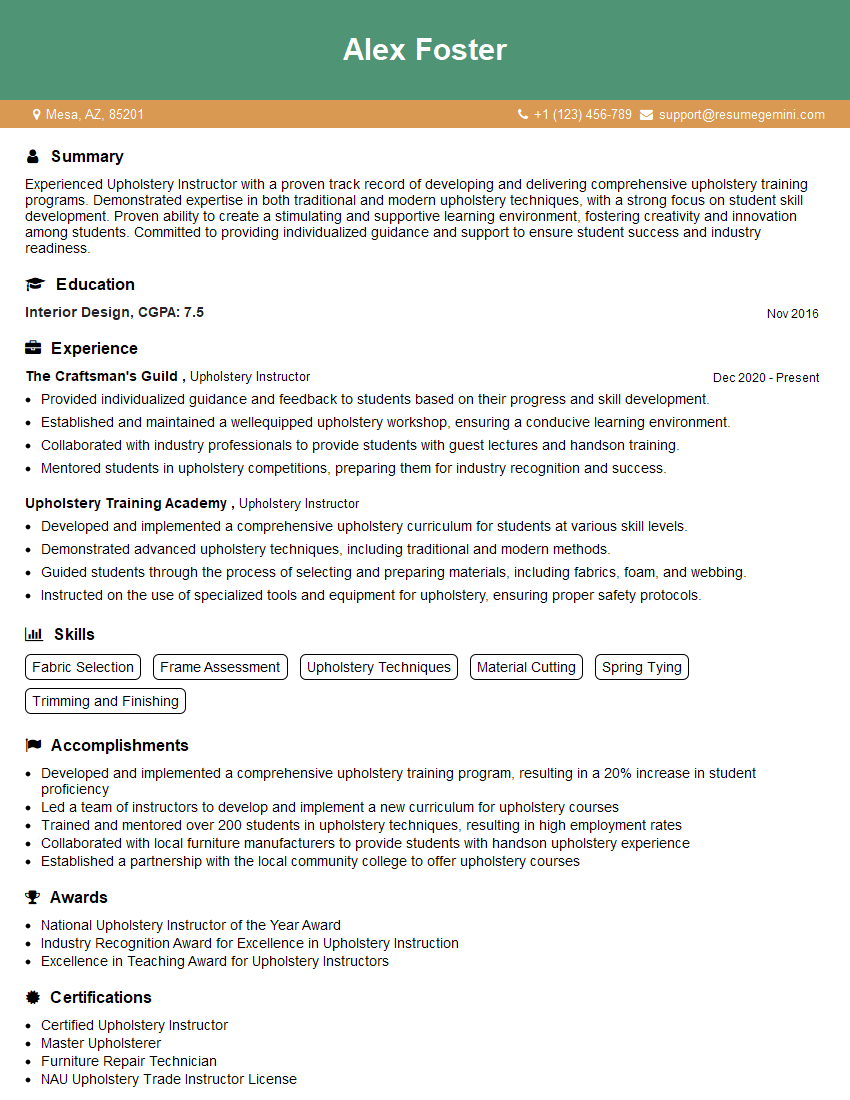
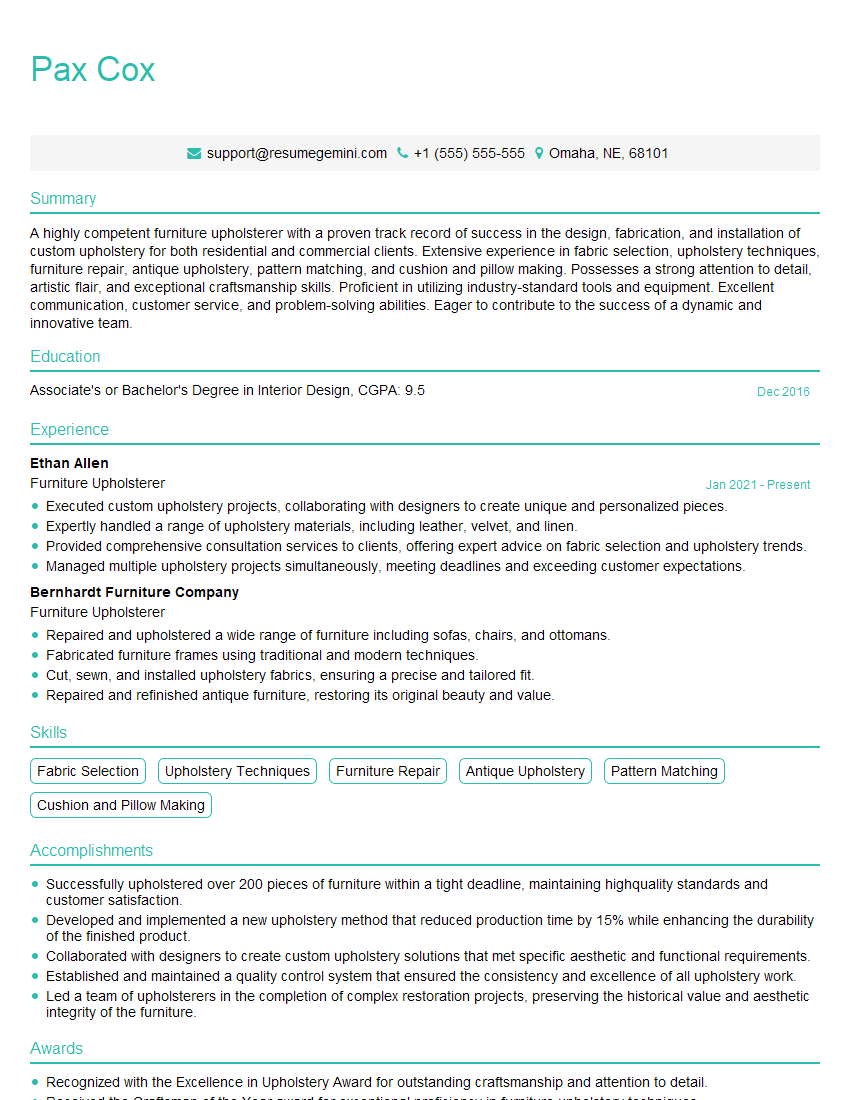
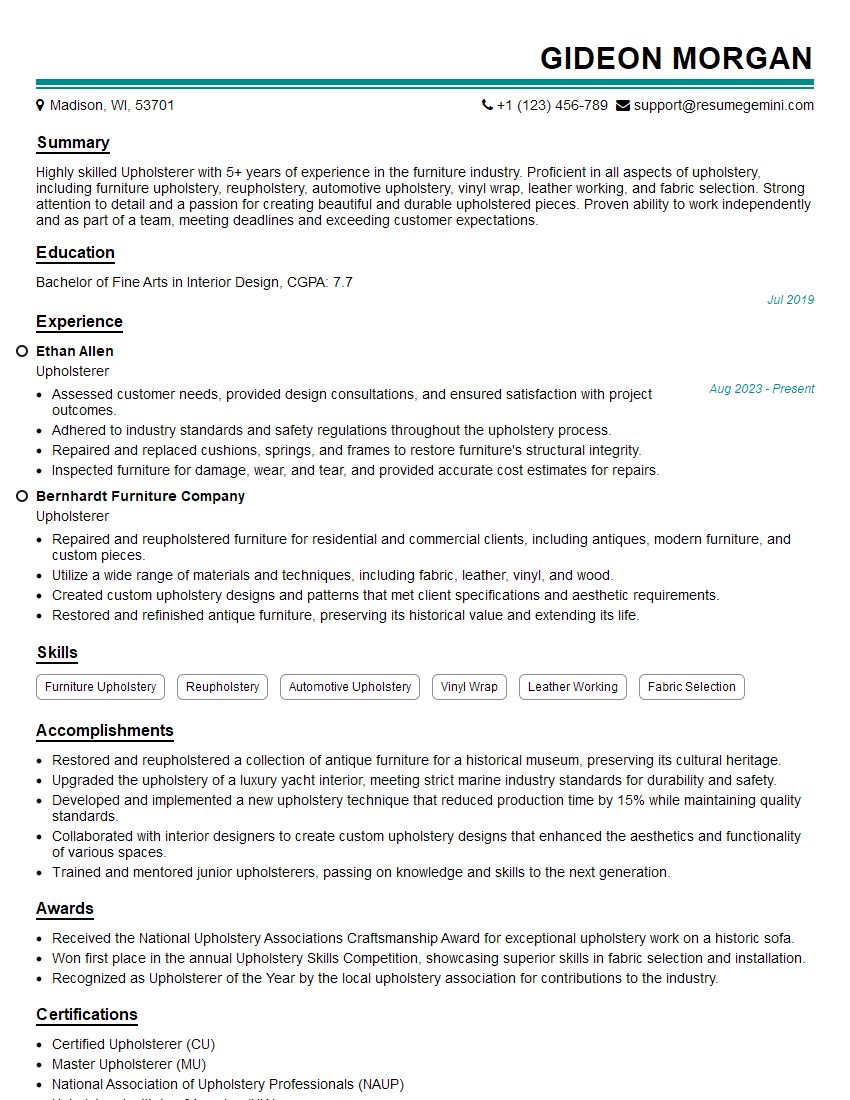
Mastering Upholstery Basics is crucial for career advancement in the furniture and design industry. A strong understanding of these concepts demonstrates your commitment to quality craftsmanship and problem-solving skills. To stand out, focus on building an ATS-friendly resume that highlights your skills and experience effectively. ResumeGemini is a trusted resource that can help you create a professional and impactful resume tailored to the specific requirements of upholstery positions. Examples of resumes tailored to Upholstery Basics are available to help you get started.
Explore more articles
Users Rating of Our Blogs
Share Your Experience
We value your feedback! Please rate our content and share your thoughts (optional).
What Readers Say About Our Blog
Very informative content, great job.
good