The right preparation can turn an interview into an opportunity to showcase your expertise. This guide to Voice Editing interview questions is your ultimate resource, providing key insights and tips to help you ace your responses and stand out as a top candidate.
Questions Asked in Voice Editing Interview
Q 1. Explain your experience with Pro Tools or other DAWs for voice editing.
Pro Tools has been my primary Digital Audio Workstation (DAW) for over a decade. I’m proficient in all aspects, from basic clip editing and manipulation to advanced mixing and mastering techniques specifically tailored for voice. My experience extends to other DAWs like Logic Pro X and Audacity, allowing me to adapt to various project needs and client preferences. I’m comfortable navigating complex sessions, managing large numbers of audio files, and utilizing various plugins for achieving the desired sonic quality. For instance, I recently used Pro Tools’ Elastic Audio functionality to seamlessly adjust the timing of a voiceover without compromising its natural quality. This was particularly crucial as the client had made some late changes to the script and timing adjustments were needed to align with the revised visuals.
Q 2. Describe your workflow for editing dialogue in a film or television show.
My dialogue editing workflow for film or television begins with careful logging and organization of the audio. I then perform a rough cut, syncing the dialogue to the picture, and identifying any issues such as noise, pops, clicks, or unwanted background sounds. Next, I meticulously clean up the audio, utilizing noise reduction and restoration techniques (which I’ll detail further in the next question). After cleaning, I refine the timing and pace of the dialogue, using tools like Pro Tools’ Elastic Audio to adjust tempo and pitch without artifacts. Finally, I perform a final mix and export the audio to the required specifications. A crucial step is communicating with the director/editor throughout this process. For example, one project required subtle adjustments in pacing to match the actors’ emotional delivery on screen. By constantly referring to the visual context, I ensure the final edit enhances the storytelling and emotional impact.
Q 3. How do you handle noise reduction and audio restoration in voice recordings?
Noise reduction and audio restoration are crucial for achieving a polished final product. My approach is multi-faceted and depends on the type and severity of the noise. I often start with spectral editing to visually identify and surgically remove unwanted sounds or clicks. For consistent background noise (like hum or air conditioning), I utilize noise reduction plugins like iZotope RX, carefully choosing parameters to avoid artifacts and preserve the natural sound of the voice. For more complex issues, like pops or clicks, I might use a combination of spectral editing, de-clickers, and sometimes even manual repair. Think of it like digitally ‘re-weaving’ the audio; it’s about careful and precise editing to restore clarity without altering the intended performance. The key is balance; aggressive noise reduction can make a voice sound unnatural. One recent project featured dialogue recorded in a room with noticeable low-frequency hum. By utilizing both spectral editing and a carefully dialed-in noise reduction plugin, I successfully removed the hum without significantly compromising the clarity and richness of the actor’s voice.
Q 4. What are your preferred methods for syncing dialogue to picture?
Accurate syncing is paramount. My preferred method involves using Pro Tools’ powerful audio and video synchronization tools. I typically start by identifying a clear, common sound between the audio and video, for example, a clap or a distinctive sound effect. This provides a reference point for aligning the audio tracks precisely. For more complex projects with multiple takes, I utilize features like ‘spotting’ which allows for very precise alignment. I then use visual cues and audio waveforms to fine-tune the sync, ensuring a natural and seamless blend. Imagine trying to put a puzzle together; a perfect visual match is essential for a seamless final product. The more accurate the initial sync, the less time is spent on complex edits later in the process.
Q 5. Explain your experience with ADR (Automated Dialogue Replacement).
ADR (Automated Dialogue Replacement) is a regular part of my work. My experience encompasses all aspects, from preparing the ADR session, guiding the actors, recording the new dialogue, to the final editing and integration with the picture. I focus on recreating the original performance’s emotion and delivery while maintaining consistency with the existing audio. This often involves careful direction of the actor to capture the correct pacing, tone, and inflection. For seamless integration, I leverage tools such as Pro Tools’ Elastic Audio to adjust the timing and pitch to match the original footage, ensuring a smooth and undetectable transition. In a recent project, an actor’s voice was barely audible in a crucial scene due to background noise. Using ADR, we were able to re-record their lines maintaining the original performance style creating a polished final edit. This highlights the essential role of precise direction and technical skill during ADR sessions.
Q 6. How do you approach editing voiceovers for commercials or narration?
Editing voiceovers for commercials or narration differs slightly from dialogue editing. The focus here is on clarity, tone, and impact. I pay close attention to the pacing, ensuring the voiceover aligns perfectly with the visuals or written copy. I also utilize EQ and compression to optimize vocal clarity and presence, making sure the message comes through loud and clear. Sometimes, creative use of reverb or delay is required to create a specific mood or atmosphere. This might involve creating a sense of spaciousness, intimacy, or even a sense of urgency, depending on the commercial’s intended impact. One memorable project involved a voiceover for a travel advertisement. By employing a touch of subtle reverb and creating a warm tonal balance, I was able to invoke a sense of calm and exploration, perfectly complementing the visuals.
Q 7. Describe your experience with different audio compression techniques.
My experience with audio compression techniques is extensive. I regularly use compression to control dynamics, enhance clarity, and add punch to voice recordings. Different compressor types (like peak, RMS, and multiband) serve different purposes. For example, I might use a light RMS compression to control vocal peaks without squashing the dynamics too much, preserving the natural sound. Multiband compression allows for more targeted control, allowing me to compress specific frequency ranges independently. The goal is always a natural-sounding result; heavy-handed compression can easily result in a lifeless or unnatural vocal sound. A recent project used multiband compression to control sibilance in a voiceover; by carefully addressing the high frequencies we achieved a smooth, clear performance that felt entirely natural to the ear. Understanding how different compressors impact the audio is key to achieving a professional finish.
Q 8. How do you identify and correct audio artifacts in voice recordings?
Identifying and correcting audio artifacts in voice recordings is crucial for achieving professional-sounding audio. Artifacts are unwanted sounds or distortions that detract from the clarity and quality of the recording. They can manifest in many ways, from clicks and pops to hums and background noise.
My process begins with careful listening using high-quality headphones. I then utilize a combination of techniques within my Digital Audio Workstation (DAW), such as:
- Noise Reduction: I employ noise reduction plugins to attenuate consistent background noise. This involves creating a noise profile from a section of silent audio and applying the reduction to the entire recording. It’s important to use this sparingly to avoid sacrificing audio quality.
- Click/Pop Removal: I use specialized tools or plugins designed to automatically detect and remove transient clicks and pops often caused by handling microphones or digital errors. Manual editing might be necessary for particularly stubborn artifacts.
- De-Clicking: For subtle clicks and pops, I use spectral editing tools, visualizing the audio as a waveform and frequency spectrum. This allows me to pinpoint and surgically remove the offending frequencies without affecting surrounding audio.
- De-Essing: Harsh sibilance (‘s’ sounds) can be tamed using de-essing plugins which reduce the intensity of high-frequency components in the vocal range without affecting overall clarity.
For example, in a recent project, a recording had a consistent low-frequency hum. I identified the frequency using a spectral analyzer, and then used a notch filter within my EQ to precisely remove it without affecting the voice’s overall warmth.
Q 9. Explain your understanding of audio equalization and its role in voice editing.
Audio equalization (EQ) is a fundamental aspect of voice editing. It allows for adjustments to the frequency balance of an audio signal, enhancing certain frequencies while attenuating others. This is vital for sculpting the voice’s tone, ensuring clarity, and achieving a specific aesthetic.
In voice editing, EQ is used to:
- Boost clarity: By slightly boosting frequencies around 2-4kHz, we can enhance vocal intelligibility and presence. This is especially useful for recordings with a muddy or muffled sound.
- Reduce harshness: Conversely, reducing high-frequency energy (8-12kHz) can tame excessive sibilance (hissing ‘s’ sounds) and overall harshness.
- Improve warmth: Subtle boosts in the low-mid range (200-500Hz) can add warmth and fullness to a voice that sounds thin or lacking body.
- Correct imbalances: EQ is often used to compensate for the frequency response of a microphone or recording environment. For instance, a room with excessive reverberation at certain frequencies might need adjustments with EQ to counter this effect.
Imagine a voice recording that sounds thin and lacks depth. Using a parametric EQ, I would gently boost the low-mid frequencies (around 250-500Hz) to add warmth and body, and perhaps slightly attenuate some of the high mids (2-4kHz) to reduce any harshness. The goal is always a natural and pleasant sound rather than an artificial or processed one.
Q 10. What are your strategies for managing large audio files and projects?
Managing large audio files and projects efficiently is crucial for preventing workflow bottlenecks. My strategy involves a multi-faceted approach:
- Organized File Structure: I use a hierarchical file structure with clearly labeled folders for each project, client, and related audio files. This makes locating specific files quick and easy.
- Project Management Software: I utilize project management tools such as [mention specific software, e.g., Basecamp, Asana] to track tasks, deadlines, and client communication. This helps keep everything organized.
- DAW-Specific Features: My DAW has features like session templates and automation that allow me to streamline workflows. For example, I set up a template with pre-configured tracks and effects for consistency across projects.
- Hard Drive Management: I use multiple hard drives, with backups regularly made to external or cloud-based storage. This prevents data loss and ensures project accessibility.
- File Compression: When sharing large files, I compress them using efficient methods like zip or other lossless compression formats without significantly impacting audio quality.
For instance, a recent large-scale audiobook project involved hundreds of individual audio files. I created a comprehensive folder structure with separate folders for each chapter, voice actor, and sound effects. This meticulous organization allowed me to quickly navigate the project and ensure efficient workflow.
Q 11. How do you maintain consistency in audio levels and tone across a project?
Maintaining consistency in audio levels and tone is paramount for a polished final product. Inconsistencies can be jarring and unprofessional. My approach involves a combination of techniques:
- Gain Staging: Careful initial recording levels are essential. I aim for a consistent signal level during the recording process to avoid clipping or excessively low signal levels.
- Audio Normalization: Once all the recordings are gathered, I normalize the audio levels to a target level, ensuring that all clips have a similar peak amplitude. Tools within my DAW allow for batch processing, making this efficient.
- Compression: Compression helps control the dynamic range of the audio, ensuring a consistent loudness. This creates a smoother and more even sound. However, I use compression subtly, avoiding over-compression that can sound artificial.
- EQ Matching: If there are tonal inconsistencies between different recordings, I use EQ to subtly shape the frequencies to achieve a more uniform sound. This might involve adjusting frequencies based on microphone differences or variations in recording environments.
- Reference Tracks: I often use a reference track (a professionally mixed audio file) to compare levels and tones, helping me gauge consistency throughout the project.
For instance, when editing a series of podcast episodes with multiple hosts, I normalized the audio to a consistent peak level, applied light compression to control dynamic range, and used EQ to match the overall tonal balance across all episodes, resulting in a seamless listening experience.
Q 12. Describe your experience working with voice actors and directors.
My experience working with voice actors and directors has been crucial in developing effective communication and collaboration skills. I’ve worked with a variety of personalities and styles, and I’ve learned how to adapt my approach to meet each individual’s needs.
I always maintain open communication, ensuring clear understanding of expectations and providing regular updates. I’m comfortable explaining technical aspects in simple, understandable terms, and I’m proactive in identifying potential issues before they become major problems. I respect creative input while ensuring the technical aspects remain polished.
With directors, I foster collaborative discussions about creative vision, reviewing edits and revisions, and providing feedback based on my technical expertise. This partnership ensures the final product aligns with both artistic and technical standards. A positive example involved collaborative sessions with a voice director to achieve a nuanced emotional delivery. By carefully selecting sections and adjusting the audio post-production, we achieved a more emotionally resonant performance than the original recording.
Q 13. Explain your experience using metadata and organizational systems for audio files.
Using metadata and organizational systems for audio files is vital for efficient workflow, especially in large projects. I consistently use standardized file naming conventions, and I embed metadata directly into the audio files. This metadata includes:
- Client Name: Makes locating client-specific files easy.
- Project Name: Provides immediate context to the file.
- Date: Allows for time-based sorting and identification.
- Voice Actor Name: Facilitates quick identification of specific performers’ recordings.
- Take Number: Assists in selecting the best version of a particular line or segment.
- Keywords: Helps categorize files based on content or context.
I also use database programs or specialized audio management software that enables me to search, filter, and manage vast numbers of audio files based on metadata. This meticulous approach significantly simplifies finding needed audio files during post-production. For example, searching ‘Client X – Project Y – Take 3’ instantly locates the specific file needed.
Q 14. How do you handle feedback and revisions during the voice editing process?
Handling feedback and revisions efficiently is essential for client satisfaction. My approach centers on clear communication, meticulous tracking, and effective implementation.
When receiving feedback, I make detailed notes, ensuring I fully understand the changes requested. I utilize revision tracking tools within my DAW to document each modification, making it easy to compare versions and quickly revert if needed.
I always confirm my understanding of revisions with the client before starting, preventing misunderstandings and unnecessary revisions. I prioritize clear communication, actively engaging with the client to ensure they feel heard and that their feedback is effectively implemented. For instance, a client might request a specific emotional tone adjustment. I’d engage in a collaborative discussion to ensure I understand the desired change, adjust the audio accordingly, and then share a revised segment for their review before final implementation.
Q 15. Describe your experience with different audio file formats (e.g., WAV, MP3, AIFF).
My experience spans a wide range of audio file formats, each with its own strengths and weaknesses. Understanding these nuances is crucial for efficient and high-quality voice editing.
- WAV (Waveform Audio File Format): This is a lossless format, meaning no audio data is lost during encoding. It’s ideal for archiving and editing, preserving the highest fidelity. However, its large file sizes can be a drawback for storage and transfer.
- MP3 (MPEG Audio Layer III): This is a lossy format, compressing the file by discarding some audio data. This results in smaller file sizes, making it suitable for online distribution and streaming. However, the compression can introduce artifacts, especially noticeable at lower bitrates, potentially impacting the quality of the final edit.
- AIFF (Audio Interchange File Format): Similar to WAV, AIFF is a lossless format commonly used on Apple platforms. It offers high fidelity but also comes with larger file sizes.
In practice, I often start with WAV or AIFF for editing to maintain maximum quality, then export to MP3 or other formats for distribution depending on the client’s needs and platform.
Career Expert Tips:
- Ace those interviews! Prepare effectively by reviewing the Top 50 Most Common Interview Questions on ResumeGemini.
- Navigate your job search with confidence! Explore a wide range of Career Tips on ResumeGemini. Learn about common challenges and recommendations to overcome them.
- Craft the perfect resume! Master the Art of Resume Writing with ResumeGemini’s guide. Showcase your unique qualifications and achievements effectively.
- Don’t miss out on holiday savings! Build your dream resume with ResumeGemini’s ATS optimized templates.
Q 16. What are the challenges of editing voice recordings with background noise?
Editing voice recordings with background noise presents several significant challenges. The goal is to remove or reduce the noise without compromising the clarity and quality of the voice.
- Noise reduction can be tricky: Aggressive noise reduction can negatively affect the audio, resulting in a muffled or unnatural sound. It’s a delicate balance.
- Different noise types require different approaches: Constant hums require different techniques than intermittent clicks or pops. Identifying the noise type is crucial.
- Preserving audio nuances: Removing background noise while preserving the natural warmth and subtleties of the voice is a key challenge. Poor noise reduction can make the voice sound artificial or ‘thin’.
I typically use a combination of techniques including noise reduction plugins, spectral editing, and careful EQ adjustments to address these challenges. Sometimes, re-recording might be the best solution if the noise is excessive.
Q 17. How do you ensure the final edited audio meets broadcast standards?
Meeting broadcast standards is paramount. This involves a multi-step process focused on ensuring the audio is clean, clear, and consistent with industry norms.
- Level matching: Ensuring consistent audio levels throughout the recording is crucial for a professional sound.
- Dialogue editing: Cleaning up any breaths, pops, or other imperfections that may be distracting.
- Dynamic range control: Managing the difference between the loudest and quietest parts to optimize the sound for broadcast.
- Audio metering: Using LUFS (Loudness Units relative to Full Scale) meters to ensure the audio meets loudness standards for broadcast.
- Compliance with specific standards: Different broadcasters have specific technical requirements, such as peak levels and bit depth. I always ensure compliance with the client’s specifications.
My workflow always includes meticulous quality control checks and often involves consultations with the client to ensure the edited audio conforms to their requirements and the target broadcast platform.
Q 18. Explain your familiarity with different microphone techniques.
Microphone technique is fundamental to capturing high-quality audio. My familiarity covers various techniques, impacting the final sound significantly.
- Distance from the source: Closer proximity generally yields a warmer sound, but increases the likelihood of capturing unwanted room noise. Distance affects the balance between the voice and any background ambiance.
- Microphone type selection: Different mics (dynamic, condenser, ribbon) have unique characteristics. A dynamic mic is robust and ideal for loud sound sources; condensers excel at capturing detail and nuances; ribbon mics offer a smoother, more vintage sound.
- Microphone placement: The angle and position of the microphone in relation to the sound source influences the final audio. Off-axis placement can introduce coloration and proximity effect.
- Pop filters and wind screens: These accessories reduce plosives (hard ‘p’ and ‘b’ sounds) and wind noise, crucial for clean recordings.
I always adapt my microphone techniques to the specific recording environment and desired sound. For instance, I use a cardioid condenser mic for voiceovers in a treated studio, but opt for a robust dynamic microphone during location recording for better noise rejection.
Q 19. Describe your experience with vocal processing techniques (e.g., de-essing, pitch correction).
Vocal processing is a crucial aspect of voice editing. I use a variety of techniques depending on the project’s needs.
- De-essing: This technique reduces harsh sibilance (hissing ‘s’ sounds) which can be particularly prominent in vocal recordings. I use de-essing plugins carefully, avoiding over-processing, to preserve naturalness.
- Pitch correction: This involves correcting minor pitch inaccuracies in the vocal performance. I employ tools like Melodyne or Auto-Tune carefully, prioritizing a natural-sounding result over overly processed vocals.
- EQ (Equalization): EQ is used to adjust the frequency balance of the voice. For example, I might boost the presence frequencies to make the voice clearer or cut frequencies that mask clarity or add muddiness.
- Compression: This technique controls the dynamic range of the voice. It can make the vocal track more consistent in volume and can add punch to the sound.
- Reverb and delay: These effects can enhance the overall feel and ambience of a voice recording, but are used judiciously.
My approach is always to enhance the audio naturally. Over-processing can result in an unnatural or artificial-sounding voice; subtleness is key.
Q 20. How do you work effectively under pressure and meet deadlines?
Working effectively under pressure and meeting deadlines is crucial in this industry. My approach is organized and proactive.
- Prioritization: I identify the most critical tasks and allocate resources accordingly.
- Time management: I break down large projects into smaller, manageable tasks with clearly defined timelines.
- Effective communication: Open and honest communication with clients and team members keeps everyone informed about progress and potential challenges.
- Problem-solving: A flexible and adaptable approach allows me to find quick solutions to unexpected problems.
For example, recently I had to deliver a voiceover edit with a very tight deadline. By meticulously planning my workflow and using efficient automation techniques, I was able to meet the deadline without compromising quality.
Q 21. Describe a situation where you had to solve a complex audio editing problem.
I once encountered a situation where a crucial voiceover recording was heavily contaminated with a low-frequency hum that was difficult to remove using standard noise reduction techniques.
The hum was likely caused by interference from nearby electrical equipment. Traditional noise reduction plugins weren’t effective because the hum was consistent across the entire frequency spectrum.
My solution involved a multi-step approach:
- Spectral editing: I used a spectral editor to carefully isolate the hum’s frequency and manually remove it across the timeline. This was a painstaking process, but necessary to avoid artifacts in the final product.
- EQ: After the spectral editing, I used a parametric equalizer to further refine the frequency response and ensure the hum was completely gone.
- Careful listening: Constant listening and careful checks were critical to minimize any unwanted effects on the overall sound.
This experience reinforced the importance of understanding different audio editing techniques and the need for a flexible and adaptive approach to problem-solving. The result was a clean and professional voiceover that met the client’s high expectations.
Q 22. What software and hardware are you proficient with for voice editing?
My proficiency in voice editing spans a wide range of software and hardware. In terms of software, I’m highly experienced with industry-standard Digital Audio Workstations (DAWs) like Pro Tools, Adobe Audition, and Logic Pro X. Each DAW has its strengths; Pro Tools is renowned for its precision and stability in large-scale projects, Adobe Audition excels at audio restoration and noise reduction, while Logic Pro X offers a powerful and intuitive workflow for creative sound design. I’m also comfortable with various plugins, specializing in noise reduction tools like iZotope RX and Waves plugins for dynamic processing and EQ.
On the hardware side, I use high-quality audio interfaces such as those from Focusrite and Universal Audio, ensuring clean signal capture with minimal noise. I’m familiar with various microphone types – condenser, dynamic, ribbon – and understand how to choose the appropriate microphone for different voice types and recording environments. My experience extends to using studio monitors from companies like KRK and Yamaha, calibrated for accurate audio reproduction, crucial for precise editing decisions.
Q 23. What are your strategies for working collaboratively with other post-production professionals?
Collaborative post-production is a cornerstone of my workflow. I believe in open communication and proactive collaboration from the initial stages of a project. Before starting any editing, I have detailed discussions with sound designers, directors, and voice actors to clarify expectations, ensuring everyone is on the same page regarding the final vision. I utilize cloud-based platforms like Dropbox and Google Drive for efficient file sharing and version control, making collaboration seamless across geographical locations. I regularly provide updates on the project’s progress and solicit feedback at key stages. For example, I’ll share a rough cut with the director early on to receive immediate feedback on pacing and tone, ensuring a final product that aligns perfectly with the overall project vision. Constructive criticism is welcomed as it enables me to create the best possible end product.
Q 24. How do you stay updated on new technologies and trends in voice editing?
Keeping abreast of the ever-evolving landscape of voice editing is crucial. I actively participate in online forums and communities dedicated to audio engineering, such as those found on Reddit or Gearslutz. I regularly attend webinars and online courses offered by companies like Lynda.com and Skillshare, focusing on new techniques and software updates. Industry publications like Sound on Sound magazine are a valuable source of information on the latest trends and technologies. Trade shows like NAMM (National Association of Music Merchants) also offer opportunities to interact with industry leaders and explore new hardware and software firsthand. I subscribe to several relevant podcasts focusing on audio production, which help me stay updated on new techniques and best practices in an easy-to-consume format. The key is a proactive, multi-pronged approach.
Q 25. What is your understanding of copyright and licensing related to audio materials?
Understanding copyright and licensing is paramount in audio work. I’m meticulous in ensuring that all audio materials used in a project are appropriately licensed. This includes understanding the difference between royalty-free, Creative Commons, and rights-managed licenses. I always check for and obtain the necessary permissions before using any copyrighted material, ensuring compliance with all relevant laws and regulations. For example, before using any pre-recorded sound effects or music, I carefully examine the licensing agreement to confirm usage rights. If unsure, I consult legal counsel to avoid any potential copyright infringement. This proactive approach safeguards against potential legal issues and ensures ethical practices.
Q 26. Explain your experience with quality control and proofing of edited audio.
Quality control is an integral part of my process. My quality control approach involves multiple stages. Firstly, I perform a detailed initial listen for any obvious errors, including noise, pops, clicks, or unwanted background sounds. Next, I meticulously check for any inconsistencies in levels, timing, or clarity. After this, I employ various techniques like spectral editing and noise reduction tools (such as iZotope RX) to polish the audio further. Finally, I always perform a final quality check, often after a period of time away from the project, to hear with fresh ears. I use reference tracks to ensure consistency in levels and overall sound quality. I am comfortable with various quality control methodologies; using both technical analysis and subjective listening. Essentially, it’s a multi-stage process aiming for perfection.
Q 27. Describe your approach to creating a clean, polished final mix for voice recordings.
Creating a clean, polished final mix for voice recordings involves a systematic approach. It starts with meticulous editing and cleaning of the raw audio, removing any unwanted noise or artifacts. I then focus on leveling and balancing the audio, ensuring a consistent volume across the entire recording. I pay close attention to the audio’s dynamic range, using compression and limiting to enhance clarity and prevent clipping. EQ is used carefully to shape the frequency response and correct any tonal imbalances, bringing out the best in the voice. Finally, I perform a final mastering stage which ensures that the audio is optimized for its intended use, whether it is for a podcast, audiobook, or other platform. This might involve adding subtle reverb or delay effects for ambiance, but always keeping a natural sound as a priority. The goal is to ensure the final mix is both technically excellent and aesthetically pleasing. Throughout, I regularly refer to quality control checklists and best practices.
Key Topics to Learn for Voice Editing Interview
- Audio Fundamentals: Understanding audio waveforms, frequency, amplitude, and dynamic range. Practical application: Identifying and correcting audio imperfections like pops, clicks, and hum.
- Noise Reduction and Restoration: Mastering techniques for noise reduction, de-essing, and audio restoration. Practical application: Cleaning up recordings to improve clarity and intelligibility.
- Dialogue Editing and Mixing: Techniques for syncing audio, dialogue editing, and creating balanced mixes. Practical application: Preparing dialogue for broadcast or distribution, ensuring clarity and consistency.
- Software Proficiency: Demonstrating expertise in industry-standard audio editing software (e.g., Pro Tools, Audacity, Adobe Audition). Practical application: Efficiently using tools for specific editing tasks and demonstrating workflow optimization.
- Workflow and Organization: Understanding efficient project management, file organization, and backup strategies. Practical application: Maintaining a structured workflow to ensure project completion within deadlines and without data loss.
- Audio Compression and EQ: Applying compression and equalization to achieve desired audio levels and tonal balance. Practical application: Improving the overall sound quality and maximizing audio impact.
- Collaboration and Communication: Understanding the importance of effective communication with clients and collaborators. Practical application: Clearly articulating technical needs and receiving feedback constructively.
Next Steps
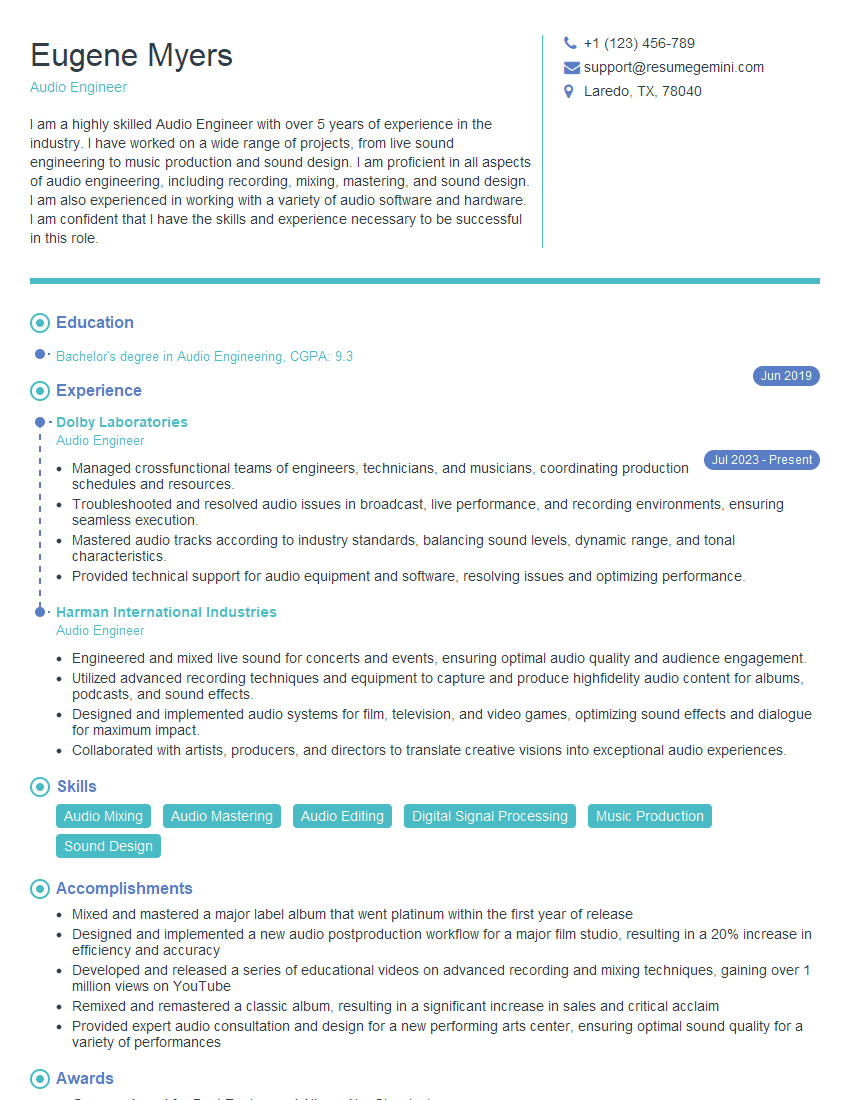
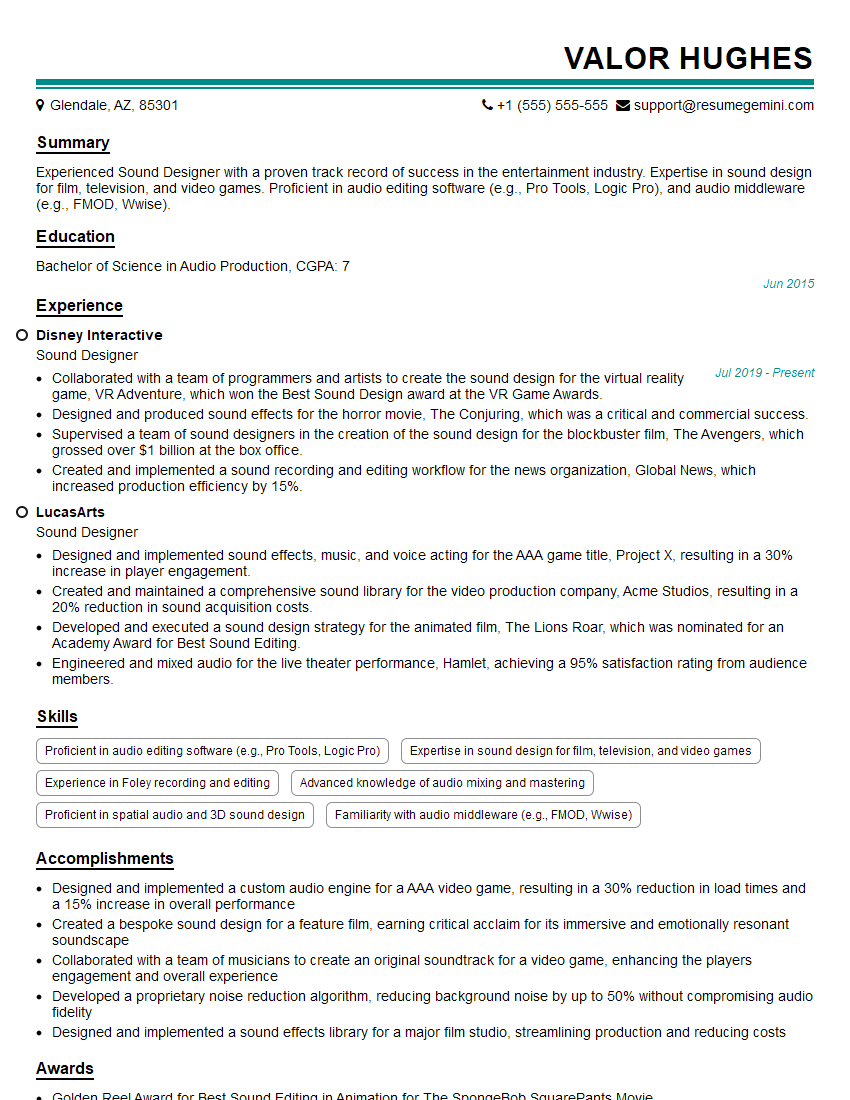
Mastering voice editing is crucial for career advancement in audio production, broadcasting, podcasting, and many other media-related fields. A strong skillset in voice editing opens doors to exciting opportunities and higher earning potential. To maximize your job prospects, create a compelling and ATS-friendly resume that highlights your skills and experience effectively. We highly recommend using ResumeGemini to build a professional resume tailored to the voice editing industry. Examples of resumes specifically designed for voice editing professionals are available to help you showcase your expertise effectively.
Explore more articles
Users Rating of Our Blogs
Share Your Experience
We value your feedback! Please rate our content and share your thoughts (optional).
What Readers Say About Our Blog
Very informative content, great job.
good