Interviews are more than just a Q&A session—they’re a chance to prove your worth. This blog dives into essential Wind Tunnel Test Planning interview questions and expert tips to help you align your answers with what hiring managers are looking for. Start preparing to shine!
Questions Asked in Wind Tunnel Test Planning Interview
Q 1. Explain the process of planning a wind tunnel test.
Planning a wind tunnel test is a meticulous process requiring careful consideration of numerous factors to ensure the test’s success and the reliability of the results. It’s like meticulously planning a complex scientific experiment – every detail matters.
The process typically involves these key steps:
- Defining Objectives: Clearly state the goals of the test. What aerodynamic characteristics are you aiming to measure? Are you testing for drag, lift, moments, or pressure distributions? For example, you might be testing a new aircraft wing design to optimize lift-to-drag ratio.
- Model Design and Scaling: Creating a scaled model of the object to be tested is crucial. This involves selecting an appropriate scale, ensuring geometric similarity and accounting for Reynolds number scaling. We’ll discuss Reynolds number in more detail in the next question.
- Wind Tunnel Selection: Choosing the right wind tunnel is paramount. Different tunnels are suited for different test types and scales (e.g., low-speed, high-speed, transonic, supersonic). The chosen tunnel should be large enough to accommodate the model and provide a sufficiently uniform flow field.
- Instrumentation and Data Acquisition: This involves selecting appropriate sensors (pressure transducers, load cells, hot-wire anemometers) and data acquisition systems to measure the desired aerodynamic quantities. A robust data acquisition plan is crucial for high-quality, reliable data.
- Test Matrix Design: This involves defining the range of test conditions (e.g., angles of attack, speeds, configurations). A well-designed test matrix ensures that sufficient data is collected to meet the objectives. For instance, you might test at multiple angles of attack to observe changes in lift and drag.
- Risk Assessment and Mitigation: Identifying potential problems (e.g., model failure, data corruption) and developing strategies to mitigate these risks is essential. For instance, a backup data acquisition system can be used to prevent data loss.
- Post-test Analysis Plan: Defining how the acquired data will be analyzed and interpreted before the test begins ensures efficient use of testing time and resources. The plan should include data validation and reduction techniques.
Q 2. How do you determine the required Reynolds number for a wind tunnel test?
The Reynolds number (Re) is a dimensionless quantity that describes the ratio of inertial forces to viscous forces in a fluid flow. It’s crucial in wind tunnel testing because it determines the flow regime (laminar or turbulent) around the model. Accurate scaling often requires matching the Reynolds number of the full-scale object in the wind tunnel test, a process known as Reynolds number similarity.
Determining the required Reynolds number involves several steps:
- Identify the full-scale Reynolds number: This is calculated using the full-scale object’s characteristic length (e.g., chord length for an airfoil), velocity, fluid density, and dynamic viscosity. The formula is:
Re = (ρVL)/μ, where ρ is density, V is velocity, L is characteristic length, and μ is dynamic viscosity. - Choose a wind tunnel and test conditions: The wind tunnel’s capabilities (maximum speed, test section dimensions) constrain the achievable Reynolds number. You must choose a wind tunnel and test conditions (velocity) that allow you to achieve a sufficiently high Reynolds number.
- Scale the model appropriately: If the wind tunnel can’t achieve the full-scale Reynolds number, the model may need to be scaled down. For example, if the full-scale Reynolds number is 10 million, but the wind tunnel only reaches 1 million at its highest speed, the model needs to be scaled to 1/10th its size. However, this may require considering other factors like model manufacturing constraints.
- Account for compressibility effects: At high speeds, compressibility effects become important and must be considered when determining the required Reynolds number. The Mach number (ratio of speed to sound speed) also plays a significant role in high-speed wind tunnel tests.
It’s important to note that perfectly matching the full-scale Reynolds number is often impractical. The goal is to achieve a sufficiently high Reynolds number to capture the dominant flow features of the full-scale object. Significant discrepancies could lead to inaccurate results, especially for flows susceptible to laminar-turbulent transition.
Q 3. Describe different types of wind tunnels and their applications.
Wind tunnels vary significantly in design and application, each suited for specific testing needs. Think of them as specialized tools, each designed for a particular job.
- Low-speed wind tunnels: These tunnels operate at speeds below the speed of sound (Mach number < 0.3). They are commonly used for testing aircraft, automobiles, and buildings. They're like the workhorses of the wind tunnel world, versatile and widely used.
- High-speed wind tunnels: These tunnels operate at supersonic (Mach number > 1) or hypersonic (Mach number >> 1) speeds. These are used for testing aerospace vehicles designed for high-speed flight. They are specialized facilities dealing with extreme conditions and require significant resources.
- Transonic wind tunnels: These tunnels operate in the transonic speed range (Mach number ≈ 1), where complex shock waves form. They are often used to test aircraft wings and bodies during the design process of supersonic aircraft.
- Atmospheric boundary layer wind tunnels: These tunnels are designed to simulate the flow of air near the Earth’s surface. They are used to study the impact of wind on structures like buildings and bridges. This is where you’d test the aerodynamic impact of a skyscraper design on its surrounding environment.
- Water tunnels: Instead of air, these tunnels use water as the working fluid. They are particularly useful for testing marine vehicles and underwater structures. You’d use this for testing the hydrodynamic characteristics of a submarine or an underwater turbine.
Q 4. What are the key considerations for model design and scaling in wind tunnel testing?
Model design and scaling are critical for accurate wind tunnel testing. It’s akin to creating a miniature but faithful replica of a real-world object for testing purposes. Geometric similarity is essential, meaning the model must have the same shape as the full-scale object, but at a smaller size.
Key considerations include:
- Geometric Similarity: The model must accurately represent the geometry of the full-scale object. Any deviations can lead to significant errors in the test results. Think of carefully crafting a scale model of an airplane — the wings, fuselage, and tail must have the correct proportions.
- Scale Selection: Choosing an appropriate scale balances practicality (e.g., model size, manufacturing cost) with the need to maintain Reynolds number similarity. A smaller scale model is often easier to build, but might necessitate higher wind tunnel speeds to maintain appropriate Reynolds number.
- Surface Finish: The model’s surface roughness must be carefully controlled, as it can significantly affect the aerodynamic characteristics. A smooth surface is usually preferred to minimize unwanted turbulent flow effects. This is particularly important for drag measurements.
- Model Construction Materials: The material should be chosen for its strength, stiffness, and low weight. Furthermore, its surface properties should be considered for their potential influence on the results. Aluminum or other lightweight materials are commonly used.
- Model Mounting: The method used to mount the model in the wind tunnel must minimize interference with the flow around it. Specialized support systems are commonly used to achieve minimal blockage effects and minimize interference with data measurements.
Q 5. How do you ensure accurate data acquisition during a wind tunnel test?
Accurate data acquisition is crucial for reliable results. It’s like capturing high-quality photographs in a photoshoot — you need the right equipment, the right lighting, and the right settings to avoid any issues.
Ensuring accurate data acquisition involves:
- Calibration of Instruments: All instruments (pressure transducers, load cells, anemometers) must be carefully calibrated before the test to ensure their accuracy. This is crucial to gain trustworthy data and must follow established protocols.
- Data Acquisition System: A high-quality data acquisition system capable of sampling data at a sufficiently high rate is required. It’s important to check the sampling rate and ensure it is sufficient for the particular experiment.
- Signal Conditioning: Signals from sensors often require conditioning (amplification, filtering) before being recorded. This is done to improve signal quality and minimize noise.
- Data Validation: Check the acquired data for outliers, noise, and other anomalies. This often involves applying data filtering techniques or averaging multiple measurements. Any unexpected values should be investigated.
- Redundancy: Using redundant sensors or data acquisition systems ensures that data loss does not occur if one component fails. A backup system is useful to prevent data loss due to equipment failure.
- Environmental Monitoring: Monitoring the wind tunnel’s environmental conditions (temperature, pressure, humidity) and documenting them as a part of the data acquisition process is needed to ensure repeatability and account for external factors that might have affected the results.
Q 6. Explain the importance of calibration in wind tunnel testing.
Calibration is essential in wind tunnel testing because it ensures the accuracy of the measurements. It’s like regularly calibrating a scale to guarantee the weight measurements are accurate – without calibration, your results are unreliable.
Calibration involves:
- Calibration of the wind tunnel itself: This involves verifying the uniformity of the flow in the test section and determining the relationship between the wind tunnel’s speed setting and the actual flow speed. A thorough calibration of the flow speed is needed. Any deviations from the expected behavior must be properly documented.
- Calibration of instruments: This involves verifying the accuracy and linearity of the sensors used in the test. Using standard equipment is essential to ensure the accuracy of the measurements.
- Calibration traceability: A chain of traceability to national or international standards should be established to ensure the reliability of the calibration results. Calibration certification documentation should be available and up to date.
- Regular Calibration: Calibration should be performed regularly (e.g., before and after each test run) to maintain accuracy. Frequencies may depend on usage and the possibility of drift.
Without proper calibration, the data obtained during a wind tunnel test is unreliable. Calibration ensures the quality and repeatability of the results.
Q 7. How do you handle unexpected issues or anomalies during a wind tunnel test?
Unexpected issues and anomalies during wind tunnel tests are common. It’s important to have a plan in place to deal with them effectively. It is like having a backup plan during a project launch – to deal with unexpected events and ensure a smooth operation.
Handling such situations involves:
- Troubleshooting: Identify the cause of the problem. This may involve examining the data, inspecting the model, or checking the wind tunnel’s systems. A systematic approach to troubleshooting can reduce downtime.
- Data Recovery: If possible, attempt to recover the lost or corrupted data. This might involve using redundant data acquisition systems or applying data recovery techniques. Always have a backup strategy in place.
- Model Repair or Replacement: If the model is damaged, it may need to be repaired or replaced. A proper diagnosis is needed to understand the need for model repair.
- Test Procedure Adjustment: Depending on the nature of the problem, the test procedure might need to be adjusted. For instance, reducing the test speed or changing the model configuration.
- Documentation: Meticulously document all unexpected issues, troubleshooting steps, and any changes made to the test procedure. The documentation is important for analysis and reporting. Transparency about issues and remedies is a must.
- Safety First: Prioritize safety. If a problem poses a safety risk, immediately stop the test and address the issue.
Q 8. Describe your experience with various data acquisition systems.
My experience encompasses a wide range of data acquisition systems used in wind tunnel testing. This includes both traditional systems relying on analog sensors and modern, high-speed digital systems. I’m proficient in using systems from various manufacturers, including but not limited to National Instruments (NI) systems utilizing LabVIEW, Beckman Coulter, and specialized wind tunnel specific systems. I’ve worked with systems capable of acquiring data from various sensors, such as pressure transducers (static, dynamic, and differential), load cells, accelerometers, hot-wire anemometers, and various optical sensors (e.g., PIV, Particle Image Velocimetry). A key aspect of my expertise lies in understanding the nuances of each system, including calibration procedures, sampling rates, signal conditioning, and data filtering techniques to ensure data accuracy and reliability. For example, during a recent project involving a model of a high-rise building, we used an NI data acquisition system with over 100 channels to simultaneously capture pressure data from numerous taps across the model’s surface. The successful integration of this complex system was critical in achieving the project’s objectives.
Understanding the limitations of each system is just as crucial. I’ve had to troubleshoot issues arising from sensor noise, aliasing, and synchronization problems, requiring in-depth understanding of signal processing and system diagnostics. My problem-solving skills allow me to identify the source of errors quickly and implement corrective actions, ensuring the validity of the acquired data.
Q 9. How do you ensure the safety of personnel and equipment during wind tunnel testing?
Safety is paramount in wind tunnel testing. My approach to ensuring safety involves a multi-layered strategy encompassing pre-test planning, rigorous safety protocols during testing, and post-test procedures. Before any test, a comprehensive risk assessment is conducted to identify potential hazards associated with the model, testing conditions, and equipment. This includes assessing the risk of model failure, the potential for high-velocity air streams, and the risk of injury from moving parts or electrical equipment. We develop detailed safety procedures based on this assessment. These procedures are reviewed and approved by a safety committee and communicated to all personnel involved in the test.
During the test, strict adherence to safety protocols is enforced. This includes the use of appropriate personal protective equipment (PPE), such as safety glasses, hearing protection, and specialized clothing. We use interlocks and emergency shut-off systems to prevent accidents. We also establish clear communication protocols between personnel to ensure that everyone is aware of the testing status and any potential hazards. For instance, I have worked on projects where we used a dedicated safety observer who monitors the test and has the authority to halt the test if any unsafe conditions arise. Post-test procedures involve careful inspection of the equipment and model to identify any damage or potential hazards.
Q 10. Explain your experience with post-processing and analysis of wind tunnel data.
Post-processing and analysis of wind tunnel data is a critical stage of any wind tunnel testing program. This involves a series of steps that transform raw data into meaningful engineering insights. My experience includes extensive work using various software packages to perform data cleaning, filtering, and validation. I regularly use Tecplot, EnSight, and ANSYS Fluent to visualize and analyze data from various wind tunnel tests. I have a strong understanding of signal processing techniques such as filtering and averaging to remove noise and extract relevant information from complex datasets.
For example, in analyzing data from a wind turbine test, I employed spectral analysis techniques using MATLAB to identify the dominant frequencies of blade vibration and correlate them to specific flow conditions. This type of analysis requires a deep understanding of both data analysis software and the underlying physical phenomena. My experience also covers advanced techniques like uncertainty analysis and error quantification. I create detailed reports that present the results clearly and concisely, using graphs, charts, and tables to illustrate key findings. These reports support the engineering conclusions, and often form the basis of design modifications or performance improvements.
Q 11. How do you identify and mitigate sources of error in wind tunnel measurements?
Identifying and mitigating sources of error is essential to obtain reliable wind tunnel results. Sources of errors can stem from various aspects of the testing process, including model imperfections, instrumentation errors, and tunnel interference effects. A methodical approach is key: we begin by understanding the potential sources of error before the test even starts. This involves careful model construction to minimize surface roughness and geometric imperfections. The instrumentation is meticulously calibrated, and the calibration uncertainty is accounted for in the final analysis. During the test, we take steps to minimize tunnel interference effects, such as using appropriate blockage corrections or employing techniques to reduce wall interference.
After the test, we carefully review the acquired data for any anomalies or inconsistencies. This might involve checking for unexpected spikes or drifts in the measurements. We employ statistical methods to identify outliers and assess the overall quality of the data. We utilize uncertainty quantification methods to estimate the uncertainty associated with the measurements and propagate this uncertainty to the final results. For example, during a test on an aircraft model, we identified a systematic bias in the pressure measurements due to a faulty pressure transducer. By identifying and correcting this error, we were able to obtain much more reliable aerodynamic data.
Q 12. What software and tools are you proficient in for wind tunnel data analysis?
My proficiency extends to several key software packages crucial for wind tunnel data analysis. I’m highly skilled in using Tecplot for visualization and analysis of 2D and 3D flow fields, including contour plots, streamlines, and vector plots. I utilize ANSYS Fluent for computational fluid dynamics (CFD) simulations to validate and complement experimental data. My expertise also includes MATLAB for advanced signal processing, statistical analysis, and custom data manipulation. EnSight provides robust capabilities for post-processing large datasets from complex wind tunnel experiments. I am also proficient in using data acquisition and control software such as LabVIEW. Finally, I am experienced with spreadsheet software like Microsoft Excel for data organization and basic statistical analysis. The selection of the software depends on the nature of the test and the specific type of analysis required. For instance, for complex turbulent flow analysis, I would prefer to use Tecplot and Fluent in combination.
Q 13. Describe your experience with uncertainty analysis in wind tunnel testing.
Uncertainty analysis is integral to any credible wind tunnel test. It provides a quantitative measure of the confidence we can have in our results. I follow established guidelines such as those provided by the AIAA (American Institute of Aeronautics and Astronautics) for conducting uncertainty analysis. This involves identifying all sources of uncertainty, quantifying their magnitudes, and propagating them through the analysis to determine the overall uncertainty in the final results. The sources of uncertainty include measurement errors, model imperfections, tunnel interference effects, and data processing errors.
For example, during an experiment, we might determine that the uncertainty in measuring the lift coefficient is ±2%. This uncertainty is a critical piece of information as it informs the interpretation of the results and guides design decisions. The process often involves using statistical methods such as Monte Carlo simulations to propagate the uncertainties. The final report includes a detailed description of the uncertainty analysis, clearly highlighting the potential impact of the uncertainties on the conclusions drawn from the experiment. Neglecting uncertainty analysis can lead to misleading results and costly design errors. Therefore, a rigorous approach is crucial to ensuring the reliability and credibility of the test results.
Q 14. How do you present and interpret wind tunnel test results effectively?
Effective presentation and interpretation of wind tunnel test results are crucial for conveying the findings to engineers and stakeholders. My approach prioritizes clarity, conciseness, and visual appeal. I utilize various presentation techniques to effectively communicate complex data, including graphs, charts, tables, and illustrations. I strive to avoid technical jargon wherever possible, ensuring that the results are accessible to a wide audience. A critical part of my process is to not just present the data but also to interpret its significance within the broader engineering context. This involves relating the results to the specific design goals and highlighting any implications for design modifications or performance improvements.
I create detailed reports that systematically present the test setup, procedures, results, and uncertainty analysis. I also include discussions that address the limitations of the test and potential areas for future investigation. For example, I might present aerodynamic coefficients with their associated uncertainties in graphical form and discuss the impact of these uncertainties on design decisions. Visual aids, such as flow visualizations or 3D models, can help greatly in conveying complex data. Ultimately, my goal is to make the results readily understandable and actionable for all stakeholders, leading to informed decisions.
Q 15. What are the limitations of wind tunnel testing?
Wind tunnel testing, while invaluable, isn’t without limitations. Think of it like a highly controlled experiment – it simplifies reality to make measurements possible. Some key limitations include:
- Scale Effects: Models are smaller than the full-scale object, leading to discrepancies in Reynolds number (a dimensionless quantity describing the ratio of inertial forces to viscous forces). This can affect aerodynamic behavior, particularly at lower speeds. For example, a small-scale aircraft model might not perfectly replicate the airflow separation characteristics of the full-size aircraft.
- Tunnel Wall Interference: The tunnel walls themselves can influence the airflow around the model, altering the results. Corrections are often applied, but they introduce uncertainties.
- Support Interference: The model needs to be supported within the tunnel, and these supports can disrupt the airflow. Clever design minimizes this, but it’s never completely eliminated. Think of trying to measure the wind around a weather vane while holding it – your hand affects the wind.
- Model Fidelity: Creating a perfect model is difficult and expensive. Simplifying assumptions are often made, which can impact accuracy. For instance, representing complex surface features like rivets or small control surfaces accurately can be challenging.
- Limited Operating Range: Wind tunnels have a limited range of operating conditions (speeds, angles of attack, etc.). Extrapolating results outside this range can be risky.
- Cost and Time: Wind tunnel testing can be expensive and time-consuming. Thorough testing requires careful planning and execution.
Career Expert Tips:
- Ace those interviews! Prepare effectively by reviewing the Top 50 Most Common Interview Questions on ResumeGemini.
- Navigate your job search with confidence! Explore a wide range of Career Tips on ResumeGemini. Learn about common challenges and recommendations to overcome them.
- Craft the perfect resume! Master the Art of Resume Writing with ResumeGemini’s guide. Showcase your unique qualifications and achievements effectively.
- Don’t miss out on holiday savings! Build your dream resume with ResumeGemini’s ATS optimized templates.
Q 16. How do you integrate wind tunnel results with CFD simulations?
Integrating wind tunnel results with CFD (Computational Fluid Dynamics) simulations is crucial for a robust aerodynamic design process. They complement each other. Think of it as having two powerful tools with slightly different strengths. Wind tunnel tests provide experimental validation in a realistic environment, while CFD simulations offer flexibility and detailed flow visualizations that are hard to get from experiments. The integration typically follows these steps:
- Validation: Initially, CFD simulations are validated against wind tunnel data. This helps in tuning the CFD model and ensuring its accuracy. We compare key parameters like lift, drag, and pitching moment coefficients from both sources.
- Refinement: Differences between the CFD and wind tunnel results are analyzed to identify potential sources of error in either the CFD model or the experimental setup. This might involve refining the mesh in the CFD simulation or reevaluating support interference effects in the wind tunnel.
- Extrapolation: CFD can then be used to explore design variations and conditions not feasible or economical to test in the wind tunnel. For example, simulating different flight conditions (altitude, speed) is much easier with CFD.
- Combined Analysis: Ultimately, a combined analysis of wind tunnel data and CFD results offers the most comprehensive understanding of the aerodynamic performance. This allows for a more informed design decision.
For example, during the design of a new aircraft wing, we’d use CFD to explore a wide range of design options. Then we would select a few promising designs for wind tunnel testing to validate the CFD predictions and to measure parameters that might be challenging to predict accurately with CFD alone.
Q 17. Describe your experience with different types of wind tunnel models (e.g., rigid, flexible).
My experience encompasses both rigid and flexible wind tunnel models. Rigid models are simpler to manufacture and test, suitable for initial aerodynamic investigations. However, flexible models are vital for assessing the effects of structural deformation on aerodynamic performance. Think of an aircraft wing flexing during flight – a rigid model can’t capture that.
- Rigid Models: These are typically made from materials like wood, aluminum, or carbon fiber composites. They provide accurate aerodynamic data for a specific configuration. I’ve used these extensively for testing various airfoils, vehicle components, and building structures.
- Flexible Models: These models incorporate flexible elements to simulate the deformation of the full-scale structure. This might involve using flexible materials or employing a system of actuators and sensors to control the model’s shape. They are more complex to build and test, requiring sophisticated instrumentation to measure both aerodynamic forces and structural deformations. I’ve worked on flexible models for aircraft wings, wind turbine blades, and tall buildings where aeroelastic effects are critical.
The choice between rigid and flexible models depends on the specific engineering objectives. If the goal is simply to understand the basic aerodynamic characteristics, a rigid model may suffice. If accurate prediction of aeroelastic effects are needed, a flexible model is essential.
Q 18. How do you manage and document wind tunnel test data?
Managing and documenting wind tunnel test data is paramount. Poor data management can lead to wasted resources and incorrect conclusions. My approach involves a systematic process:
- Data Acquisition System: Using a sophisticated data acquisition system (DAQ) to record all relevant parameters (pressure, forces, moments, flow velocity, etc.) with high precision and accuracy. The DAQ system is calibrated and regularly checked to ensure data reliability.
- Organized File Structure: All data is stored in a well-organized directory structure, with clear and consistent naming conventions. Metadata, including test conditions, model geometry, and instrumentation details, is meticulously documented for each test run.
- Database Management: Using a database management system (DBMS) to store and manage large amounts of data efficiently. This enables quick retrieval and analysis of specific datasets based on various test parameters.
- Version Control: Implementing version control for all data files and reports. This allows tracking of changes made to the data and ensures data integrity.
- Data Validation and Error Checking: Rigorous data validation checks and error detection techniques are applied to identify and correct potential errors or inconsistencies in the recorded data.
- Detailed Reports: Comprehensive reports are generated, containing processed data, graphs, charts, and a complete summary of findings and conclusions. These reports are reviewed and approved before dissemination.
This systematic approach ensures the long-term accessibility, integrity, and usability of the data, enabling effective analysis and interpretation of the results.
Q 19. Explain your experience with test matrix design and optimization.
Test matrix design and optimization are critical for efficient and effective wind tunnel testing. The goal is to extract maximum information with minimal test runs. It’s like planning a scientific experiment – you want to cover all the important variables systematically without wasting resources.
- Factorial Design: Often, a factorial design is employed to explore the effect of multiple parameters (e.g., angle of attack, Reynolds number, Mach number) on aerodynamic performance. This involves systematically varying each parameter across a range of values.
- Response Surface Methodology (RSM): RSM is a powerful statistical technique for optimizing experimental designs. It helps in identifying the optimal combination of parameters to achieve a desired outcome, such as minimizing drag or maximizing lift.
- Design of Experiments (DOE): DOE software tools are used to generate optimal test matrices, ensuring that the selected test points provide maximum information with minimal redundancy. This allows to effectively navigate the design space while controlling experimental error and reducing the number of necessary test runs.
For example, when testing an aircraft wing, we might use a fractional factorial design to explore the effects of angle of attack, flap deflection, and Mach number on lift and drag. RSM could then be employed to identify the optimal combination of these parameters for maximizing lift-to-drag ratio.
Q 20. How do you select appropriate instrumentation for a given wind tunnel test?
Selecting appropriate instrumentation for a wind tunnel test is crucial for obtaining accurate and reliable data. The choice depends heavily on the test objectives and the type of model being tested. Think of it like choosing the right tools for a job – you wouldn’t use a hammer to tighten a screw.
- Force and Moment Balances: These are used to measure the aerodynamic forces (lift, drag, side force) and moments (pitching moment, rolling moment, yawing moment) acting on the model. The choice depends on the size and weight of the model.
- Pressure Scanners: Used to measure the surface pressure distribution on the model. This data provides insights into the flow field and can be used to calculate aerodynamic forces and moments.
- Hot-wire Anemometry: This technique measures the local flow velocity and turbulence intensity using a heated wire. This is valuable for detailed flow field investigations.
- Particle Image Velocimetry (PIV): PIV provides non-intrusive flow field measurements. It involves seeding the flow with small particles and using lasers and cameras to capture their movement. PIV provides high-resolution velocity maps, giving a comprehensive understanding of the airflow around the model.
- Strain Gauges: Used to measure the strains and deformations in flexible models during aeroelastic tests.
In summary, the selection of instrumentation depends on the specifics of the test and should be carefully considered to ensure that the collected data is both comprehensive and reliable.
Q 21. What are the key factors to consider when selecting a wind tunnel for a specific application?
Selecting the right wind tunnel for a specific application is crucial, as different tunnels are optimized for different purposes. It’s like selecting the right car for a journey – a sports car isn’t suitable for off-roading. Key factors include:
- Test Section Size: The test section must be large enough to accommodate the model while minimizing tunnel wall interference. The size needs to correspond to the dimensions of the object under test.
- Velocity Range: The tunnel should be capable of producing the required flow velocities (speeds). This is determined by the flight conditions or flow speeds relevant to the application.
- Turbulence Intensity: Lower turbulence intensity is generally preferred, as it reduces the uncertainty in the measurements. The level of turbulence intensity required depends on the sensitivity of the aerodynamic characteristics being investigated.
- Type of Tunnel: Different tunnel types (e.g., low-speed, high-speed, transonic, supersonic) are designed for different flow regimes. The tunnel type is selected based on the speed range relevant to the application.
- Cost and Availability: The cost of renting or using a wind tunnel can vary significantly, and accessibility can be a constraint. These are important practical considerations in the selection process.
For example, testing a large-scale aircraft model would require a large low-speed wind tunnel. Testing a high-speed projectile would necessitate a supersonic wind tunnel. Careful consideration of these factors is essential for ensuring that the selected wind tunnel is suitable for the application and will yield reliable results.
Q 22. Describe your experience with wind tunnel facility maintenance and operations.
My experience with wind tunnel facility maintenance and operations spans over 15 years, encompassing various roles from junior technician to senior engineer. I’ve been involved in all aspects, from routine checks and calibrations to major overhauls and troubleshooting complex system failures. This includes familiarity with various wind tunnel types – from low-speed open-return tunnels to closed-circuit facilities and specialized configurations.
For example, in a recent project involving a low-speed wind tunnel, we identified a slight imbalance in the fan’s rotation, leading to minor turbulence in the test section. Through meticulous calibration and adjustment of the fan motor and associated components, we were able to restore the flow uniformity to within acceptable tolerances. This involved detailed analysis of pressure readings, velocity profiles, and turbulence intensity measurements. We also maintain comprehensive maintenance logs and documentation, adhering to strict safety protocols and regulatory guidelines.
My responsibilities also include overseeing the preventative maintenance schedules, ensuring the availability of spare parts, and managing a team of technicians who are responsible for the day-to-day operations of the facility. We use a Computerized Maintenance Management System (CMMS) to track maintenance activities, predict potential failures, and optimize resource allocation.
Q 23. How do you evaluate the quality of wind tunnel test data?
Evaluating the quality of wind tunnel test data is crucial for ensuring the accuracy and reliability of aerodynamic predictions. It’s a multi-faceted process that goes beyond simply looking at the raw data. We assess the quality using several key indicators.
- Data repeatability and consistency: Multiple test runs under identical conditions should yield similar results. Significant deviations suggest potential problems with the setup, instrumentation, or even the model itself. We statistically analyze the data to quantify repeatability.
- Flow quality in the test section: Turbulence, flow uniformity, and freestream velocity are checked to ensure they meet the required specifications for the test. We use various techniques such as hot-wire anemometry and pressure taps to assess flow quality.
- Instrumentation accuracy and calibration: All instruments – such as pressure transducers, load cells, and hot-wire anemometers – must be regularly calibrated to ensure their accuracy. Traceability to national standards is essential. We employ rigorous calibration procedures and maintain detailed calibration records.
- Model integrity: The model’s surface finish, proper mounting, and any potential interference from support structures can affect the data quality. Thorough inspection before, during, and after tests is critical.
- Data reduction and processing techniques: Appropriate methods for filtering noise, removing outliers, and applying corrections are crucial for accurate analysis. We use validated data reduction software and follow established industry best practices.
For example, if we notice an unusually high level of scatter in the lift coefficient data, we might investigate the model’s mounting, the flow quality, or the instrument calibration to identify the root cause. Any anomalies need thorough investigation before accepting the data as valid.
Q 24. Explain your experience with troubleshooting wind tunnel equipment malfunctions.
Troubleshooting wind tunnel equipment malfunctions requires a systematic and methodical approach. My experience includes diagnosing and resolving issues related to various systems, including the wind tunnel’s drive system, control systems, data acquisition systems, and instrumentation.
A recent example involved a sudden drop in the wind tunnel’s speed during a test run. My initial steps included:
- Identifying the problem: Analyzing the error messages from the control system and observing the tunnel’s behavior provided initial clues.
- Systemic checks: We systematically checked all the components in the drive system – the motor, gearbox, and power supply – using established diagnostic tools and procedures.
- Data review: We reviewed historical data from the tunnel’s control system to check for patterns or prior instances of similar issues.
- Isolate the fault: This step led us to a faulty bearing in the gearbox, causing increased friction and power loss.
- Repair or replacement: The gearbox underwent repair or if necessary, was replaced with a spare.
- Verification: After repair, we performed multiple test runs to verify the resolution of the issue.
This systematic approach, combined with knowledge of the wind tunnel’s design and operation, allowed for quick identification and rectification of the problem, minimizing downtime and project delays. Collaboration with the manufacturer’s technical support was also vital in this instance.
Q 25. Describe your approach to developing a test plan for a complex aerodynamic design.
Developing a test plan for a complex aerodynamic design requires careful consideration of numerous factors. My approach is structured and iterative, focusing on clarity, completeness, and efficiency.
- Define objectives and scope: Clearly state the aerodynamic goals of the test, specifying the data needed to achieve those goals. This involves identifying the range of angles of attack, Reynolds numbers, Mach numbers, and other relevant parameters.
- Model design and fabrication: The model must accurately represent the design’s key features, yet be robust enough to withstand the wind tunnel environment. This involves considerations about the model’s material, surface finish, and mounting system.
- Instrumentation selection: Choose the appropriate sensors based on the test objectives. This may involve pressure taps, force balances, hot-wire anemometry, or Particle Image Velocimetry (PIV) depending on the complexity of the flow field.
- Test matrix design: Create a detailed matrix defining all the test conditions, including angles of attack, Reynolds numbers, and any other relevant variables. This should optimize the test time while ensuring adequate data coverage.
- Safety and risk assessment: Identify potential hazards and implement appropriate safety procedures. This is crucial in preventing accidents and ensuring the safety of personnel and equipment.
- Data acquisition and analysis plan: Outline the procedures for data acquisition, validation, processing, and analysis. This includes specifying the data acquisition system, software, and relevant post-processing techniques.
- Iterative refinement: The plan is not set in stone. After initial tests, it might be necessary to refine the test matrix or adjust the instrumentation based on the preliminary results.
For instance, when testing a novel aircraft configuration, we might start with basic force and moment measurements at a range of angles of attack. Preliminary results might then lead us to perform detailed flow visualization experiments to understand complex flow phenomena like vortex shedding. This iterative approach allows for a flexible and adaptive testing strategy.
Q 26. How do you manage the budget and timeline for a wind tunnel testing project?
Managing the budget and timeline for a wind tunnel testing project involves careful planning and proactive monitoring. We use a combination of techniques to maintain control.
- Detailed cost estimation: A thorough breakdown of all costs is prepared before the project starts, including model fabrication, tunnel time, instrumentation, personnel costs, data analysis, and reporting. Contingency funds are always included to account for unexpected issues.
- Realistic scheduling: The timeline should be realistically developed, taking into account potential delays and unforeseen circumstances. Critical path analysis is employed to identify potential bottlenecks.
- Regular progress monitoring: The project’s progress is tracked closely against the schedule and budget. Regular meetings are held to review the progress, identify potential problems, and make necessary adjustments. Project management software is often utilized for this purpose.
- Effective communication: Maintaining open communication with all stakeholders – clients, engineers, and technicians – is essential to ensure that everyone is aware of the project’s status and any potential challenges. This proactive communication approach prevents conflicts and facilitates a coordinated response to unforeseen issues.
- Risk management: A risk assessment is conducted to identify potential risks that could impact the budget or timeline. Mitigation strategies are developed for each identified risk.
For example, if a model needs significant rework, we would evaluate the impact on the timeline and budget, communicate the change to stakeholders, and explore alternative solutions to minimize delays and cost overruns.
Q 27. How do you communicate effectively with engineers, technicians, and management during a wind tunnel test?
Effective communication is crucial for the success of a wind tunnel test. I use a multi-pronged approach:
- Pre-test briefing: A detailed briefing is given to all team members before the start of the test, outlining the objectives, procedures, and safety protocols. This ensures everyone is on the same page and understands their roles.
- Clear and concise instructions: During the test, instructions are given clearly and concisely to minimize misunderstandings and ensure efficient workflow. This includes clear communication between the test engineer, technicians operating the tunnel and data acquisition systems, and any other supporting staff.
- Regular updates: Regular updates on the test’s progress, any encountered issues, and any changes to the plan are communicated to all stakeholders. This maintains transparency and prevents miscommunication.
- Constructive feedback: A positive and collaborative environment is maintained to encourage feedback and suggestions from all team members. This helps identify potential problems early and promotes a sense of shared responsibility.
- Documentation: Meticulous documentation of all procedures, observations, and results is maintained. This serves as an invaluable resource for troubleshooting, future reference, and reporting.
For instance, during a particularly complex test, involving several different measurement techniques, I utilize a combination of verbal instruction, visual aids such as diagrams and checklists, and regular feedback sessions to ensure that the entire team has a solid understanding of each step of the process. This minimizes errors and increases overall efficiency.
Q 28. What is your experience with reporting and presenting results from wind tunnel testing to stakeholders?
Reporting and presenting results from wind tunnel testing requires a clear and concise presentation of complex data. My experience involves creating comprehensive reports and delivering presentations to a variety of audiences, ranging from technical experts to non-technical stakeholders.
My approach involves:
- Data visualization: Using graphs, charts, and images to present the data in a visually appealing and easily understandable manner. This includes appropriate use of color coding, labeling, and legends to facilitate clear data interpretation.
- Clear and concise writing: Reports are written in a clear, concise, and accessible style, avoiding technical jargon where possible. A summary of key findings is presented upfront, followed by a detailed explanation of the methodology and results.
- Contextualization: The results are presented within the broader context of the design’s objectives and the project’s goals. This helps stakeholders understand the significance of the findings and their implications for the overall design.
- Uncertainty analysis: An analysis of the uncertainty associated with the measurements and the results is included to provide a measure of confidence in the findings. This ensures transparency and credibility.
- Recommendations: Based on the results, clear recommendations are provided to guide future design iterations or decision-making. This provides actionable insights to guide further development.
For example, when presenting results to a non-technical audience, I use visual aids and analogies to explain complex aerodynamic concepts. When presenting to technical experts, I provide detailed analysis and address potential limitations of the testing methodology. The adaptation of the presentation style to the audience is crucial for effective communication.
Key Topics to Learn for Wind Tunnel Test Planning Interview
- Test Objectives and Scope Definition: Understanding how to clearly define the goals of a wind tunnel test and the parameters to be investigated. This includes identifying key performance indicators (KPIs) and establishing measurable success criteria.
- Model Design and Manufacturing: Knowledge of the process involved in creating accurate and representative models for wind tunnel testing, considering scaling factors, material selection, and surface finish.
- Instrumentation and Measurement Techniques: Familiarity with various measurement techniques (pressure, force, velocity) and the associated instrumentation (pressure taps, load cells, hot-wire anemometry). Understanding data acquisition systems and their limitations is crucial.
- Test Setup and Procedures: Developing detailed test plans outlining the sequence of tests, the required equipment, safety protocols, and data recording procedures. This includes understanding the importance of repeatability and accuracy.
- Data Analysis and Interpretation: Proficiency in analyzing collected data, identifying trends, and drawing meaningful conclusions. This involves applying statistical methods and understanding potential sources of error.
- Uncertainty Analysis and Error Mitigation: Understanding the sources of uncertainty in wind tunnel testing and employing appropriate techniques to minimize their impact on the results. This includes identifying systematic and random errors.
- Report Writing and Presentation: Communicating test results effectively through clear and concise technical reports and presentations. This involves visualizing data, drawing relevant conclusions, and making recommendations based on the findings.
- Computational Fluid Dynamics (CFD) Integration: Understanding the role of CFD simulations in complementing and validating wind tunnel test results. This involves appreciating the strengths and limitations of both methods.
Next Steps
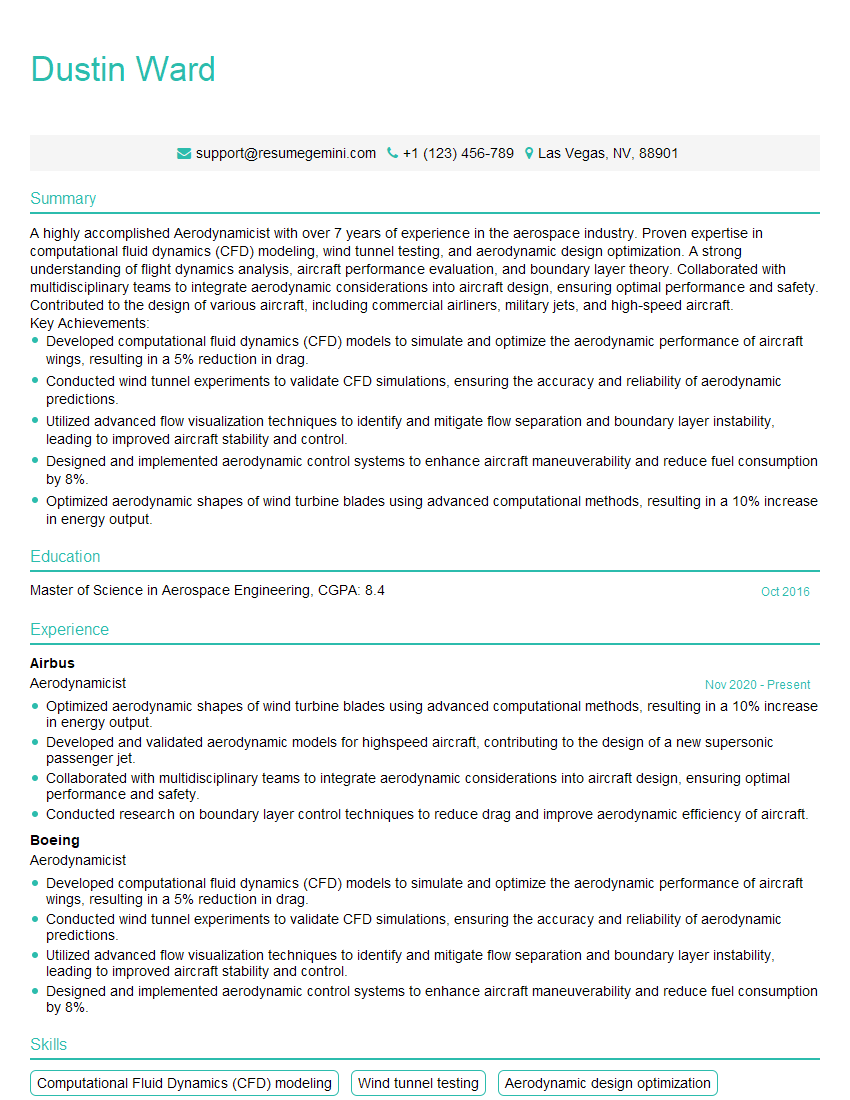
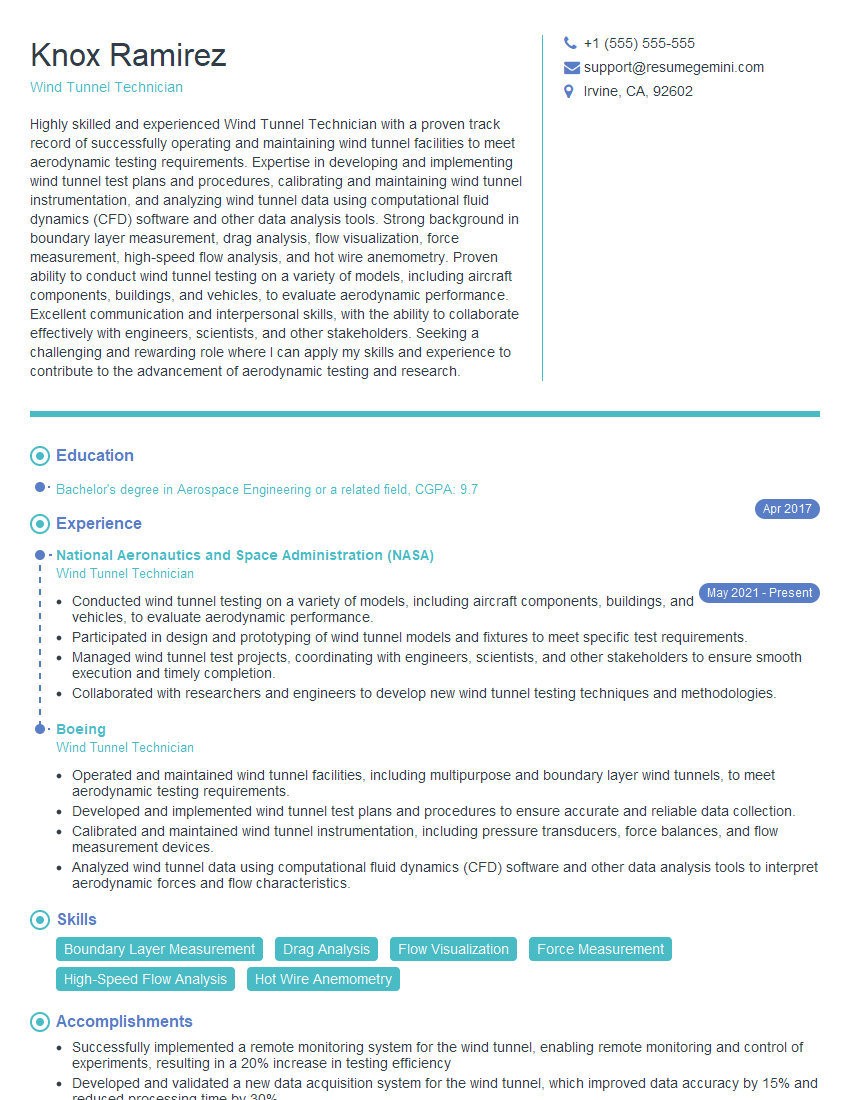
Mastering Wind Tunnel Test Planning is essential for career advancement in aerospace engineering and related fields. A strong understanding of these principles demonstrates a commitment to detail, problem-solving, and technical expertise – highly valued qualities in the industry. To enhance your job prospects, creating an ATS-friendly resume is crucial. ResumeGemini is a trusted resource to help you build a professional and impactful resume that highlights your skills and experience. We provide examples of resumes tailored to Wind Tunnel Test Planning to help you get started. Take the next step towards your dream career today!
Explore more articles
Users Rating of Our Blogs
Share Your Experience
We value your feedback! Please rate our content and share your thoughts (optional).
What Readers Say About Our Blog
Very informative content, great job.
good