Feeling uncertain about what to expect in your upcoming interview? We’ve got you covered! This blog highlights the most important Wood Fencing interview questions and provides actionable advice to help you stand out as the ideal candidate. Let’s pave the way for your success.
Questions Asked in Wood Fencing Interview
Q 1. What types of wood are best suited for fence construction in different climates?
Choosing the right wood for your fence depends heavily on your climate. Different species offer varying degrees of rot resistance, insect resistance, and overall durability. Think of it like choosing the right clothing for different weather conditions – you wouldn’t wear a swimsuit in a blizzard!
- Hot, Humid Climates: In areas with high humidity and rainfall, you’ll want a naturally rot-resistant wood like cedar, redwood, or treated pine. These woods are less prone to decay and insect infestation in these challenging conditions. Cedar, for instance, contains natural oils that act as a preservative.
- Dry, Arid Climates: While rot might be less of a concern in dry climates, wood can still be susceptible to cracking and warping due to fluctuating temperatures and moisture levels. Here, pressure-treated lumber is a good choice, as the treatment helps prevent damage from both insects and moisture variations. Even hardwoods like locust or oak can perform well, but will require proper sealing to minimize cracking.
- Cold Climates: In cold, snowy regions, the main concern is frost heave (the ground expanding and contracting with freezing and thawing) which can disrupt the fence’s foundation. Pressure-treated lumber is highly recommended, as its durability helps withstand these forces. Additionally, ensure you use proper post hole depths and consider using frost protection measures like gravel at the bottom of the post holes.
Ultimately, consulting a local lumber yard is key. They’ll know what species are readily available and best suited to the specific conditions in your area.
Q 2. Describe the process of setting fence posts.
Setting fence posts is crucial for a strong and lasting fence. Imagine building a house on a weak foundation – it won’t stand! The process involves several key steps:
- Digging the Holes: Use a post hole digger to create holes at least a third of the post’s length deep (or deeper, depending on soil type and local frost line). The deeper, the more stable your fence will be.
- Setting the Posts: Place each post in the hole, ensuring it’s plumb (perfectly vertical) using a level. Temporarily brace the post to hold it in place. You might use rocks or a temporary support.
- Adding Gravel (Optional): A layer of gravel at the bottom of the hole improves drainage and helps prevent settling.
- Backfilling: Fill the hole around the post with gravel or a concrete mix. Compact the material firmly to prevent settling and provide a strong foundation. For a more robust and long-lasting fence, concrete is recommended, especially in unstable soil.
- Checking Level and Plumb: Once the concrete sets (or the soil is compacted), re-check the level and plumb of each post. Make any necessary adjustments.
Using a post level and plumb bob during this process is essential to guarantee a straight fence.
Q 3. Explain different fence styles and their respective applications.
Fence styles vary widely, each with its own strengths and applications. Consider it like choosing the right tool for the job – a screwdriver isn’t ideal for hammering nails.
- Privacy Fence: Solid, vertical boards provide maximum privacy. Ideal for backyard boundaries, creating secluded areas, or screening unsightly views. Commonly made of close-set boards.
- Picket Fence: A classic, charming style with spaced vertical pickets. Offers some privacy but allows for light and air to pass through. Perfect for decorative purposes and creating a welcoming feel.
- Split-Rail Fence: A rustic, traditional style using horizontal rails. Provides minimal privacy but is great for defining property lines in open spaces and adds a rural aesthetic.
- Shadowbox Fence: A privacy fence with boards overlapping, creating a visual barrier with slight gaps between each board. Offers more privacy than a picket fence but allows for some ventilation.
- Board-on-Board Fence: Similar to a privacy fence, but more sturdy because of the double layer of vertical boards. This creates a more substantial looking and durable fence.
The best style depends on your needs, budget, and aesthetic preferences. Think about the level of privacy you need, the overall look you want, and the maintenance you’re willing to undertake.
Q 4. How do you ensure proper fence alignment and leveling?
Ensuring proper alignment and leveling is key to a professional-looking and structurally sound fence. It’s like building a straight wall – if it’s not level, it’ll look crooked and potentially unstable. Here’s how:
- String Line: Use a string line stretched between the end posts to establish a perfect straight line along which you can place your other posts.
- Level: Use a level on each post to ensure they’re perfectly vertical (plumb) and that the fence’s height remains consistent. Make any necessary adjustments by adding or removing soil or concrete before it sets.
- Post-Spacing: Maintain consistent spacing between posts. This ensures a uniform look and provides the right support for the fence rails and boards.
- Measuring and Checking: Regularly check the string line and level throughout the installation process to maintain accuracy.
Consistent checking and adjustments throughout the process ensure a straight, level fence that will last.
Q 5. What are the common problems encountered during fence installation?
Several common problems can arise during fence installation. Being prepared for them can save you time, frustration, and money.
- Uneven Terrain: Dealing with slopes and uneven ground requires additional planning and techniques, like adjusting post depths or using steps.
- Incorrect Post Placement: Failing to correctly level and plumb the posts can lead to a crooked or unstable fence.
- Poor Material Quality: Using low-quality wood or materials can result in premature rot, warping, or damage.
- Improper Fastening: Using inadequate fasteners or improper techniques can weaken the fence structure.
- Weather Conditions: Unexpected rain or extreme temperatures can impact the installation process and the longevity of the fence.
Careful planning, preparation, and attention to detail during each step helps mitigate these issues.
Q 6. How do you address uneven terrain during fence construction?
Uneven terrain presents a challenge, but it’s solvable. The goal is to create a level fence even on a sloping surface. Think of it like building steps on a hillside, but for your fence.
- Step-Down Method: For moderate slopes, you can create steps, setting posts at different heights to achieve a level fence along each horizontal section. This will create a stepped look, which can be visually appealing depending on the style of your fence.
- Varying Post Depths: Adjust the depth of the post holes to compensate for the slope. Deeper holes are needed on the higher side of the slope to keep the fence rails level.
- Use of Post Bases: Consider using adjustable post bases or concrete footings to level individual posts on uneven ground.
- Cutting Posts: In some cases, you may need to cut posts to different lengths to achieve level rails.
Careful surveying of the land before starting the installation is essential to determining the best approach for your specific situation.
Q 7. Describe your experience with different types of fence gates.
I’ve worked with a variety of fence gates, each suitable for different applications and aesthetic preferences. It’s like choosing the right door for a house – a sliding barn door isn’t ideal for a small apartment.
- Swing Gates: These are the most common type, swinging open on hinges. They can be either single or double, with the latter providing wider openings. They are simple and generally easy to install but require enough space to swing fully open.
- Sliding Gates: These slide along a track, making them ideal for limited space. They are more complex to install, requiring a well-built track system and often need additional hardware. They’re also generally more expensive.
- Walk-Through Gates: Smaller gates designed for pedestrian access. Often integrated into a larger fence. They are commonly used with a separate vehicle gate and are usually simpler to build and install.
- Arched Gates: These add a decorative touch. They are more intricate to build and require special considerations during construction to ensure their structural integrity.
The choice depends on factors like available space, the weight of the gate, and the overall design of the fence.
Q 8. How do you calculate the materials needed for a fence project?
Calculating materials for a wood fence requires meticulous planning. It’s not just about the length of the fence; you need to factor in post spacing, gate dimensions, and even waste. I start by carefully measuring the perimeter of the area to be fenced. Then, I determine the post spacing – typically 6 to 8 feet apart, depending on the height and type of fence. This spacing determines the number of posts needed. Next, I calculate the length of the rails needed, considering the number of horizontal rails and their length. For example, a 100-foot fence with 8-foot post spacing will require approximately 13 posts (100ft / 8ft ≈ 13). If using 8-foot rails, you’ll need approximately 12 rails (assuming two rails per section). Finally, I calculate the amount of fencing boards needed, considering overlaps and waste (usually adding 10-15%). I always overestimate slightly to account for imperfections or unexpected issues. I use a spreadsheet to organize this calculation and provide a detailed materials list to the client.
Example: Let’s say we’re building a 50-foot fence with 6-foot post spacing and using 6-foot long rails (two rails per section). We’ll need approximately 9 posts (50ft / 6ft ≈ 9), and 8 sets of rails (approximately 16 rails). Adding in the boards and accounting for waste, the final materials list would be far more extensive, detailing quantity, dimensions and type for each item.
Q 9. What safety precautions do you take during fence construction?
Safety is paramount in fence construction. Before starting any project, I always conduct a thorough site survey to identify potential hazards like underground utilities, uneven terrain, and obstacles. I then ensure I have all the necessary personal protective equipment (PPE), including safety glasses, gloves, steel-toe boots, and a hard hat. When using power tools, I always follow the manufacturer’s instructions and use appropriate safety guards. I also emphasize safe digging practices, using a call-before-you-dig service to locate underground utilities and avoiding digging near power lines. Working at heights requires extra caution; I utilize scaffolding or ladders safely, always maintaining three points of contact. Finally, I ensure the work area is kept clean and organized to minimize trip hazards. A clear communication system with my team is vital to ensure everyone is aware of potential risks.
Q 10. Explain your experience with post-hole diggers and augers.
I’ve extensive experience with both post-hole diggers and augers. Post-hole diggers are excellent for quick and efficient digging in softer soils, especially for larger projects. Augers are more versatile, capable of handling various soil conditions including rocky or hard-packed earth. However, they require more physical effort, especially for larger-diameter holes. My choice of tool depends on the soil type and project scale. For example, in a large project with mostly clay soil, I would prefer a post-hole digger, while a rocky area would demand an auger. I’m proficient in using both manually operated and power-driven versions of both tools. I always prioritize safe operation and regular maintenance to ensure optimal performance and longevity of the equipment.
Q 11. How do you handle customer complaints or issues during a project?
Handling customer complaints is a crucial part of the job. My approach is proactive and focused on resolution. I always listen attentively to the customer’s concerns, showing empathy and understanding. I then thoroughly investigate the issue, making sure to identify the root cause. This may involve examining the work completed or reviewing the initial project plans. Once the cause is identified, I discuss potential solutions with the customer, focusing on what is feasible and fair. Transparency is vital – I keep the customer informed every step of the way, providing realistic timelines for addressing the issues. In situations requiring further work, I make sure the corrections are completed to the customer’s satisfaction. I always strive to turn negative experiences into opportunities to improve my services and build trust.
Q 12. What is your experience with different types of fence fasteners?
My experience encompasses a wide range of fence fasteners, each with its own strengths and weaknesses. I regularly use galvanized nails for securing fence boards, choosing the appropriate size and gauge for the wood thickness. For added strength and longevity, I also utilize screws, particularly deck screws which are designed for outdoor use and resistance to rot. For posts and rails, I often use post anchors and lag bolts to ensure robust connections. When working with specific fence styles, such as those with decorative features, I might utilize specialized fasteners like ring-shank nails or specialized screws for superior hold. The selection of fastener always depends on the type of wood, the fence design, and the local climate. For example, in areas with high humidity, I would opt for corrosion-resistant fasteners to prevent premature failure.
Q 13. How do you maintain the quality of your work throughout a project?
Maintaining consistent quality throughout a project involves a multi-faceted approach. I start by using high-quality materials, sourced from reputable suppliers. Precise measurements and careful planning are crucial to minimize waste and ensure a seamless fit. I follow established construction techniques and regularly inspect my work to identify and correct any errors or imperfections early on. Clear communication with my team is key to ensuring everyone is on the same page, understands the standards, and performs their tasks to a high level. I also incorporate regular quality checks throughout the construction process, using checklists and visual inspections to ensure adherence to the project specifications and client expectations. Finally, a thorough final inspection ensures the fence is structurally sound, aesthetically pleasing, and meets the agreed-upon standards.
Q 14. Describe your process for repairing damaged fence sections.
Repairing damaged fence sections requires careful assessment of the damage before commencing any repair work. First, I identify the cause of damage – whether it’s due to weather, vandalism, or other factors. Then, I carefully remove the damaged section, making sure to preserve as much of the surrounding structure as possible. This may involve removing boards, posts or rails. New materials, matching the existing fence in style and color, are carefully cut and prepared for installation. Using appropriate fasteners, I securely attach the new section, ensuring a snug and stable fit. Finally, I perform a thorough inspection to confirm the repair is structurally sound and aesthetically consistent with the rest of the fence. For extensive repairs, or if multiple sections are damaged, a complete section replacement might be more suitable, or even complete fence reconstruction might be the best option depending on the extent of the damage.
Q 15. What tools and equipment are essential for efficient fence construction?
Efficient wood fence construction relies on the right tools. Think of it like baking a cake – you need the right ingredients and utensils for a perfect result. For post-hole digging, a post hole digger (manual or power auger) is essential for speed and accuracy. A level is crucial for ensuring straight, plumb posts. For cutting lumber, a circular saw or miter saw provides precise cuts. You’ll also need a post-pounder or sledgehammer to set posts, measuring tape for accurate dimensions, safety glasses and work gloves for protection, and a shovel for backfilling.
- Power Auger: Significantly speeds up post-hole digging, especially in challenging soil.
- Level: Essential for perfectly straight fence lines and preventing leaning posts, impacting both aesthetics and structural integrity.
- Circular Saw/Miter Saw: Allows for accurate cutting of fence rails and boards.
- Post Pounder/Sledgehammer: Essential for firmly setting fence posts, preventing future movement.
Beyond these basics, clamps are invaluable for assembling sections, and a nail gun or hammer significantly accelerates the fastening process. Having the right tools not only increases efficiency but also ensures a professional finish and minimizes the risk of injury.
Career Expert Tips:
- Ace those interviews! Prepare effectively by reviewing the Top 50 Most Common Interview Questions on ResumeGemini.
- Navigate your job search with confidence! Explore a wide range of Career Tips on ResumeGemini. Learn about common challenges and recommendations to overcome them.
- Craft the perfect resume! Master the Art of Resume Writing with ResumeGemini’s guide. Showcase your unique qualifications and achievements effectively.
- Don’t miss out on holiday savings! Build your dream resume with ResumeGemini’s ATS optimized templates.
Q 16. How do you deal with difficult soil conditions during post installation?
Difficult soil conditions, like rocky ground or clay, present significant challenges during post installation. Imagine trying to hammer a nail into a rock – it’s nearly impossible! The solution is strategic preparation and the right techniques. For rocky soil, pre-drilling holes with a power auger can help break up the rock and make it easier to set the posts. Alternatively, you might need to carefully remove rocks around the hole to create a stable base.
For clay, which can be very hard and compact, adding water to soften the soil around the post hole can help. This makes it easier to set the post straight. If the soil is extremely unstable, you may even consider using concrete to set the posts, providing a firm foundation that will prevent settling.
Sometimes, the use of specialized equipment like a hydraulic post driver becomes necessary to overcome extremely challenging conditions, ensuring posts are properly set and aligned even in unyielding terrain. Remember, proper post installation is critical for the long-term stability of the entire fence.
Q 17. How do you ensure the longevity and durability of your fence constructions?
Longevity and durability in fence construction involve careful planning and execution. Think of it as building a house – a strong foundation and quality materials are key. Starting with properly treated lumber is crucial; pressure-treated lumber provides excellent resistance to rot and insect damage. Choosing the right type of lumber based on the climate and environment is also important. Using galvanized or stainless steel fasteners prevents corrosion and ensures long-lasting connections.
Proper post installation, as discussed earlier, is paramount. Posts that are not set correctly will lead to a leaning or unstable fence. A well-designed fence also incorporates proper spacing and bracing to ensure structural integrity. Regular maintenance, such as staining or sealing the wood every few years to protect it from the elements, further enhances its lifespan. Finally, correct alignment and level installation dramatically reduce future maintenance and ensure the longevity of the fence.
Q 18. Describe your experience with pressure-treated lumber.
Pressure-treated lumber is a staple in my work. It’s essentially wood that has been treated with chemicals under pressure to protect it from rot, decay, and insect infestation. I frequently specify ground contact pressure-treated lumber for fence posts and boards that are directly in contact with the soil, maximizing their lifespan. The choice of pressure treatment depends on the specific needs of the project and local regulations. For example, I would generally avoid using chromated copper arsenate (CCA) treated lumber due to environmental concerns, opting instead for environmentally friendlier alternatives.
My experience has shown that while pressure-treated lumber is more durable and requires less maintenance than untreated lumber, it’s not indestructible. Proper installation, attention to detail, and regular maintenance are still essential to maximize its lifespan. I’ve learned to always inspect the lumber for any defects before using it and carefully follow manufacturers’ recommendations for storage and handling.
Q 19. What are the common building codes and regulations related to fence construction?
Building codes and regulations regarding fence construction vary significantly by location. It’s crucial to familiarize oneself with the local codes before starting any project. Common regulations often cover aspects like fence height, setback requirements from property lines, materials allowed, and structural integrity. For example, some areas may have height restrictions, particularly near airports or roadways. Others may specify the minimum distance a fence must be from a property line. Permitting requirements also often exist for projects above a certain size or height.
Ignoring these regulations can lead to fines or even the need to dismantle the fence. Always check with your local building department or a qualified professional to ensure compliance and prevent future complications. They can also provide valuable guidance on site-specific considerations.
Q 20. Explain your knowledge of different fence treatments and finishes.
Numerous fence treatments and finishes are available, each impacting the fence’s appearance and longevity. Think of it like choosing paint for your house – different finishes offer varied protection and aesthetics. Common treatments include pressure treatment (as discussed earlier), which protects against rot and insects. Exterior-grade stains offer both UV protection and aesthetic enhancement, improving the fence’s color and appearance.
Sealants provide water resistance, preventing moisture damage. Paints offer a similar level of protection and a wider range of color options. The choice of treatment depends on factors like climate, budget, and aesthetic preferences. For example, in a humid climate, a water-resistant sealant is especially important. A highly visible area might necessitate a stain or paint that complements the surrounding landscape.
Q 21. How do you manage a team during a large-scale fence project?
Managing a large-scale fence project effectively requires clear communication, detailed planning, and a well-defined workflow. Think of it as orchestrating a symphony – each section needs to be coordinated flawlessly for a harmonious result. I start by clearly defining roles and responsibilities for each team member. This could involve designating individuals for digging post holes, others for setting posts, and yet others for installing rails and boards.
A detailed schedule, including daily and weekly milestones, ensures the project stays on track. Regular check-ins and team meetings help to identify and address any potential issues promptly. Maintaining open communication and addressing concerns proactively prevents small problems from escalating into major delays. I encourage open feedback and collaboration, creating a positive and productive work environment. Successful project management often involves anticipation and preparedness for unforeseen obstacles.
Q 22. How do you handle unexpected challenges or changes during a project?
Unexpected challenges are par for the course in fence construction. My approach centers on proactive planning and flexible problem-solving. Before starting any project, I conduct a thorough site assessment, identifying potential obstacles like underground utilities, difficult terrain, or existing structures. This helps prevent surprises. If unforeseen issues arise—say, encountering a rock during post-hole digging—I immediately reassess the situation. I communicate transparently with the client, exploring solutions together. Options might range from adjusting the fence line slightly to employing specialized equipment. For instance, a large boulder could necessitate using a rock auger instead of a post-hole digger. Documentation is key; I meticulously record all changes and their justifications, ensuring the final product aligns with the client’s vision and the initial plan (with necessary modifications clearly documented).
Ultimately, my goal is to maintain project integrity and client satisfaction, even when faced with the unexpected. A recent project involved a significant change in soil conditions halfway through. Instead of panicking, we opted for a slightly different post-setting method to ensure stability, keeping the client fully informed and involved in the decision-making process.
Q 23. Describe your experience with various fence designs (e.g., picket, privacy, split rail).
My experience encompasses a broad range of fence designs. I’m proficient in constructing picket fences, known for their classic charm and versatility; privacy fences, offering seclusion and security; and split-rail fences, ideal for rustic settings. Picket fences require precise spacing and alignment, and I can work with various materials like cedar, redwood, or vinyl to achieve different aesthetic looks. Privacy fences, often using solid boards or panels, demand careful attention to wind load and structural integrity, especially in areas prone to high winds. For split-rail fences, choosing the right type of wood, ensuring correct post placement, and achieving a visually appealing staggered pattern is paramount.
I’ve successfully completed projects ranging from small residential picket fences to extensive privacy fences for commercial properties. Each design presents unique challenges—for example, a sloped property requires specific post-setting techniques for a level fence, while working around existing landscaping necessitates careful planning and execution. Understanding the client’s aesthetic preferences and functional requirements is fundamental in delivering a satisfactory result.
Q 24. What are the different types of fence foundations and when should each be used?
Fence foundations are crucial for long-term durability. Several types exist, each suited to specific conditions:
- Post-hole setting in compacted soil: This is the most basic method, suitable for fences in stable, well-drained soil. Posts are set directly into holes dug to appropriate depth.
- Concrete footings: This provides superior stability, especially in loose or unstable soil, or for taller fences. Posts are set into concrete footings, ensuring a strong and long-lasting base.
- Sleeved posts: For certain situations, using a sleeve allows for easy post replacement later. The post is encased in a metal or PVC sleeve, which is then set in concrete.
- Sonotubes/Forms: Pre-cast concrete is also a reliable option, reducing the need for on-site mixing. The choice between these depends on site accessibility and labor costs.
The choice of foundation depends heavily on factors such as soil type, fence height, local climate, and anticipated wind loads. I always perform a thorough site analysis to recommend the most suitable foundation type. For instance, in areas with expansive clay soils, concrete footings are essential to prevent post movement due to seasonal changes in soil moisture.
Q 25. How do you estimate the time required for a fence project?
Accurate time estimation is vital for effective project management. My estimation process is detailed and considers several crucial factors. First, I carefully review the fence design and its specifications—length, height, material type, foundation requirements. I also factor in the site’s accessibility and any potential challenges, such as sloping terrain or existing obstructions. I then break down the project into smaller, manageable tasks: site preparation, post-hole digging, post setting, installing the rails, attaching the fencing material, and final cleanup. Each task is assigned an estimated timeframe based on past experience and the project’s complexity.
Furthermore, I account for potential delays due to weather conditions, material delivery times, and unexpected site challenges. I prefer to provide clients with a range of completion time, offering a best-case and worst-case scenario to ensure transparency and manage expectations. For instance, a 100-foot fence might take 2-3 days in ideal conditions, but 4-5 days factoring potential setbacks. I always schedule time for quality control checks at each stage, ensuring the final product meets my standards.
Q 26. What is your experience with using different types of concrete for fence foundations?
My experience includes working with various types of concrete for fence foundations, each suited to specific needs and conditions. Standard ready-mix concrete is commonly used for its affordability and ease of use. For situations requiring higher strength or faster setting, I might opt for a high-performance concrete mix. In extreme cold weather, I would use a concrete mix formulated for cold-weather application to prevent cracking. The choice of concrete also depends on the soil conditions. For instance, in extremely wet or poorly drained soil, a specialized concrete mix that enhances drainage and prevents frost heave could be necessary. In addition to the type of concrete mix, paying careful attention to the correct water-cement ratio is critical to achieve a strong and durable foundation.
In selecting the concrete, I always consider the overall project cost and the long-term performance requirements. While using a higher-grade concrete might increase initial expenses, it could save costs in the long run by preventing premature deterioration and the need for costly repairs.
Q 27. How do you ensure proper drainage around fence posts?
Proper drainage around fence posts is essential to prevent rot and extend the fence’s lifespan. I achieve this through several techniques. First, I ensure that post holes are dug deep enough to place the posts below the frost line in colder climates. This prevents frost heave, which can lift the posts and damage the fence. Second, I use gravel or crushed stone backfill around the posts. This creates a well-drained environment, allowing excess water to drain away from the wood. When setting posts in concrete, I ensure the concrete is properly mixed and compacted to prevent voids and ensure adequate drainage.
Finally, I may install drainage channels or gravel berms around the fence line to manage surface water flow and direct it away from the fence. This is especially important in areas with high rainfall or poor soil drainage. This comprehensive approach guarantees that the fence posts remain dry and protected from damage due to prolonged moisture exposure.
Q 28. What is your approach to working with clients on custom fence designs?
Collaborating with clients on custom fence designs is a rewarding aspect of my work. My approach prioritizes clear communication and understanding their needs. I start with an initial consultation to discuss their vision, budget, and functional requirements for the fence. We explore various design options, considering factors such as materials, style, height, and gates. I then provide detailed drawings and cost estimates to ensure transparency and allow the client to make informed decisions.
Throughout the process, I maintain open communication, addressing any questions or concerns promptly. I also encourage client input and feedback, adapting the design to their preferences whenever possible. For example, I’ve worked with clients to incorporate specific features, like built-in planters or decorative accents, reflecting their personal style. Regular updates on the project’s progress help maintain client confidence and involvement, ultimately resulting in a fence that exceeds their expectations and becomes a source of pride.
Key Topics to Learn for Your Wood Fencing Interview
- Wood Types and Properties: Understanding the characteristics of different wood species (e.g., cedar, redwood, pine) and their suitability for fencing applications. Consider durability, cost, and aesthetic appeal.
- Fence Construction Techniques: Familiarize yourself with various fence styles (e.g., post and rail, picket, privacy) and the steps involved in their construction. This includes post setting, rail installation, and fastening techniques.
- Tools and Equipment: Demonstrate knowledge of common tools used in wood fencing, such as post hole diggers, measuring tapes, levels, saws, drills, and fasteners. Understanding their proper use and safety precautions is crucial.
- Estimating and Budgeting: Practice calculating material quantities, labor costs, and overall project budgets. Be able to explain your approach to estimating and managing project expenses.
- Safety Regulations and Best Practices: Highlight your awareness of relevant safety regulations and best practices for working with power tools, handling materials, and ensuring job site safety.
- Problem-Solving and Troubleshooting: Be prepared to discuss your approach to identifying and resolving common issues encountered during fence construction, such as uneven ground, damaged materials, or weather-related challenges.
- Maintenance and Repair: Showcase your understanding of routine fence maintenance, including staining, sealing, and repairing damaged sections. Knowing how to extend the life of a fence is valuable.
- Local Building Codes and Regulations: Demonstrate awareness of any local building codes or regulations related to fence height, materials, and setbacks. This shows initiative and responsibility.
Next Steps
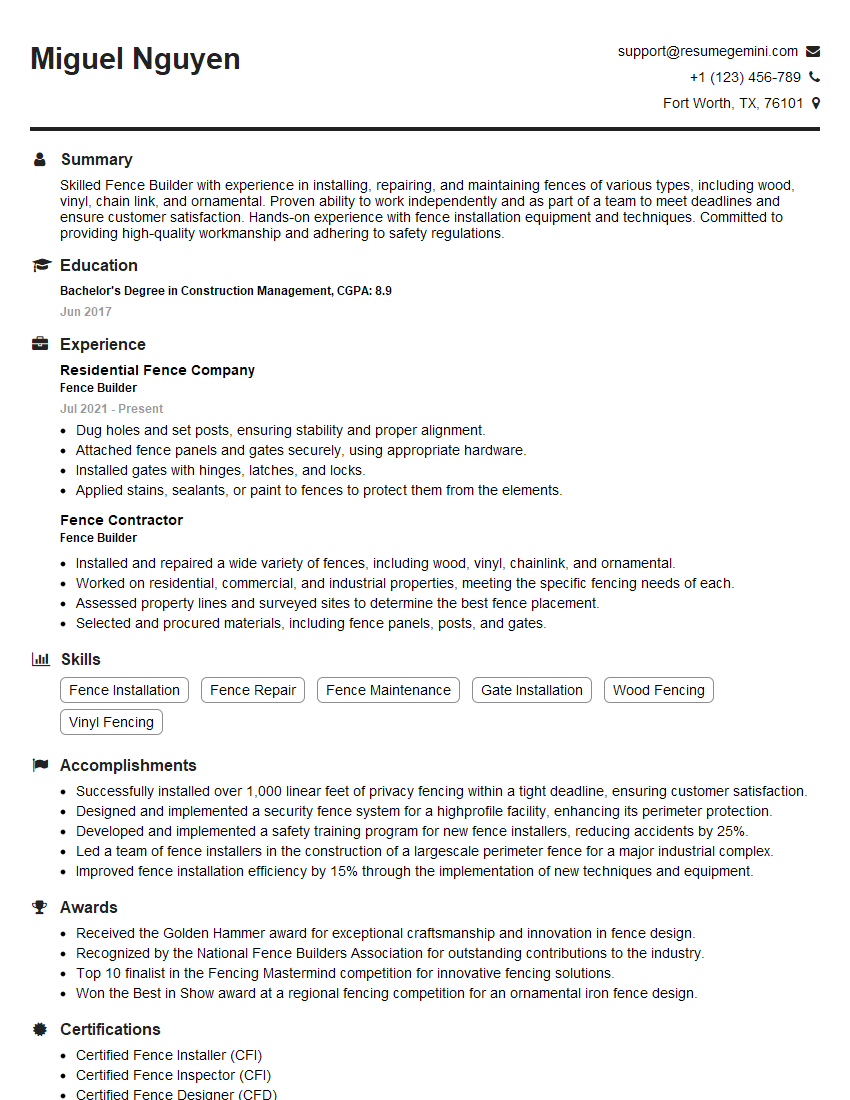
Mastering the skills and knowledge of wood fencing opens doors to a rewarding career with opportunities for growth and advancement. A strong resume is key to showcasing your expertise and securing your dream job. Creating an ATS-friendly resume is crucial for getting noticed by employers. We highly recommend using ResumeGemini to build a professional and impactful resume that highlights your qualifications effectively. ResumeGemini provides examples of resumes tailored to the Wood Fencing industry, helping you present your skills and experience in the best possible light. Take the next step towards your successful career in wood fencing today!
Explore more articles
Users Rating of Our Blogs
Share Your Experience
We value your feedback! Please rate our content and share your thoughts (optional).
What Readers Say About Our Blog
Very informative content, great job.
good