The right preparation can turn an interview into an opportunity to showcase your expertise. This guide to Yarn Embroidery interview questions is your ultimate resource, providing key insights and tips to help you ace your responses and stand out as a top candidate.
Questions Asked in Yarn Embroidery Interview
Q 1. Describe your experience with different types of yarn suitable for embroidery.
Selecting the right yarn is crucial for successful yarn embroidery. Different yarns offer varied textures, thicknesses, and fiber compositions, each impacting the final embroidered piece. My experience encompasses a wide range, from delicate wools to sturdy acrylics and even specialty yarns like silk or linen blends.
Wool: Offers a beautiful drape and warmth, ideal for creating textured and cozy designs. I often use merino wool for its softness and evenness, while Shetland wool provides a unique rustic charm.
Acrylic: A cost-effective and readily available option, acrylic yarns come in a vast array of colors and are easy to care for. They’re perfect for projects that need durability and vibrant hues. I find them particularly useful for beginners because they are forgiving.
Cotton: A strong, natural fiber suitable for creating crisp, clean stitches. Percale cotton yarns are excellent for fine details, while heavier cotton yarns lend themselves to bold, rustic designs.
Silk: Provides a luxurious sheen and drape, though it can be more challenging to work with due to its delicate nature. I reserve silk for high-end projects where its unique qualities enhance the design.
The choice depends entirely on the project: a delicate floral design might call for fine merino wool, while a bold sampler would benefit from sturdy acrylics.
Q 2. Explain the various embroidery stitches you are proficient in.
My embroidery stitch repertoire is extensive, encompassing both basic and advanced techniques. I’m highly proficient in a range of stitches, each contributing unique visual and textural elements to the final piece.
Basic Stitches: Running stitch, backstitch, satin stitch, stem stitch, French knots.
More Advanced Stitches: Chain stitch, lazy daisy stitch, fly stitch, seed stitch, and various filling stitches like detached chain stitch and woven wheel stitch.
The choice of stitch depends heavily on the design. For instance, I’d use backstitch for sharp lines in lettering, while satin stitch would fill a solid area with smooth color, and French knots add texture and dimension.
Beyond individual stitches, I’m also adept at combining different stitches to create complex and visually rich effects. This layering of techniques is what elevates simple embroidery to more sophisticated art.
Q 3. How do you choose the appropriate needle size for different yarn weights?
Needle selection is paramount for successful yarn embroidery. The needle’s size must match the yarn weight to ensure proper stitch formation and prevent yarn breakage or damage to the fabric. Generally, thicker yarns require larger needles, while thinner yarns require finer needles.
Here’s a simplified guideline:
Bulky yarns: Needles size 16-18
Worsted weight yarns: Needles size 10-14
Fine yarns (fingering or lace): Needles size 6-8
Always test the needle and yarn combination on a scrap of fabric before starting your main project. This helps you avoid unforeseen issues.
Beyond the basic size, the type of needle also matters. Sharp needles are best for even stitches, while blunt needles might be used with heavier yarns or fabrics.
Q 4. What are the common challenges faced in yarn embroidery and how do you overcome them?
Yarn embroidery, while rewarding, presents certain challenges. One common issue is managing yarn thickness and tension. Thick yarns can be difficult to maneuver, and inconsistent tension leads to uneven stitches.
Solution for yarn thickness: I often use embroidery hoops to keep the fabric taut. This helps to control the yarn and prevent it from bunching or puckering.
Solution for tension: Practicing consistent tension requires attention and time. A slow, steady approach is key. I also use techniques like slightly pre-stretching the yarn to account for its tendency to relax under tension.
Another challenge is knotting; I mitigate this by using the ‘knotless’ beginning and ending techniques to create a clean finish and prevent large knots showing on the front or back of the fabric.
Finally, maintaining even color and texture across a large area can prove difficult, often necessitating careful consideration of stitch choice and technique.
Q 5. Describe your process for transferring a design onto fabric for embroidery.
Transferring a design onto fabric for yarn embroidery involves several methods, each with its own advantages.
Tracing: I use lightboxes or windows to trace designs from printed patterns onto water-soluble stabilizer or tracing paper, then transfer it to fabric using tracing tools like pencils or markers. This approach is very precise and is good for detailed designs.
Printing: For designs that require clear lines or are very complex, I might use printer transfer paper (such as inkjet or laser transfer paper) designed for fabrics. This method often requires pre-treating the fabric for proper adherence.
Freehand: For simpler designs, I sometimes use freehand sketching. This requires more skill, but it allows for spontaneity and adjustments during the process.
After transferring the design, I always test the stabilizer or transfer paper on a scrap of fabric to ensure it doesn’t affect the yarn or the embroidery process negatively. The choice of transfer method depends on the complexity and size of the project.
Q 6. How do you maintain consistent tension while embroidering with yarn?
Maintaining consistent tension is crucial for even and beautiful stitches. It’s a skill that develops with practice, but here are some techniques I employ:
Use an embroidery hoop: This keeps the fabric taut and helps control the yarn’s movement and avoids puckering.
Consistent Pull: Avoid pulling the yarn too tightly or too loosely. Imagine the yarn as a fine thread, always pulling with a gentle, consistent motion.
Practice: Consistent tension is developed over time. Practice simple stitches until you develop a feel for the correct tension.
Breaks: Taking regular breaks prevents fatigue, which can lead to inconsistent tension.
The ‘feel’ for tension is an important part of this. Think of a violinist controlling the bow – a steady, controlled hand makes for smooth, even notes, just as steady hand movement translates to even stitches in embroidery.
Q 7. Explain your experience with different embroidery hoops or frames.
My experience with embroidery hoops and frames spans various types, each suited for different needs and project sizes.
Traditional Wooden Hoops: These are versatile and widely available. They’re great for smaller projects and provide excellent tension control. I often use them for smaller, intricate pieces.
Adjustable Plastic Hoops: Convenient for adjusting the tension, especially useful when working with thicker fabrics or yarns.
Large Embroidery Frames: These frames are indispensable for larger projects like wall hangings or tapestries. They offer better support for larger pieces and keep the fabric taut without undue stress on the design.
Magnetic Hoops: These innovative hoops offer a quick and easy way to secure fabric and are useful for small projects where changing the hoops frequently would otherwise be tedious.
The choice of hoop or frame depends on the project’s size and complexity. I select the one that offers the best support and tension control for the specific job.
Q 8. How do you care for and maintain your embroidery tools and materials?
Proper care of embroidery tools and materials is crucial for longevity and consistent quality. Think of it like caring for your favorite artist’s brushes – the better you care for them, the longer they’ll last and the better they’ll perform.
- Needles: After each use, gently wipe my needles clean with a soft cloth to remove any yarn fibers or lint. I store them in a designated needle case to prevent bending or breakage. Different needles are suited for different yarn weights – using the right needle prevents breakage and ensures even stitches.
- Yarn: I store my yarn in a cool, dry place, away from direct sunlight and moisture, to prevent fading and deterioration. I use airtight containers or zippered bags to protect it from dust and pests. Proper storage prevents the yarn from becoming brittle or matted.
- Scissors: I regularly sharpen my embroidery scissors to maintain a clean cut. Dull scissors can fray the yarn and make precise work difficult. I also clean them with a soft cloth to remove any yarn residue.
- Embroidery Hoops: I wipe my embroidery hoops clean after each project to remove any lingering fabric or yarn. Proper cleaning helps prevent rust on metal hoops.
- Fabric: Before beginning a project, I always pre-wash and iron the fabric to remove any sizing or wrinkles that could affect the stitching or create inconsistencies in the final piece. This step ensures a smooth, even surface for your embroidery.
Q 9. Describe your process for finishing an embroidered piece.
Finishing an embroidered piece is as important as the embroidery itself. It elevates the piece from a project to a finished artwork, protecting it and enhancing its presentation. My finishing process involves several key steps:
- Removing the Hoop: Carefully remove the embroidered fabric from the hoop, ensuring no undue strain is placed on the stitches.
- Washing (if needed): Depending on the yarn and fabric used, I might gently hand wash the piece in cool water with a mild detergent. I always air-dry to avoid shrinkage or damage.
- Ironing (if needed): After washing, I carefully iron the piece from the back, using a pressing cloth to protect the embroidery. Ironing smooths the fabric and helps the piece to lay flat.
- Trimming Loose Ends: I carefully trim any loose ends of yarn, ensuring they are neatly woven in and won’t unravel.
- Blocking (optional): For some projects, especially those with lace or textured stitches, blocking is used to reshape and even out the fabric. This might involve pinning the piece to a damp cloth until dry.
- Mounting or Framing: Finally, I decide how to present the finished piece, whether by framing it, mounting it on a card, or incorporating it into a larger project. A well-chosen frame or mounting enhances the final look.
Q 10. What are the different types of fabrics best suited for yarn embroidery?
Fabric choice is paramount in yarn embroidery. The fabric’s weave, weight, and texture directly impact the final appearance and how the stitches sit. Different yarns require different fabrics for optimal results. Too loose of a weave can make the stitches difficult to manage; too tight may make it hard to insert your needle.
- Evenweave Fabrics: These are ideal for most yarn embroidery projects. The even, consistent weave allows for precise stitch placement and a clean finish. Examples include Aida cloth (commonly used for counted cross-stitch which is a type of yarn embroidery), linen, and evenweave cotton.
- Linen: Linen’s slight texture and drape add a unique visual appeal to the finished piece, making it particularly suitable for more rustic or vintage-style designs. It has good stitch stability but can be slightly more difficult to work with than evenweave cotton.
- Cotton: Cotton is a versatile option, offering varying levels of weave density and textures. It’s a good all-around choice for beginners.
- Canvas: Heavier weight canvas fabrics offer strength and stability, well-suited for projects with heavier yarns or dense stitching.
- Wool: Though less common, certain wool fabrics can be suitable for yarn embroidery, offering a unique texture and appearance. The choice depends heavily on the type of wool fabric.
When choosing a fabric, always consider the weight of your yarn and the complexity of your design. A heavier yarn will require a sturdier fabric, while intricate designs might benefit from a finer weave.
Q 11. How do you plan and execute a complex embroidery project?
Planning and executing a complex embroidery project requires meticulous attention to detail and a structured approach. Imagine it like constructing a building – you wouldn’t start without blueprints!
- Design Development: I start by sketching my design, experimenting with different layouts and stitch combinations. This might involve transferring a digital design onto paper, or creating an original design freehand.
- Fabric Selection: Based on the design’s intricacy and yarn choice, I select the most appropriate fabric.
- Yarn Selection: Color, texture, and fiber content are crucial considerations. I gather the necessary yarns, checking for consistency in color and weight. Sometimes I need to dye yarns to achieve the precise shade I need.
- Transferring the Design: I carefully transfer the design to the fabric using a method such as tracing, lightbox projection, or using a water-soluble pen.
- Stitch Planning: I plan the stitching process step-by-step, considering the order of colors and stitch types to ensure efficiency and a cohesive outcome. I might even create a chart of stitching order for complex sections.
- Execution & Monitoring: I begin the embroidery, frequently checking the progress against my design and making adjustments as needed. This might involve pausing to assess progress, and adjusting tension to maintain evenness.
- Documentation: For truly complex projects, I might take photographs at key stages to track progress and aid future reproductions.
Q 12. How do you manage your time effectively when working on multiple embroidery projects?
Juggling multiple embroidery projects requires effective time management strategies. I use a combination of techniques to avoid feeling overwhelmed.
- Project Prioritization: I prioritize projects based on deadlines, importance, and personal motivation. This might involve using a planner, to-do list, or a project management application.
- Time Blocking: I allocate specific time slots for each project, ensuring focused work sessions. This is crucial to maintaining momentum and preventing burnout. I also include buffer time for unexpected delays or interruptions.
- Batching Similar Tasks: I group similar tasks together. For example, I might dedicate a session to preparing all the necessary materials for multiple projects.
- Setting Realistic Goals: I avoid overcommitment by setting achievable daily or weekly goals for each project. This prevents feeling discouraged by overwhelming progress metrics. It’s better to have several smaller achievements than one enormous, potentially unfinished one.
- Regular Breaks: I take regular breaks to avoid eye strain and maintain focus. Short breaks can help improve the quality of your work over long periods of time. Short walks or stretching can also help to refresh focus.
Q 13. How do you adapt your embroidery techniques to different design styles?
Adapting to different design styles in yarn embroidery involves understanding the unique characteristics of each style and adjusting my techniques accordingly. It’s like learning a new instrument – once you know the basics, you can adapt the skills for many genres of music.
- Stitch Selection: Different stitches create different textures and visual effects. For example, dense satin stitches create a smooth, solid surface, while openwork stitches create a delicate, airy effect. Choosing the right stitch helps to execute your style properly.
- Yarn Choice: The type of yarn (wool, cotton, silk) and its weight influence the overall look and feel. Thick, textured yarns create a rustic feel, while fine, smooth yarns create a more refined appearance.
- Color Palette: The color scheme significantly impacts the mood and style. Bold, contrasting colors create a vibrant effect, while muted, harmonious colors create a serene atmosphere.
- Layout and Composition: The way elements are arranged within the design dictates the final outcome. Symmetrical layouts convey order and balance, while asymmetrical layouts evoke spontaneity and freedom.
By carefully selecting the appropriate stitches, yarns, colors, and composition, I can effectively adapt my techniques to execute various design styles from minimalist to maximalist.
Q 14. Describe your experience working with color palettes in yarn embroidery.
Color palette selection is critical in yarn embroidery, impacting the emotional response and the overall success of the project. It’s like selecting the colors in a painting – the right combination can evoke a powerful response.
- Color Theory: I have a deep understanding of color theory, using the color wheel to create harmonious or contrasting palettes. Understanding relationships like complementary, analogous, and triadic color schemes is critical in choosing successful schemes.
- Yarn Dyeing: To achieve precise color matches or unique shades, I frequently dye my own yarn. This provides maximum creative control over the color spectrum of a project.
- Mood and Theme: The color palette should align with the intended mood and theme of the design. Warm colors like oranges and reds evoke energy and warmth, while cool colors like blues and greens evoke calmness and serenity.
- Gradients and Shading: To add depth and dimension, I use a range of shades within a color family, creating subtle gradients and shading effects to achieve realism or a 3-D effect.
- Experimentation: I always experiment with different color combinations, often creating small test swatches before committing to a large project. Experimentation and risk tolerance are highly important.
Q 15. How do you handle unexpected problems or mistakes during embroidery?
Handling mistakes in yarn embroidery is all about a calm, methodical approach. It’s rare to complete a piece without encountering some snags! My first step is always to assess the problem. Is it a simple pulled thread that can be easily re-stitched? Or is it a more significant design flaw requiring more intervention?
For minor issues, like a broken stitch, I simply use a needle to carefully re-thread the yarn and continue. For larger issues, I might employ techniques like unpicking (carefully!) a small section to correct the mistake and restitch, or even strategically incorporate the error into the overall design, creating a unique element.
For example, once I accidentally skipped a section of a floral design. Instead of restarting, I used that ‘gap’ to subtly incorporate a shadow effect, making the flower look more dimensional and ultimately, more interesting. The key is adaptability and resourcefulness.
Career Expert Tips:
- Ace those interviews! Prepare effectively by reviewing the Top 50 Most Common Interview Questions on ResumeGemini.
- Navigate your job search with confidence! Explore a wide range of Career Tips on ResumeGemini. Learn about common challenges and recommendations to overcome them.
- Craft the perfect resume! Master the Art of Resume Writing with ResumeGemini’s guide. Showcase your unique qualifications and achievements effectively.
- Don’t miss out on holiday savings! Build your dream resume with ResumeGemini’s ATS optimized templates.
Q 16. Explain your understanding of different yarn fibers (cotton, wool, silk, etc.).
Understanding yarn fibers is crucial for successful yarn embroidery. Each fiber brings unique qualities to the project—affecting everything from drape and texture to durability and colorfastness.
- Cotton: A strong, readily available, and easy-to-work-with fiber. It holds color well and is perfect for projects requiring durability, but it can be prone to shrinking.
- Wool: A naturally warm and resilient fiber with a lovely texture. Its elasticity makes it forgiving for mistakes, and it’s excellent for creating textured designs. However, wool can be more challenging to work with due to its texture.
- Silk: Exquisitely luxurious and delicate, silk adds a beautiful sheen and drape. It’s ideal for intricate designs but demands careful handling due to its fragility.
- Acrylic: A synthetic fiber that’s affordable, easy to care for, and comes in a wide array of colors. It’s a great choice for beginners, but it might not have the same luxury feel as natural fibers.
I always consider the characteristics of the yarn when choosing it for a particular project. For a child’s toy, I might choose durable acrylic. For a delicate piece of wall art, I would select fine silk or a high-quality wool.
Q 17. How do you create three-dimensional effects in your yarn embroidery work?
Creating three-dimensional effects in yarn embroidery is about manipulating the yarn to build layers and texture. There are several techniques:
- Layering: Stitching multiple layers of yarn on top of each other to create depth and volume. This can be done with different colors or textures of yarn to add visual interest.
- French knots and raised stitches: These stitches create small, raised bumps that add texture and dimension, excellent for creating flower centers or highlights.
- Free-standing lace: Using soluble fabric as a base, creating a pattern, then removing the base to leave a three-dimensional lace structure.
- Appliqué and padding: Adding small pieces of fabric or stuffing under the yarn embroidery to raise sections, creating a puffed-up effect.
For example, in a landscape scene, I might use layering to create depth in the hills, raised stitches to highlight a sun-dappled meadow, and French knots for tiny flowers. It’s all about controlled manipulation of the yarn to create the desired effect.
Q 18. Describe your experience with free-motion embroidery (if applicable).
While my primary focus is hand embroidery, I have some experience with free-motion embroidery on a sewing machine. Free-motion embroidery allows for more fluid designs and quicker coverage than hand-stitching. This technique involves dropping the feed dogs on the machine and moving the fabric manually, guiding the needle to create the desired pattern.
I find it particularly helpful for creating backgrounds or filling large areas with texture. For instance, I used free-motion to create a textured sky in a recent landscape piece—it provided a much more painterly effect than I could easily achieve with hand-stitching alone. However, the intricacy and control you have with hand embroidery are still hard to replicate with a machine. The precision is different, with handwork allowing for minute details.
Q 19. How do you price your work (if freelance or self-employed)?
Pricing my work is a careful balancing act between valuing my time and skill and being competitive in the market. I consider several factors:
- Time invested: This is the most significant factor. I track the hours spent on design, material selection, stitching, and finishing.
- Materials cost: High-quality yarns, especially silk or specialty threads, significantly impact the cost.
- Complexity of the design: Intricate designs with many details take longer and require more skill, justifying a higher price.
- Size of the piece: Larger pieces naturally take longer and use more materials.
- Client’s requests: Custom designs or specific material requests may increase the price.
I often use a combination of hourly rate and material cost-plus-markup to determine my prices. I also research similar pieces from other artists to gauge market value, ensuring my pricing is both fair and competitive.
Q 20. How do you stay updated with current trends in yarn embroidery?
Staying updated on current trends in yarn embroidery involves a multi-pronged approach:
- Online communities: I actively participate in online forums, groups, and social media pages dedicated to embroidery. This allows me to see new techniques, materials, and designs.
- Magazines and books: I subscribe to relevant magazines and regularly browse craft books for inspiration and new ideas.
- Workshops and classes: Attending workshops and classes provides hands-on experience with new techniques from experienced instructors.
- Visiting exhibitions and galleries: This helps me see the work of other artists, understand market trends, and identify new possibilities.
- Following influential embroiderers: I follow leading artists on social media platforms for their creative insights and to stay aware of the latest techniques.
It’s a continuous process of learning and exploration, which is what makes this craft so exciting and ever-evolving.
Q 21. Describe your experience working with different embroidery machines (if applicable).
My primary focus is hand embroidery, but I have limited experience with embroidery machines, mostly in the context of exploring their potential for background textures or repetitive stitching. I’ve experimented with both basic domestic sewing machines adapted for free-motion embroidery and more specialized embroidery machines.
While I appreciate the efficiency of machine embroidery for certain aspects, the level of control and artistic expression in hand embroidery still surpasses anything a machine can achieve, particularly when it comes to the nuances of yarn embroidery. For truly intricate or one-of-a-kind pieces, hand-stitching is still my preferred method.
Q 22. What is your preferred method for creating embroidery patterns?
My preferred method for creating embroidery patterns involves a blend of digital and hand-drawn techniques. I often begin with a sketch, translating my initial ideas onto paper. This allows for a free-flowing creative process where I can experiment with different compositions and stitch styles. Once I’m happy with the sketch, I digitize it using embroidery software. This software allows for precise placement of stitches, color selection, and the ability to experiment with stitch density and variations. I find this digital step crucial for achieving consistency and accuracy in the final embroidery.
For example, if I’m designing a floral pattern, I’ll sketch the individual flowers and leaves first, paying close attention to petal shapes and leaf veins. Then, I’ll scan the sketch and import it into my embroidery software. Here, I can meticulously adjust the stitch paths to create texture and depth within each element, ensuring a cohesive and aesthetically pleasing final result.
Q 23. How do you ensure the longevity and durability of your embroidered pieces?
Ensuring the longevity and durability of my embroidered pieces involves careful consideration at every stage of the process, from fabric selection to finishing techniques. Firstly, I prioritize using high-quality materials. This includes selecting durable yarns like 100% wool or a sturdy cotton blend that can withstand wear and tear. The backing fabric should also be chosen for its strength and ability to support the embroidery.
After the embroidery is complete, I pre-wash the fabric according to the yarn’s care instructions to prevent shrinkage or color bleeding. Finally, I use a stabilizer, often a tear-away or wash-away type, during the stitching process to maintain fabric integrity and prevent puckering. This helps to preserve the intricate details of the design. For added protection, I sometimes consider a light pressing after washing, but always test a hidden area first to ensure the fabric and yarn respond well to heat.
Q 24. Describe your process for selecting appropriate backing fabrics for yarn embroidery.
Selecting the appropriate backing fabric for yarn embroidery is crucial; it impacts the final look and feel, and the overall longevity of the piece. The choice depends heavily on the project’s requirements and the type of yarn being used. For instance, a lightweight linen or cotton works well for delicate embroidery with fine yarns, as it provides enough support without being too bulky. For heavier yarns or more substantial projects, a sturdy cotton canvas or even a heavier weight linen offers better support and prevents distortion.
I always consider the weave of the fabric. A tightly woven fabric prevents the yarn from sinking into the fabric and keeps the stitches neat and well-defined. The color of the backing fabric also matters, especially for lighter-colored yarns where the background might show through. In such cases, I select a neutral-toned fabric that complements the yarn color without detracting from it. I often test a small sample before committing to the full piece, to check for compatibility between the yarn and fabric.
Q 25. How do you maintain accurate stitch count and evenness while embroidering?
Maintaining accurate stitch count and evenness is paramount for professional-looking embroidery. It involves a combination of planning, technique, and careful execution. Before beginning, I carefully examine the pattern, noting any areas that might require extra attention or adjustments in stitch density. I often use a stitch counter, either a physical tool or an app on my phone, to ensure consistency. A well-lit workspace and the correct tension on the embroidery hoop also play a significant role.
To achieve evenness, I focus on maintaining consistent tension on my yarn throughout the stitching process, avoiding pulling too tightly or too loosely. Regularly checking the fabric and adjusting the hoop as needed prevents distortions and helps to ensure the stitches remain uniform. Practice is key here; the more I work, the more naturally I can maintain evenness in my stitching.
Q 26. Explain your experience with different types of embroidery hoops.
My experience with embroidery hoops is extensive, and I’ve worked with various types, each with its own advantages and disadvantages. I find that simple wooden hoops are excellent for smaller projects and provide good visibility of the fabric. However, for larger pieces, I prefer quick-release hoops or adjustable hoops that allow for easier access to the entire embroidery area. Metal hoops are another option, offering exceptional tension control and suitability for complex or denser designs.
The choice often depends on the project’s size and complexity. For instance, quick-release hoops are ideal for working on intricate designs because they allow me to readily adjust the tension without constantly re-hooping. For projects that need exceptional tension, such as densely packed embroidery, a metal hoop provides the most secure and consistent tension. Ultimately, I choose the hoop that best suits the specific demands of the project.
Q 27. Describe your experience with using stabilizers in yarn embroidery.
Stabilizers are essential in yarn embroidery, particularly for projects with intricate details or when using heavier yarns. They provide support to the fabric, preventing puckering or distortion during stitching. I use a variety of stabilizers, including tear-away, wash-away, and cut-away stabilizers, depending on the specific needs of the project. Tear-away stabilizers are great for easily removing after stitching and are usually used on projects where some underlying fabric show-through is acceptable. Wash-away stabilizers dissolve in water making them perfect for finer projects.
For heavier designs or where a completely smooth finish is required, I often use cut-away stabilizers. These are left in place after stitching, providing extra durability and structure to the embroidered piece. My choice of stabilizer is determined by factors such as the fabric type, the yarn weight, and the design complexity. If I am using a delicate fabric, I would likely opt for a tear-away stabilizer to minimize damage. For dense embroidery, on a sturdier fabric, a cut-away stabilizer would be preferred to give exceptional support.
Q 28. How do you handle client requests or revisions on embroidery projects?
Handling client requests and revisions is a crucial part of my process. I begin by actively listening and understanding the client’s vision, asking clarifying questions to ensure we’re on the same page. I then present a detailed proposal outlining the process, timeline, and cost, including provisions for potential revisions. Open and honest communication is key—I keep clients updated throughout the project, providing progress photos and addressing any concerns promptly.
For revisions, I document all changes carefully, including details of any adjustments to design, materials, or techniques. I ensure these revisions are integrated seamlessly into the project without compromising the quality or integrity of the final embroidery. I always maintain a professional and understanding demeanor, offering creative solutions where possible to satisfy the client’s needs. For instance, if a client wants to change a color, I’ll readily offer alternate yarn suggestions and show them fabric swatches to ensure they’re satisfied with the color. This collaborative approach ensures a positive client experience and a final product that aligns with their expectations.
Key Topics to Learn for Yarn Embroidery Interview
- Yarn Selection and Properties: Understanding different yarn types (cotton, wool, silk, etc.), their textures, thicknesses, and suitability for various embroidery techniques.
- Stitch Techniques: Mastering fundamental embroidery stitches (e.g., stem stitch, satin stitch, French knots) and their applications in creating different textures and effects.
- Fabric Choice and Preparation: Selecting appropriate fabrics for embroidery (e.g., linen, cotton, canvas) and preparing them for optimal stitch retention and evenness.
- Pattern Design and Transfer: Creating or adapting embroidery patterns, accurately transferring them onto fabric using various methods (e.g., tracing, carbon paper).
- Color Theory and Palette Selection: Understanding color harmonies and creating visually appealing embroidery palettes to enhance designs.
- Project Planning and Execution: Planning a project from concept to completion, managing time effectively, and troubleshooting common issues during the embroidery process.
- Finishing Techniques: Properly finishing embroidered pieces, including techniques for securing threads, adding embellishments, and framing or mounting the finished work.
- Tools and Equipment: Familiarity with essential embroidery tools (e.g., needles, hoops, scissors) and their proper use and maintenance.
- Troubleshooting and Problem Solving: Identifying and resolving common embroidery problems, such as uneven tension, tangled threads, or broken needles.
- Understanding different Yarn Embroidery styles: Exploring various styles and techniques within Yarn Embroidery, such as free-motion, surface embroidery, or specific cultural styles.
Next Steps
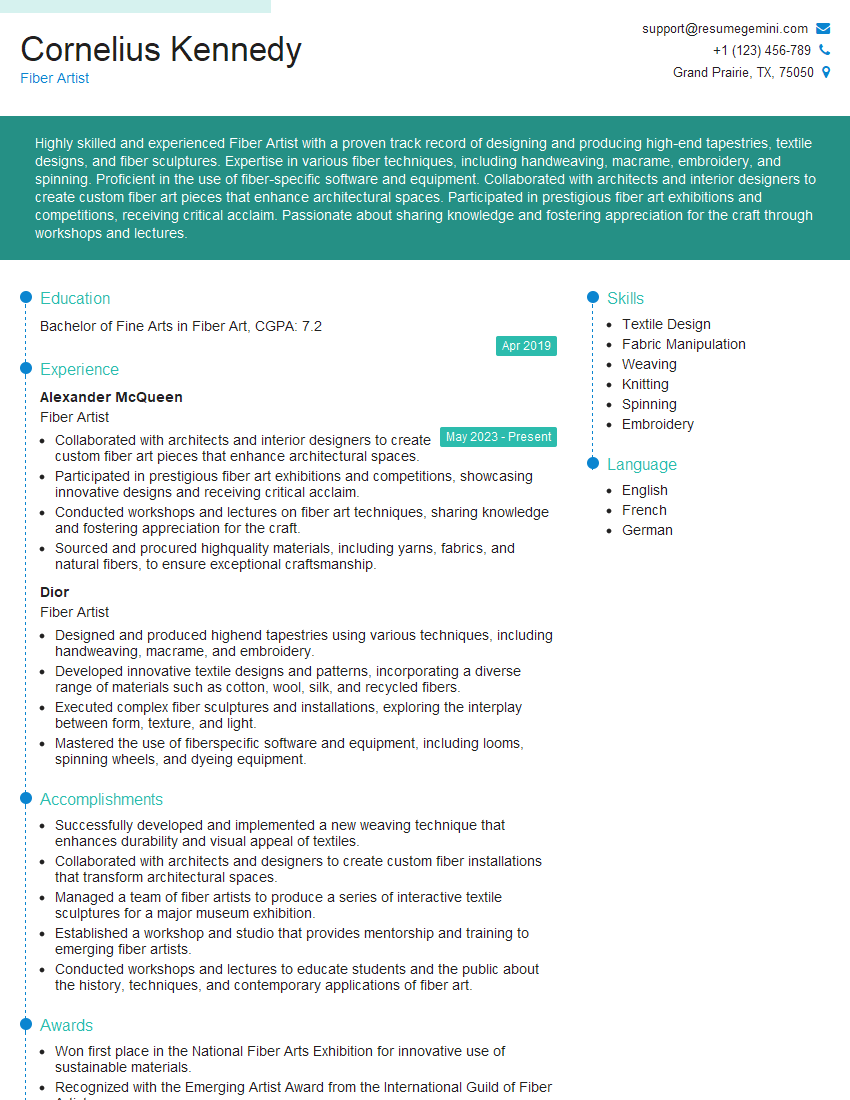
Mastering Yarn Embroidery opens doors to exciting career opportunities in textile design, crafting, and potentially even teaching. To stand out, creating a strong, ATS-friendly resume is crucial. ResumeGemini is a trusted resource that can help you build a professional resume that highlights your skills and experience effectively. Examples of resumes tailored to Yarn Embroidery are available, showcasing how to present your abilities in the best possible light. Invest time in crafting a compelling resume—it’s your first impression on potential employers.
Explore more articles
Users Rating of Our Blogs
Share Your Experience
We value your feedback! Please rate our content and share your thoughts (optional).
What Readers Say About Our Blog
Very informative content, great job.
good