Every successful interview starts with knowing what to expect. In this blog, we’ll take you through the top Electron Microscopy (SEM/TEM) interview questions, breaking them down with expert tips to help you deliver impactful answers. Step into your next interview fully prepared and ready to succeed.
Questions Asked in Electron Microscopy (SEM/TEM) Interview
Q 1. Explain the basic principles of SEM and TEM.
Both Scanning Electron Microscopy (SEM) and Transmission Electron Microscopy (TEM) are powerful techniques used to visualize the micro- and nanostructures of materials. However, they achieve this using fundamentally different approaches. SEM uses a focused beam of electrons to scan the surface of a sample, generating signals that reveal surface topography and composition. Think of it like shining a flashlight on an object and observing the shadows and reflections to understand its shape. TEM, on the other hand, transmits a beam of electrons through an extremely thin sample. The interaction of electrons with the sample provides information about the internal structure, crystallographic orientation, and elemental composition.
Q 2. What are the key differences between SEM and TEM?
The key differences between SEM and TEM lie in how they interact with the sample and the type of information they provide. SEM examines the surface of a sample, providing high-resolution images of topography and surface composition. It’s ideal for examining relatively large samples with complex surface features. TEM, conversely, examines the interior of a sample, providing information about internal structure, crystallography, and elemental composition at a much higher resolution. However, this requires extremely thin samples (typically less than 100 nm). Imagine the difference between looking at the outside of a house versus having a cross-section to view its internal structure. SEM provides the exterior view, while TEM gives the internal blueprint.
- Sample preparation: SEM requires less extensive sample preparation than TEM.
- Resolution: TEM offers significantly higher resolution than SEM, allowing for visualization of much smaller features.
- Information obtained: SEM primarily provides surface information (topography, composition), while TEM provides both surface and internal structural information (crystal structure, elemental composition).
- Sample thickness: SEM can handle relatively thick samples, while TEM requires ultrathin samples.
Q 3. Describe the process of sample preparation for SEM.
Sample preparation for SEM is crucial for obtaining high-quality images. The specific steps depend on the sample’s nature and the desired information. However, a common workflow involves these steps:
- Cleaning: Removing any dust or debris from the sample’s surface using compressed air, ultrasound bath, or other appropriate methods. Contamination can severely affect image quality.
- Mounting: Attaching the sample to a suitable stub using conductive adhesive, ensuring good electrical contact. This is vital for proper electron beam interaction.
- Coating (optional): Applying a thin conductive coating (e.g., gold, platinum) to non-conductive samples to prevent charging effects during imaging. Charging can cause artifacts and image distortion.
- Drying: Ensuring the sample is completely dry to prevent the formation of ice crystals or other artifacts under the electron beam.
For instance, if analyzing a biological sample, fixation and dehydration steps may be necessary before mounting. For a metal sample, simple cleaning and mounting might be sufficient.
Q 4. How do you prepare samples for TEM?
Preparing samples for TEM is significantly more complex than for SEM due to the requirement of extremely thin samples (often less than 100 nm). This typically involves several steps:
- Sectioning: Using ultramicrotomy with a diamond knife to create thin sections of the sample. This requires specialized equipment and expertise.
- Ion milling (or focused ion beam milling): An alternative to ultramicrotomy, this technique uses a focused ion beam to progressively thin the sample to electron transparency.
- Stainng (for biological samples): Using heavy metal stains to increase contrast between different structures within the sample. This is crucial for visualizing biological samples effectively.
The choice of method depends on the sample’s nature and the desired resolution. For instance, biological samples often require staining and ultramicrotomy, while some materials science samples may be thinned using ion milling. It is a delicate process demanding patience and precision.
Q 5. What are the different imaging modes in SEM?
SEM offers various imaging modes, each providing unique information:
- Secondary Electron (SE) Imaging: This is the most common mode, providing high-resolution topographic information. SE electrons are emitted from the sample’s surface due to inelastic scattering of the primary electron beam. The image shows surface details like texture, roughness, and three-dimensional structure.
- Backscattered Electron (BSE) Imaging: BSE electrons are elastically scattered from the sample, providing compositional contrast. Heavier elements appear brighter than lighter elements, revealing compositional variations in the sample.
- Energy-Dispersive X-ray Spectroscopy (EDS): This technique analyzes the X-rays emitted from the sample upon interaction with the electron beam, providing elemental composition information at a specific location.
Choosing the appropriate imaging mode depends on the research question. If you need surface topography, SE imaging is ideal. For compositional analysis, BSE imaging or EDS is necessary.
Q 6. What are the different imaging modes in TEM?
TEM also offers diverse imaging modes, often providing complementary information:
- Bright-field (BF) Imaging: This mode is analogous to optical microscopy, where transmitted electrons form the image. Thicker areas appear darker, offering information on sample thickness and morphology.
- Dark-field (DF) Imaging: This mode uses scattered electrons to form the image, highlighting grain boundaries and small precipitates. It offers high contrast for small particles or defects.
- High-Resolution Transmission Electron Microscopy (HRTEM): HRTEM provides atomic-scale resolution, allowing direct visualization of crystal lattices and atomic arrangements. It is a crucial technique for materials science and nanotechnology.
The selection of imaging mode hinges on the sample and the scientific objectives. BF imaging provides an overview of the sample morphology, while DF and HRTEM offer detailed structural information.
Q 7. Explain the concept of diffraction in TEM.
Diffraction in TEM is a crucial technique for determining the crystal structure of a material. When the electron beam interacts with the periodic arrangement of atoms in a crystal lattice, the electrons are scattered in specific directions dictated by Bragg’s law. This phenomenon results in a diffraction pattern, which is a spatial arrangement of bright spots (reflections). Each spot represents a specific set of lattice planes in the crystal, and the arrangement of spots reveals the crystal symmetry and lattice parameters.
Analyzing these diffraction patterns allows us to identify the crystal structure, determine the orientation of the crystal lattice, and assess the presence of crystal defects. This analysis is invaluable in material science, allowing researchers to correlate the microscopic structure with the macroscopic properties of materials. For example, a researcher might use diffraction to identify the crystalline phase of a newly synthesized material or to study the orientation of nanocrystals within a thin film.
Q 8. How do you interpret SEM images?
Interpreting SEM images involves understanding the interplay of several factors: topography, composition, and electron-beam interactions. We’re essentially looking at a 3D surface rendered in 2D. The brighter areas generally represent areas that are either higher on the surface (due to more backscattered electrons) or have a higher atomic number (due to increased backscattering). Darker areas may be lower in elevation or composed of elements with lower atomic numbers.
For instance, imagine analyzing a fractured metal sample. The SEM image would show the uneven fracture surface. Bright regions could indicate the presence of a higher-atomic-number inclusion within the metal matrix, while darker regions might represent voids or areas with different crystal orientations. We also look for features like grain boundaries, cracks, or other surface details that reveal information about the material’s properties and processing history.
Specific image processing techniques, like edge enhancement or grayscale adjustments, can further aid interpretation. Always cross-reference SEM results with other analytical techniques, such as EDS (Energy-Dispersive X-ray Spectroscopy), for a complete understanding.
Q 9. How do you interpret TEM images?
TEM image interpretation is more complex than SEM, as it involves analyzing transmitted electrons, providing information about the internal structure of a material at the nanometer scale. We see a projection of the sample’s thickness, and the contrast arises from differences in electron scattering caused by variations in thickness, density, crystal structure, and atomic number. Bright areas typically indicate regions where electrons have passed through easily, suggesting thinner regions or areas with lower atomic number. Darker areas represent regions that scattered more electrons, indicating thicker areas, higher density, or heavier elements.
Consider analyzing a high-resolution TEM image of a semiconductor material. The lattice fringes would be visible, providing crucial information about the crystal structure and defects. The contrast changes can reveal dislocations, grain boundaries, or even individual atoms. Different imaging modes (like bright-field, dark-field, or high-resolution) provide different types of information.
Accurate interpretation also requires knowledge of diffraction patterns, which provide additional information about crystal orientation and structure. Careful analysis and potentially comparison with simulations are vital for a thorough understanding.
Q 10. What are the limitations of SEM?
SEM, while a powerful tool, has some limitations. The resolution is generally lower than TEM, usually in the nanometer range but often limited by the electron beam’s interaction volume with the sample. This makes resolving very fine features difficult. The sample preparation can also be challenging, requiring conductive coating for non-conductive materials to prevent charging artifacts, which can distort the image. Furthermore, SEM is primarily a surface technique; information about the sample’s interior is limited.
Another limitation is beam damage. The high-energy electron beam can alter or damage sensitive samples, especially organic materials or biological specimens. Finally, the depth of field is limited, meaning that only a small depth of the sample is in focus at a time. Obtaining a focused image across a rough surface can require multiple shots.
Q 11. What are the limitations of TEM?
TEM, despite its superior resolution, also has limitations. Sample preparation for TEM is significantly more complex and time-consuming than SEM. Samples need to be extremely thin (often less than 100 nm), requiring techniques like ion milling or ultramicrotomy, and this can introduce artifacts. TEM is also sensitive to beam damage and requires high vacuum. Only small, thin samples can be analysed.
Another limitation is that TEM analysis typically requires specialized expertise and expensive equipment. The high vacuum needed for the column to operate properly makes it difficult to examine certain kinds of samples that are sensitive to vacuum or release volatile components under vacuum.
Lastly, interpreting TEM images can be challenging and requires a strong understanding of diffraction and image contrast mechanisms.
Q 12. Describe the role of vacuum in electron microscopy.
Vacuum is crucial in electron microscopy because electrons are easily scattered by air molecules. A high vacuum environment (typically 10-6 to 10-9 torr) minimizes these scattering events, allowing the electron beam to travel long distances without significant loss of energy or direction. This ensures a sharp and clear image. Without a vacuum, the electrons would collide with air molecules, causing them to lose energy and scatter randomly, resulting in a blurry or completely unusable image.
In SEM specifically, the vacuum prevents arcing and charging effects, ensuring the electron beam interacts appropriately with the sample surface. For TEM, the high vacuum is critical as we are dealing with a very thin sample and the electrons need to pass through it without significant loss of energy or direction.
Q 13. Explain the function of electron lenses in electron microscopy.
Electron lenses in electron microscopy function similarly to glass lenses in optical microscopy but use electromagnetic fields instead of glass to focus the electron beam. They consist of coils that generate magnetic fields that act on the electrons, bending their trajectories and bringing them to a focus. The strength of the magnetic field determines the lens’s focusing power and magnification.
A typical electron microscope has several lenses: a condenser lens to control the beam size and intensity; an objective lens, which forms the primary image; and projector lenses which magnify the image for viewing. By adjusting the current through these lenses, the operator can control the magnification and focus of the electron beam, allowing detailed visualization of the sample.
The precise control over the electron beam’s trajectory and focusing is paramount to achieving high-resolution imaging and analytical capabilities.
Q 14. How does magnification work in SEM and TEM?
Magnification in both SEM and TEM is achieved by manipulating the electron beam’s trajectory using electromagnetic lenses. In SEM, the magnification is primarily determined by the strength of the objective lens and the distance between the sample and the detector. A stronger magnetic field in the objective lens leads to stronger focusing and a higher magnification.
In TEM, the magnification is a multi-stage process. The objective lens initially magnifies the image of the sample. Subsequent projector lenses further magnify this intermediate image before it reaches the screen or detector. The final magnification is the product of the magnification provided by each lens, and each lens contributes to the overall magnification.
In both techniques, the magnification is digitally controlled and precisely adjustable, allowing for detailed examination of the sample at various scales.
Q 15. What is resolution in electron microscopy and how is it affected by various factors?
Resolution in electron microscopy refers to the ability to distinguish between two closely spaced points. In simpler terms, it’s how much detail you can see. Higher resolution means you can see finer features. In both SEM (Scanning Electron Microscopy) and TEM (Transmission Electron Microscopy), resolution is fundamentally limited by the wavelength of the electrons used. Since electrons have a much shorter wavelength than light, electron microscopes achieve far superior resolution compared to optical microscopes.
Several factors influence resolution:
- Wavelength of electrons: Shorter wavelengths (higher accelerating voltage) lead to better resolution. This is a fundamental limit.
- Spherical aberration: Electrons don’t all focus at a single point due to the lens imperfections, blurring the image. Advanced lens designs like correctors help mitigate this.
- Chromatic aberration: Electrons with slightly different energies have slightly different focal lengths, leading to blurring. Monochromators can reduce this effect.
- Astigmatism: Imperfections in the electromagnetic lenses create asymmetrical focusing, causing elongation of the image. Astigmatism correction is crucial for optimal resolution.
- Sample preparation: Poorly prepared samples can introduce artifacts that obscure details, reducing effective resolution. Contamination on the sample surface is a common culprit.
- Detector efficiency: The detector’s ability to collect and resolve the scattered electrons also affects the final image quality and resolution.
For example, a state-of-the-art TEM might achieve sub-angstrom resolution, allowing visualization of individual atoms, whereas a typical SEM might reach resolutions in the nanometer range, sufficient for imaging microstructure and surface features.
Career Expert Tips:
- Ace those interviews! Prepare effectively by reviewing the Top 50 Most Common Interview Questions on ResumeGemini.
- Navigate your job search with confidence! Explore a wide range of Career Tips on ResumeGemini. Learn about common challenges and recommendations to overcome them.
- Craft the perfect resume! Master the Art of Resume Writing with ResumeGemini’s guide. Showcase your unique qualifications and achievements effectively.
- Don’t miss out on holiday savings! Build your dream resume with ResumeGemini’s ATS optimized templates.
Q 16. What is EDS and how does it work in conjunction with SEM?
Energy-Dispersive X-ray Spectroscopy (EDS) is an analytical technique used in conjunction with SEM to determine the elemental composition of a sample. When a high-energy electron beam interacts with the sample, it causes the atoms within the sample to emit characteristic X-rays. The energy of these X-rays is unique to each element.
EDS works by detecting these characteristic X-rays and measuring their energy. This energy is then used to identify the elements present and quantify their relative abundances. The entire process is automated with sophisticated software.
In SEM, the electron beam scans the sample surface, and at each point, an EDS spectrum is generated. This allows for elemental mapping, which visualizes the spatial distribution of elements within the sample.
Imagine analyzing a microchip. EDS can identify the different materials like silicon, copper, and gold used in the fabrication process and show where they are located on the chip. This is crucial for quality control and failure analysis.
Q 17. What is EELS and how does it provide compositional and chemical information?
Electron Energy Loss Spectroscopy (EELS) is a powerful technique used primarily in TEM to obtain detailed compositional and chemical information about a sample at a very high spatial resolution. Unlike EDS which focuses on core-level excitations, EELS analyzes the inelastic scattering of electrons as they pass through the thin sample.
As electrons traverse the sample, they lose energy through various interactions with the atoms. These energy losses are characteristic of different elements and their bonding states. By analyzing the energy loss spectrum, we can identify the elements present and determine their chemical bonding environments (oxidation states, coordination numbers etc.).
EELS offers advantages over EDS in several aspects: it provides information on light elements (like lithium, boron, and carbon), which are hard to detect efficiently with EDS, and it provides information about the chemical bonding by analyzing the fine structure within the energy loss edges. This helps determining the valence state, the degree of hybridization of the atoms in the sample.
For example, EELS can distinguish between graphite and diamond based on subtle differences in their carbon bonding, something that might be difficult to achieve with EDS alone. It’s incredibly valuable in materials science for characterizing nanomaterials, catalysts, and biological specimens.
Q 18. Explain the concept of depth of field in SEM.
Depth of field in SEM refers to the range of distances from the sample surface that appear acceptably sharp in the image. It’s essentially the range of distances that are in focus. A large depth of field means that a wider range of z-distances will appear sharp. This is in direct contrast to optical microscopy. This allows seeing features on a rough surface in focus.
Depth of field in SEM is inversely proportional to the aperture size. A smaller aperture size (smaller electron beam diameter) results in a larger depth of field, while a larger aperture leads to a shallower depth of field but improved resolution. It’s a trade-off between resolution and the area appearing in focus.
Think of it like taking a photo. With a wide aperture (shallow depth of field), the background is blurry, but the subject is sharply focused. With a narrow aperture (deep depth of field), both the background and the subject are in focus, but the overall image may appear slightly less sharp. In SEM, we often choose settings that prioritize a large depth of field, especially when imaging rough surfaces.
Q 19. How do you address sample charging in SEM?
Sample charging in SEM occurs when the electron beam interacts with a non-conductive sample, causing a build-up of static electricity. This charge can deflect the electron beam, causing image distortions like streaking, artifacts, and beam instabilities. It is more pronounced in samples that are insulators or have poor electrical conductivity.
Several strategies can address sample charging:
- Coating with a conductive layer: This is the most common method. A thin layer of conductive material, such as gold, platinum, or carbon, is sputtered onto the sample surface, providing a pathway for the charge to dissipate. This is the most common and often the best solution.
- Low beam current/energy: Using a lower accelerating voltage or beam current reduces the amount of charge generated. This can reduce the charging but may also compromise resolution or signal quality.
- Using a lower beam current/energy: Reducing the beam current reduces the amount of charge build-up, though it might lower image quality slightly.
- Environmental SEM (ESEM): ESEM operates at higher pressures, which reduces charging by allowing for greater conductivity in the surrounding gas.
- Flood coating: Using a low-energy electron flood gun to neutralize the charges building up on the sample.
The best approach depends on the sample and the desired image quality. A combination of techniques is often employed for optimal results.
Q 20. What are some common artifacts observed in SEM and TEM images, and how can they be minimized?
Several artifacts can appear in SEM and TEM images, compromising their interpretation. Minimizing these artifacts is crucial for accurate analysis.
Common SEM artifacts include:
- Charging: As discussed previously, this results in image distortions.
- Beam damage: The electron beam can damage or alter the sample, especially sensitive materials like polymers or biological specimens.
- Contamination: Dust or other particles on the sample surface can obscure features.
- Shadowing: Uneven sample topography can lead to areas appearing darker or lighter due to shadowing effects.
Common TEM artifacts include:
- Beam damage: More pronounced in TEM due to higher beam intensities.
- Specimen drift: The sample can move during imaging, leading to blurred images.
- Astigmatism: Causes elliptical distortion of the image.
- Diffraction effects: Diffraction of electrons can lead to the appearance of extra spots or rings in the image.
Minimizing artifacts involves careful sample preparation, optimized imaging conditions, and the use of appropriate image processing techniques. For example, cryogenic techniques can reduce beam damage in biological samples. Careful cleaning of samples reduces contamination, and proper alignment of the microscope minimizes astigmatism.
Q 21. Describe your experience with image analysis software used in electron microscopy.
Throughout my career, I’ve extensively used several image analysis software packages commonly employed in electron microscopy. My experience spans both commercial and open-source options. I’m proficient in using software for:
- Image processing and enhancement: This includes background subtraction, noise reduction, contrast adjustment, and filtering techniques.
- Particle size and shape analysis: Measuring particle sizes, aspect ratios, and other morphological features.
- Elemental mapping and quantification: Analyzing EDS and EELS data to generate elemental maps and determine the relative abundance of elements.
- 3D reconstruction: Creating 3D models from a series of 2D images obtained through various techniques like tilt series.
- Data visualization and presentation: Generating publication-quality images and graphs.
Specifically, I have considerable experience with ImageJ/Fiji (open-source), Gatan Microscopy Suite (commercial), and Digital Micrograph (commercial). My expertise extends to utilizing scripting and macro languages within these software packages to automate repetitive tasks and develop customized analysis workflows. For example, I developed a macro in ImageJ to automate the process of measuring the average grain size from SEM images of a polycrystalline material.
Furthermore, I’m adept at using specialized software such as ASTM E112-13 for image analysis and reporting.
Q 22. Explain your experience with different types of electron detectors.
My experience encompasses a wide range of electron detectors used in both SEM and TEM. In SEM, I’m proficient with secondary electron (SE) detectors, which provide high-resolution surface imaging, revealing topography and surface features. I’ve extensively used backscattered electron (BSE) detectors for compositional contrast, allowing me to distinguish elements based on their atomic number. For example, in analyzing a geological sample, BSE imaging clearly differentiated quartz from feldspar due to their differing atomic compositions. Additionally, I’ve worked with energy-dispersive X-ray spectroscopy (EDS) detectors integrated into the SEM, providing elemental analysis of the sample’s surface. This is crucial for identifying the chemical composition of inclusions or coatings. In TEM, I have experience with various detectors including bright-field and dark-field detectors used for imaging crystalline structures and identifying defects. Furthermore, I’ve utilized high-angle annular dark-field (HAADF) detectors, which provide Z-contrast images, offering valuable insights into the elemental composition and distribution within the sample.
Beyond these standard detectors, I’ve also had experience with more specialized detectors like cathodoluminescence detectors (for analyzing light emitted by materials under electron bombardment) and electron backscatter diffraction (EBSD) detectors (for crystallographic orientation mapping).
Q 23. Describe your experience troubleshooting electron microscopy equipment.
Troubleshooting electron microscopes requires a systematic approach, combining theoretical knowledge with practical experience. I’ve encountered various issues, from vacuum leaks (indicated by a rising pressure gauge) to high-voltage instabilities (manifested as image flickering or beam instability). My approach begins with checking the most common culprits first: vacuum system integrity, filament emission current, and high voltage stability. I use diagnostic tools such as vacuum gauges and beam current monitors. For instance, a persistent high vacuum reading in a specific section of the column might suggest a leak near that area, potentially in an o-ring. Identifying the faulty component often involves a process of elimination and visual inspection. Sometimes, a simple recalibration of the system parameters resolves the problem. If it’s more complex, I consult the microscope’s service manuals and documentation, utilizing schematics to isolate the faulty part. I’ve also collaborated with service engineers for complex repairs. A memorable incident involved a malfunctioning stigmator, resulting in an astigmatic image. By carefully adjusting the stigmator controls, in combination with observing the image improvement, I was able to successfully resolve the issue. Documentation is paramount; I maintain detailed logs for troubleshooting procedures and repairs to provide a clear record of actions taken and outcomes.
Q 24. How do you maintain and clean electron microscopy equipment?
Maintaining and cleaning electron microscopy equipment is critical for optimal performance and longevity. Regular maintenance includes daily checks of the vacuum system, filament status, and high voltage stability. The column and sample chamber require frequent cleaning to prevent contamination. This includes using appropriate cleaning solutions (often solvents specific for the equipment) and swabs. The sample stage must be carefully cleaned to remove any residue that could affect subsequent samples. The cleaning procedure varies depending on the type of contamination—for example, carbon contamination requires a specific cleaning process differing from the removal of organic residues. Preventative maintenance includes regular replacement of critical components such as the filament and vacuum pump oil to ensure optimal system operation. Regular checks on the alignment of the electron optical column ensure superior image quality. I strictly adhere to the manufacturer’s guidelines and recommended cleaning procedures. For example, some components may require specific types of cleaning agents to prevent damage, and understanding these protocols is critical to prevent costly repairs.
Q 25. What safety precautions are necessary when operating electron microscopes?
Operating electron microscopes demands strict adherence to safety protocols. The high voltage and vacuum present significant risks. Personal protective equipment (PPE), including safety glasses and lab coats, is mandatory. Proper training on the equipment’s operation is essential before handling the microscope. Specific procedures exist for handling samples to prevent damage to the instrument and to avoid potential hazards. For instance, the use of gloves is crucial to prevent contamination, and appropriate handling tools are used to prevent accidental damage to samples. Additionally, proper grounding and safety interlocks are crucial safety features to prevent electrical shocks. Before any maintenance or repair, the high voltage must be completely shut down and the vacuum released. Furthermore, understanding the handling of potentially hazardous materials (e.g., toxic or radioactive samples) is crucial to ensure a safe working environment. Regular safety checks and training are essential for maintaining a safe working environment and minimizing potential risks.
Q 26. Describe your experience with cryogenic sample preparation.
Cryogenic sample preparation is crucial for preserving the native state of biological samples, preventing artifacts from dehydration or ice crystal formation. My experience involves preparing samples using techniques like plunge freezing, high-pressure freezing, and freeze-substitution. Plunge freezing involves rapidly immersing the sample into liquid ethane or propane, vitrifying the water and minimizing ice crystal formation. High-pressure freezing employs a specialized apparatus to freeze the sample under pressure, leading to even faster freezing rates. Freeze-substitution replaces the water in the frozen sample with an organic solvent, facilitating further sample processing for TEM imaging. For example, I used this method extensively in preparing biological samples for investigating the microstructure of cell membranes. Careful attention to detail is paramount, from sample mounting to the cooling rate and subsequent processing steps to avoid introducing artifacts. I use specialized cryogenic equipment, and my experience ensures that samples are optimally prepared for high-resolution cryogenic electron microscopy (cryo-EM) analysis.
Q 27. Explain your experience with different types of TEM sample holders.
My experience with TEM sample holders is extensive and covers various types, each designed for specific sample types and applications. I regularly use single-tilt holders for standard imaging, double-tilt holders for precise sample orientation and tomography, and cryo-holders for maintaining the sample at cryogenic temperatures. Specialized holders, like heating holders, are employed for in-situ experiments involving temperature variations. Each holder type has specific operational parameters and constraints. For instance, cryo-holders require careful handling to maintain the sample temperature and prevent contamination. I’m also experienced with holders designed for specific materials or sample geometries, ensuring that the sample is appropriately positioned and secured during the imaging process. Understanding the mechanics and limitations of each holder type enables me to optimize the imaging conditions and minimize artifacts.
Q 28. Discuss your experience working with various materials in SEM/TEM analysis.
My SEM/TEM analysis experience spans a broad range of materials, including metals, ceramics, polymers, semiconductors, and biological samples. In materials science, I’ve characterized the microstructure and composition of various alloys, identifying phases and defects. For instance, I analyzed the grain boundaries in a steel sample using TEM to understand its mechanical properties. In the semiconductor industry, I’ve investigated the quality and structure of thin films and nanostructures, identifying defects and determining their impact on device performance. With polymers, my work has focused on imaging morphology, determining crystal structure and identifying degradation processes. In biological samples, I’ve investigated cellular structures and their interaction with nanomaterials. The preparation techniques and imaging parameters vary considerably depending on the material being analyzed. For example, metals might require polishing and etching, whereas biological samples require more delicate fixation and staining procedures. This experience across multiple material classes has equipped me with expertise in selecting appropriate sample preparation and imaging techniques to achieve optimal results.
Key Topics to Learn for Electron Microscopy (SEM/TEM) Interview
- Fundamentals of Electron Optics: Understanding electron beam generation, focusing, and manipulation. This includes lens types, aberrations, and their impact on image resolution.
- Sample Preparation Techniques: Mastering various methods for preparing samples for SEM and TEM analysis, considering the impact of each technique on the final image and data interpretation. This includes considerations for different sample types (metals, polymers, biological specimens).
- SEM Imaging Modes: Familiarity with different SEM imaging techniques (secondary electron imaging, backscattered electron imaging, etc.) and their applications in materials characterization.
- TEM Imaging Modes: Understanding bright-field, dark-field, and high-resolution TEM imaging, along with diffraction techniques and their use in determining crystal structure and composition.
- Image Analysis and Interpretation: Developing skills in analyzing SEM and TEM micrographs to extract quantitative and qualitative information about sample morphology, composition, and structure.
- Specimen Contamination and Artifacts: Identifying and mitigating sources of artifacts in SEM/TEM imaging, ensuring data reliability and accuracy.
- Data Acquisition and Processing: Proficiency in operating SEM/TEM instruments, acquiring high-quality images, and processing the data using image analysis software.
- Practical Applications: Understanding the application of SEM/TEM in diverse fields like materials science, nanotechnology, biology, and medicine. Be prepared to discuss specific examples and case studies.
- Troubleshooting and Problem-Solving: Demonstrating the ability to identify and resolve common issues encountered during SEM/TEM operation and sample preparation.
- Advanced Techniques (Optional): Depending on the seniority of the role, be prepared to discuss advanced techniques such as EELS, EDS, cryo-EM, or tomography.
Next Steps
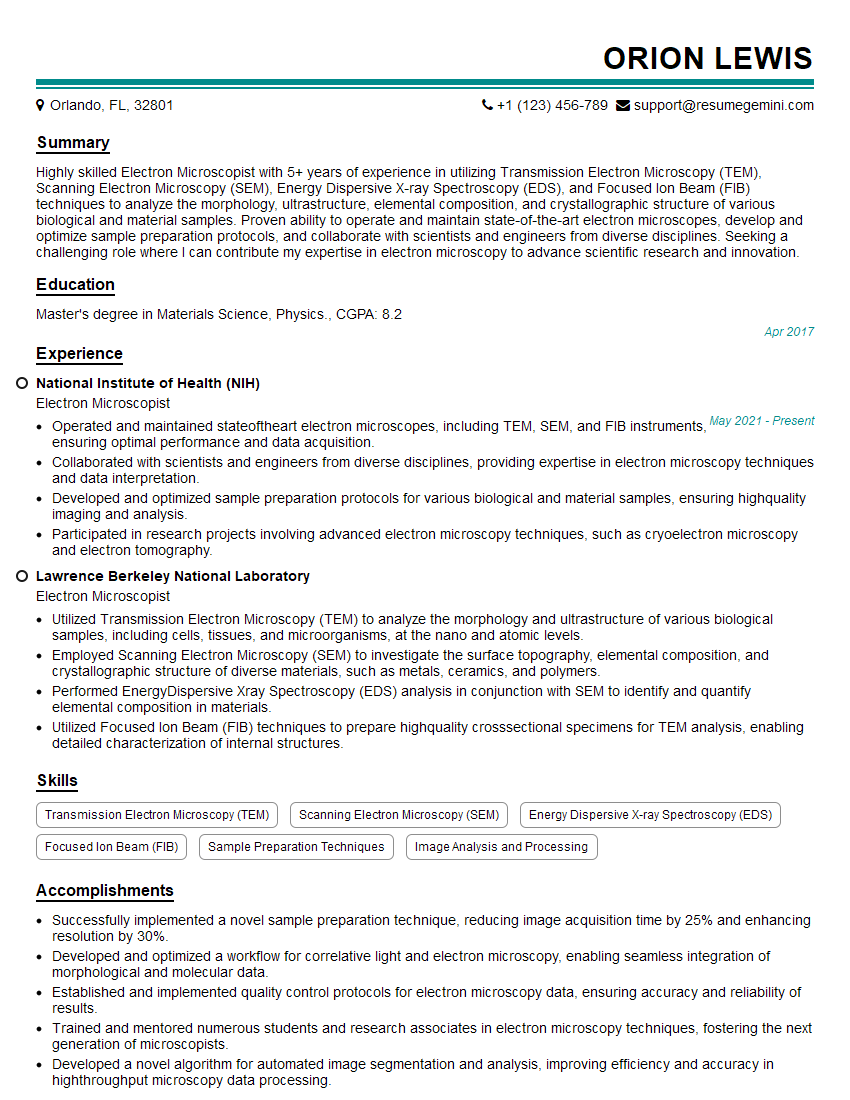
Mastering Electron Microscopy (SEM/TEM) opens doors to exciting career opportunities in research, development, and quality control across various industries. To maximize your job prospects, creating a strong, ATS-friendly resume is crucial. ResumeGemini is a trusted resource that can help you build a compelling and effective resume that highlights your skills and experience in Electron Microscopy. Examples of resumes tailored to Electron Microscopy (SEM/TEM) roles are available to guide you.
Explore more articles
Users Rating of Our Blogs
Share Your Experience
We value your feedback! Please rate our content and share your thoughts (optional).
What Readers Say About Our Blog
Very informative content, great job.
good






